ISSUE: Summer 2009
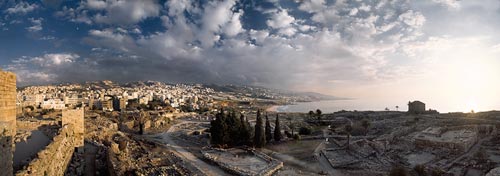
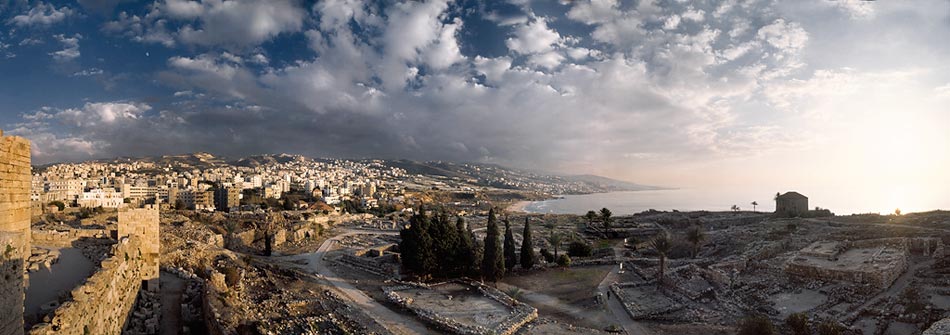
- The view from Byblos castle. Stefan Sonntag / CC BY-NC-ND 2.0
- In my opinion, Lebanon is the scene of a historic test that will determine the future of humanity.”
- President Ahmadinejad, Iran, July 25, 2006
- Beirut’s hopelessness relies upon its resilience. There are those who praise the courage of its people, their valor amid despair, but it is this very capacity for survival, for eternal renewal, that is Beirut’s tragedy. If the city were allowed to die—if its airport closed forever, if its imports and exports were frozen, its currency destroyed, if its people gave up—then its war could end.”
- Robert Fisk, Pity the Nation
A joke went around Beirut during the summer of 2006, as the taunting and touchbacks between Israel and Lebanon finally set off the spark of war, involving a notoriously swish section of the city called Achrafieh, a neighborhood whose idle doyennes are known for their opulent dress and fondness for facelifts. When Israeli General Dan Halutz, in the throes of an escalating duel of war drums, threatened to “turn Lebanon’s clock back twenty years,” so the joke goes, it was the best news the women of Achrafieh had heard in decades. Tack on a few more and we’ll talk.
As it turns out, the Lebanese may be able to turn back that clock all on their own. Nearly three years have passed since the final ceasefire with Israel was brokered in the Levant, and though the bombing stopped and the bodies were returned, Lebanon’s latest in a long line of violent conflicts left the country in a state of suspension, perhaps even reversal. The country’s recent spiritual, economic, and political crisis, however, was already in progress when the Israeli tanks rolled in and might be sourced back to the cataclysmic blast that killed former prime minister Rafik Hariri on Valentine’s Day 2005. Three years later, evidence of the explosion, which killed twenty-two others and gouged a fifteen-foot crater into the ground, still blights one of Beirut’s loveliest spots, its Mediterranean promenade. The stretch of the seaside corniche where Hariri’s assassination took place looks only recently repaved; the water mains still regularly erupt, dousing the decimated buildings on either side of the street with Beirut’s version of a fire hydrant’s jubilant summer spray. One of the more spectacular markers in a city liberally engraved with its history of suffering, Beirut seems both unprepared and unwilling to contend with what the site represents.
That most consequential breed of dreamer—the kind with resources—Hariri symbolized a hope for peace in Lebanon, the seat of his most extravagant dream yet. Having chosen the mountainous, coastal country of his birth as a pseudo-retirement destination in the mid-1980s, despite the minor buzz-kill of a raging civil war, in the ensuing decades Hariri threw his sizable financial lot and professional acumen into restoring Lebanon. Derided for the ruthlessness that made him a billionaire and accused of seeking little more than glory—a political parvenu coasting on his fat bankroll and steamrolling charisma—Hariri was a Sunni Muslim, a nouveau Saudi who had left Lebanon to make it big in construction. His tenacity eventually earned him a loyal electoral base, however, and he was elected prime minister twice, from 1992–1998 and 2000–2004.
Though the effects of the civil war are on every corner and every face, citizens of Beirut rarely refer to it directly.
In 2004, Hariri resigned in protest over a Syrian power play to extend then-president Èmile Lahoud’s term beyond its legal limit, a move that soured his previously tolerant relations with Syria, Lebanon’s neighbor and occupier. There is every indication that at the time of his death Hariri was plotting, with the aggression that won the hearts of his people and assured his death, for the withdrawal of Syrian troops, who had entered Lebanon in 1976, shortly after the onset of the civil war. The Syrian occupation lasted, on and off, for almost thirty years; they finally succumbed to global pressure and left in 2005—two and half months after Hariri’s blood ran through Ain-Mreisse.
Though the effects of the civil war are on every corner and every face, citizens of Beirut rarely refer to it directly; talk of war—if not politics—is almost superstitiously avoided, or effaced with dry humor. The Achrafieh joke was one of several offered to me, during a recent trip to Lebanon’s capital, as an example of the mordant, melancholy wit that has become as natural to the Lebanese as the olives, parsley, and radishes that prelude their traditional meals. “You have to laugh,” I was told, “Or else . . ” The ellipsis, in fact, gets closer than a hundred thousand words to capturing the terrible potentiality paralyzing Lebanon, which recently went six, ominously freighted months without a president and is sinking into the worst economic depression since the civil war. “As if they were the result of some natural calamity rather than a man-made catastrophe,” journalist Robert Fisk wrote, the Lebanese refer to the fifteen years of civil war as al-hawadess, or “the events.” The post-war attempt to rebuild the country’s infrastructure was ardent but somewhat cosmetic; that recovery has been further waylaid by the inexorable rise of Hezbollah, “the party of God,” now not just a war-baiting Shia militia but a recognized political party.
Hezbollah is the latest in the country’s long line of party crashers: Having filled its sociopolitical dance card with some of civilization’s greatest empires—Phoenician, Persian, Roman, Byzantine, Arab—Lebanon was under near-consistent Ottoman rule from the sixteenth century until 1920, when the French, one of the Allied countries divvying up the Middle East after World War I, assumed control. The Lebanese took advantage of France’s own occupation in 1943 to finally gain independence, but not before the French had developed a “confessionalist” democracy, which attempted to represent the country’s major religious groups (there are eighteen recognized) by population, mandating a Maronite Christian president, Sunni prime minister, Shia speaker of parliament, and Orthodox Christian deputy prime minister. This sort of extravagantly utopian conception of power-sharing was confirmed by a National Pact when the French went home; it actually worked fairly well, until it didn’t. Until the fact that Lebanon has not had an official census since 1932, largely out of fear of tipping the power balance in the growing Muslim population’s favor, became outrageous. Until April 13, 1975, to be exact.
There was a pattern to the way Lebanon’s fissures blew into fault lines, and that pattern is repeating now; it’s a process with consequences most of Beirut’s citizens—who refer to Hariri’s assassination, with typical obfuscation, as “the earthquake”—can’t bear to contemplate, much less name. The city was locked down in anticipation of the presidential election scheduled for the next day. I asked if they thought the twelfth time might be the charm.
The bombings and high profile assassinations rose in number and severity over the course of 2007—a Christian legislator was killed in September and an Army general in December; Syria-backed Hezbollah was blamed in both cases—and the election for a new president had been delayed eleven times since Émile Lahoud left office in November. The entire country seemed suspended with dread, wondering if the next shot fired in Beirut, the next explosion in the street, would be the one that sent Lebanon tumbling. The twelfth attempt at a presidential election was scheduled for January 12, 2008, several days after my arrival in the capital.
“Everything in Lebanon is beautiful,” Carlo assured me, before turning away and adding: “Except the politics.” I had spotted him—short, compact, and dressed for a trendy wine bar rather than a trans-Atlantic flight—in the endless check-in line in New York, but it wasn’t until we were changing planes in Jordan, twelve hours and several crushing cinematic offerings later, that he introduced himself.
Carlo fell comfortably into the role of personal escort as we were led through the airport by a strutting airline clerk. “You don’t speak Arabic?” he asked, and I said I did not, but could make do in French. More than fifty years after the brief but penetrative French mandate ended, the language still gilds the Lebanese vernacular; unluckily for me, most are loath to use it for more than “hello,” “good-bye,” and “thank you very much indeed.”
“Is anyone waiting for you?” I told him no. It was hardly Beirut’s fault. No one was waiting for me in general.
Carlo moved to New York when the war broke out in 2006; his wife was now seven months pregnant. I asked him how often he returned to Beirut and his voice went flat: “I don’t.” His dad was ill, he explained. It was clear that this would be the last time Carlo saw his father, and the trip was a burden.
While brokering the retrieval of my baggage from our original flight, Carlo asked me a question that, though it became quite familiar, I was never able to answer to anyone’s satisfaction: “Why Beirut?” I told him I had come to explore, that I had a standing interest in the city and a couple of weeks free, which was true enough. His brown eyes flickered, unsold. He asked where I was staying and I mentioned the hotel I picked because it looked clean and was by the sea. Then, a final and ultimate question: “Is anyone waiting for you?” I told him no, and Carlo’s expression of confusion and dismay was positively infectious. It was hardly Beirut’s fault. No one was waiting for me in general.
Beirut is not a walking city. Neither is it a driving city, nor particularly a public transportation city. When I asked the hotel concierge for the best way to get to the famously re-built downtown area, also the site of the National Parliament, she said, “Walk along the shore for a while, and eventually . . you’ll want to turn right.” I held, hoping this is just a quirky opener. “Ask someone on the street,” she continued, then offered the koan that would wrap up every such mystical interaction: “You can’t get lost.”
Indeed, I could. The problem with getting lost in Beirut is that looking lost is tantamount to looking suspicious. There are few people in the streets, fewer still who are alone; within seconds of setting out I knew that neither strolling nor stopping were viable options in the city. The idea, security-wise, is to slow down the cars—with zigzagging barricades that prevent vehicles from tossing a bomb and zooming away—and speed up the people. Private guards patrol the front of nearly every building, and the Lebanese Army is out in force on most corners. There is only hustling, with your head down.
When I finally found the downtown—a peanut butter-hued, art deco enclave studded with crumblingly authentic mosques and churches—only soldiers roamed the area. A maze of barricades and riotous spirals of razor wire made reaching a destination mere steps away a triumph of will and logistics. Turning down a new block meant another search of your bag and your person by another young man with a long, elegantly snouted automatic rifle strapped across his back. High fashion shops lined the radial streets surrounding the clock tower in Nijmeh Square, but they were shuttered. There was a mean wind whipping in off the Mediterranean, and I had seen fewer than a dozen civilians in over an hour. I ended up on a wide, wildly trafficked avenue, where I was finally granted a full vantage of the imperious el-Amin mosque, which Hariri was building at the time of his death and where he and his seven bodyguards are now laid to rest. I pulled out my camera to take a picture of the blue and gold structure, its minarets twisting high into Beirut’s ragged skyline, and felt the nearby soldiers tweak to me, settling their focus.
“Nowhere is Beirut’s resilience more apparent than in its reconstructed city center. In 1990, Downtown was in shambles, a deserted no man’s land, a ghost town.” This from the 2006 tourist guide I picked up later that afternoon, stumbling out of that same ghost town. I had stopped at the Virgin Megastore—found on all tourist maps of Beirut—because it was adjacent to Martyrs’ Square, the memorial I had been courting hopelessly, lined as it was by an intimidating show of barricades and wire. The Virgin Megastore is a four-floor behemoth and was, despite all appearances, open. I know there are four floors because I traveled—in escalator slo-mo—to each one, trying to find someone who would take my ten dollars for Lebanon 2006: Official General Tourism Guide.
After that, I ate a pound of almonds, tore my pants on an errant coil of wire and declared myself defeated by Beirut in Round One. I had been searching throughout the afternoon for an outlet adaptor for my computer, continuing a saga begun the night before, when a marvelously timid young woman made five separate trips to my room, each time bearing a new contraption that fit neither my machine nor the hotel’s outlets. Adapt, adaptor, adaptive; I was sure I had packed the fucking thing. I made one last try, ducking into a tiny cell phone shack on the way home. The skinny kid manning the goods was just about to tell me he was sorry when I noticed exactly what I needed, stray and unpackaged, sitting on a shelf under the counter, between his phone and his lighter. “That?” he said, tossing it to me, “You can have that, I don’t even know what it is.”
“People are going to think you’re a spy,” Rafael said. “Are you not a spy?”
We were in the Prague Café on the American University of Beirut campus, close to Hamra street. It was a Friday afternoon and the place was packed with smoke and really good-looking people. Written in white chalk on a small board hung behind the bar was the dictum of the day: “When a woman has a nervous breakdown she goes shopping. When a man has a nervous breakdown he invades a country.” Rafael was a friend of Felicia—herself a stranger, a journalist friend of a friend home visiting from Dubai, where she had taken a reporting post several months ago.
Rafael works for an environmental group and recently had been escorted away from the US Embassy, where he had gone to take pictures of the water birds—unheard of in the city—drawn in by the large pools that collected in front of the building after a heavy rain. He only got a few snaps in before the guards descended. Everything was in lockdown in anticipation of the presidential election scheduled for the next day. I asked if they believed the election would be held this time.
Rafael equated Lebanon’s political détente with the other dark force currently gripping his life: a punishing divorce. What he had realized, he said, was that the nature of the split with his wife—the communication breakdown, alienation, and rapidly degrading standards of protocol—was almost identical to that tearing Lebanon asunder. “It’s all about power,” he said, his eyes rounding. “It’s not about who’s right or what’s best or some deep belief—you lose sight of all that, and it becomes about who has more control, who comes out on top. Who did what years and years ago and who has to pay.” Felicia and I sipped and fiddled at our drinks and Rafael sat back: “Power.”
It’s hard to talk about anything else when you’re breaking up. Try—and be amazed at the backroads your brain will traverse to get back to where it wants to be. Everyone in Beirut talks politics, all the time: it’s like history’s longest break-up between the world’s most promising couple, argued by the Middle East’s greediest lawyers and contingent on the custody of several million traumatized children, who will grow into needy adults with trust issues and a tendency to freak out other countries in bed.
Gathering himself from his chair, Rafael took his leave with the briefest of Beirut synopses: “Everyone thinks everyone is a spy,” he said. “And they might as well line the whole city with razor wire.”
Hezbollah emerged in 1982, a pet militia of the Ayatollah Khomeini. They trained under Iran’s Islamic Revolutionary Guard to fight the Israeli invasion of southern Lebanon, which had left between twelve and nineteen thousand Lebanese dead, many of them Shiites. Led by secretary-general Sheikh Hassan Nasrallah since 1992, Hezbollah is cited as a terrorist organization by both Canada and the United States, while most of Europe recognizes them as a legitimate resistance movement. Before September 11, 2001, Hezbollah was responsible for the deaths of more American citizens than any other Islamic group (including a 1983 truck bombing in Beirut that killed 241 Marines), and yet in 2005 the United States showed signs of capitulating to the United Nations’ attempts to smooth Hezbollah’s way into mainstream Lebanese politics. Some suggest that the US is too depleted by Iraq and Afghanistan to risk toying with the puppets of Syria and Iran; all militias but Hezbollah were forced to disarm at the end of the civil war, and with over $100 million in annual funding from Iran, as well as a flourishing network of black market business and intelligence, they have ballooned, right under our noses, into the world’s premier terror network. Even al Qaeda looks to Hezbollah for training and advice, perhaps in how to use the kidnapping and torture of foreigners—particularly Americans—to their greatest advantage.
Having successfully ended the Israeli occupation of Lebanon in 2000, and winning the support of 87 percent of the Lebanese population during the war he essentially started in 2006, Nasrallah knew a raging gravy-train when he saw it. He has leveraged that momentum into Hezbollah’s increasing influence as a political party; they won 14 of Lebanon’s 128 parliamentary seats in 2005 and have forged opposition alliances with both Amal, another Shia faction, and the largest Christian bloc in parliament, led by former military commander Michel Aoun. In a 1985 manifesto Hezbollah laid down its agenda: to eject Western colonialism from the country, bring the Phalangists to justice for the atrocities committed during the civil war, eradicate the “Jewish entity” of Israel, and bring the Islamic revolution lockstepping through Lebanon.
Nasrallah, born and raised in Beirut, has stood down on that last claim of late, but the recent political crisis, fueled by Hezbollah’s demand for veto power in the cabinet, has rendered the party both as strong and as divisive as it has ever been. In 2007, Lebanon was ranked 28th on the Failed State Index—after Pakistan and North Korea but before Kenya and Moldova—and rose to 18th by the end of 2008. It’s a stalemate in the parliament, with none of the parties able to agree on a national unity government for Lebanon, each group stubbornly holding onto their bids for prevalence, for power, while the people pay the price in the streets, withstanding bombings and staging increasingly violent protests for resolution. The cabinet is unwilling, in other words, to stay together for the kids. They won’t even share custody.
Later that evening, Felicia and a pair of her friends picked me up in a blue BMW and headed for Gemmayzeh, a Christian enclave known for the nightclubs you won’t find in its Muslim counterpart. Like many of the young Lebanese I met, Felicia is well-connected, geographically: she has already lived in more countries than most Americans will ever visit, including the United States, where her family waited out the civil war. Her stunning, raven-haired girlfriends were also raised primarily in the US, and could toggle between frankly accented American English and the rhythmic, glottal flow of Arabic.
The empty streets clapped out our footsteps as we approached Kayan, a low-lit pub that serves bad music and big, strong drinks. The bar was packed with heads nodding in time—improbably, I felt—to Cornershop and Roxette. Two drinks in I was trying to explain myself to Rob, an NGO worker from Florida, and not faring very well. Rob was rangy and kind and made jokes about whether it was too early in the evening to send a booty text. Dipping in and ducking back in the lurching choreography of a first, loud conversation, he told me that even a year ago, even right after the war, he would have said there was a 10 percent chance of the entire country spinning out of control on any given day. “Now,” he shouted, raising his eyebrows and working his palms like pistons, to ensure I got the point above the music: “Fifty-fifty.”
Seated at the bar was a young Lebanese man with a blazing white bandage fitted across the bridge of his nose. A punch-up seemed unlikely for such a slickly drawn boy; Rob said it was probably a nose job. Beirut has become the plastic surgery capital of the region, a Middle Eastern counterpart to its similarly middle-classless, ex-patriot satellite country, Brazil. In 2007, Lebanese banks began offering multi-thousand dollar loans specifically for the purpose of plastic surgery, and it is currently the investment of choice; the recently re-sculpted brandish their bandages like Hermès scarves. “It makes no sense!” I yelled over Rob’s shoulder, as Felicia bounced to the beat at the next table. It was Friday night, and everyone was glad to be alive and in good company. And yet it makes perfect sense: in the face of astronomical disarray, perhaps the sanest impulse is to fix what you can.
Having opted out of a group ski trip, I began my Saturday with a walk over to Gouraud street. I was seated in Le Rouge Café for almost half an hour, watching a cycle of customers order, eat, and gesture for the cheque before I mortified the waiter by informing him that no one would be joining me. This is where the Parisian influence ends: one does not eat alone in Beirut, and I collected looks from my fellow diners, in between deeply held drags of their cigarettes, that could as easily have passed between us at my first born’s funeral. I thought of Carlo, and his grief at my predicament: “Is anyone waiting for you?”
I walked south into Ras El Nabaa, and had Lebanon’s National Museum entirely to myself on a Saturday afternoon. There was one guard on duty, and we played a lethargic game of cat and mouse as I lingered over two floors of mosaics, Bronze Age baubles, and Roman sarcophagi. Every thirty feet or so I heard the jingle of the guard’s keys a respectful distance behind, as he rose once again and limped toward an adjacent corner. This is the type of thing that would usually make me laugh, but it was one of those days where I can’t understand how anyone makes it down the street with all of the shit they have inside of them. So it just made me want to cry.
“Take a look at what accurate munitions can do,” said the Irishman sitting directly in front of me. We were leaving Beirut, circling into the valley beneath the nasty gap in the middle of the Mdairej Bridge. From the low angle of our detour, the damage to the Middle East’s tallest bridge was even more spectacular, and the Palestinian woman beside me began taking pictures, centering the long blank space in her digital monitor. The Israelis bombed the bridge in 2006, taking out a two hundred foot support beam and crippling Beirut’s supply traffic.
After a week of early morning calls, there had finally been enough people for a trip to Anjar and Baalbek to go forward, and so there were four of us in the back of a minivan: Peter—the Irishman—and his wife Margaret, Nisrine—the Palestinian—and myself, along with our Lebanese guide Raaida, and Hassan, who was hulking, bashful, and drove like the blazes.
President Clinton—now he almost got there; there might be peace today, she said, had it not been for that chubby tramp and her big, red lips.
Nisrine had not been to Lebanon since she was three; a documentary filmmaker in Beirut for interviews, she had been skeptical that her host could pull off a visa, but here she was. The Irish couple toured Damascus the previous day, and drew a striking picture. “Maybe I could borrow your passport,” Nisrine said, with what would become her trademark, edgy deadpan, “and see for myself.” Over forty-some years she had been all over the world and not entered the countries bordering hers. Earlier she had turned to me, by way of introduction, and asked if I was interested in seeing the Jeita caves with her the next day. “If there are two people,” she said, eyebrows all but waggling, “they have to take us.” I liked Nisrine immediately; I would go, I wouldn’t let her down. She asked me again throughout the day, just to be sure.
Raaida was wide-mouthed and willowy; wrapped in sunglasses and two wool sweaters, she chatted about our itinerary while the rest of us made dippy comments about the weather, the food, the countries of our birth. Late into his sixties, Peter was essentially retired but in Beirut consulting: he had spent a career as an electrical engineer building power plants around the world. “You’ve come to fix our power!” Raaida exclaimed, and Peter chuckled: “God himself couldn’t fix the power here.”
President Bush was in the region, but he wasn’t coming to Lebanon. He had been photographed goofing off with Saudi sheiks, then exchanging backslaps with Israeli emissaries. These images, Nisrine said, confirmed that he was not serious about the Palestinian cause. President Clinton—now he almost got there; there might be peace today, she said, had it not been for that chubby tramp and her big, red lips. At this—or words to this effect—Margaret chimed in for the first time that morning, with an approving murmur that confirmed not the subversion of the Clinton administration’s agenda for peace in the Middle East but the notorious sluttery of young American women.
Fewer than fifteen kilometers from the Syrian border in the east of Lebanon, Baalbek is the birthplace of Hezbollah. The first members began training there in 1979, and today it is considered the group’s strategic headquarters. The ruins found at Baalbek are devastating, encompassing the largest Roman temples ever built and evidence of a settlement dating back to the Bronze Age. Excavation in the area—like all excavation in the archeologically larded Lebanese countryside—halted with the civil war, and has not resumed. Tourism, once a lifeblood industry, is increasingly untenable. There were no guards, no barriers, and no other visitors. We drifted through the heady sprawl of the site, picking and wobbling and jumping back at the treacherous drop that divides the temples of Jupiter and Bacchus. The noon call to prayer began to sound throughout not just the city but the valley, the loudest and most plaintive I had heard. It threaded between the towering pillars below, in no rush to reach our ears.
Leaving the site, we were beset by four or five old men selling gum, scarves, and green and yellow Party of God commemorative gear. They tugged at our elbows, blocking our path in an impressive formation; when it became clear that they were going to follow us the several blocks back to the car, a mixture of embarrassment and a more complicated tension overtook our group. “Well, I decided against the Hezbollah T-shirt,” Peter cracked, strapping back into his seat, breaking our heavy silence. And we all laughed, delivered by Peter’s perfect delivery.
During lunch—platter after platter of traditional food served by the fireplace of a large, drafty family restaurant in Zahleh—we six were finally facing one another, and the minor revelations of a shared meal eased the way into franker talk: Nisrine tolerates Americans and reveres the Japanese; Margaret doesn’t drink and never has; Raaida is off carbs and was so tickled by Peter’s use of the expression “a moment on the lips, a lifetime on the hips” that she made him write it down; Hassan smokes between courses; and I can eat my weight in baba ganoush.
The bitter candied fruit arrived for dessert as Raaida called to me from the far end of the table: “Michelle! Hassan has something he’s been wanting to ask you all day.” I leaned over my plate to catch Hassan’s eyes two seats over, but he was mortified—shook his head no—and Raaida continued for him. “He’s very curious about your name—he wants to know if you knew the opposition leader is named Michel Aoun, and his party color is orange.” There is even, I would learn, an “Orange TV” channel, which it is said Aoun uses to spread “Iranian jihadist propaganda.” Hassan looked down at me, blushing to the rafters, and I assured him, a little flushed myself, that I was Orange in name only.
Raaida and Nisrine had been cordial, almost careful with one another throughout the morning, lapsing often into Arabic, but spoke more freely over lunch. “We built much of what is here,” Nisrine said, and Raaida allowed it, “and now we can’t even visit.” After a few moments’ deliberation, Nisrine put down her glass and declared that four days in Lebanon, meeting and speaking with the people of Beirut, had made it clear to her that the Palestinians were better off than the Lebanese. “In an occupied country there is a solution,” she said, “get rid of the occupier, get rid of the problem. The people still have hope.” But in Lebanon, she went on, the problems are so complex, the roots so twisted, that at this point there is no path out, or none that the people can see, and that is a far worse place to be.
This was more than Raaida could bear; being pitied by a Palestinian was definitely not on the itinerary. Her eyes filled with tears and the fragile good humor that had borne us all through the day instantly gave way. “If you want to know the truth,” she said, looking around the table, “if I can speak openly—I am miserable.” She made a sharp, helpless gesture, indicating a temporary reprieve from her officious persona: “I am very depressed, my whole country is depressed. We are frightened. Everyone is trying to leave but there is nowhere to go—there are no jobs, no money. We don’t know what will happen—for us this is a terrible time. If I can say the truth.” Nisrine was the only one who spoke. “Yes,” she said. “Yes.”
During the ride back over the mountain we were buoyant again, as Raaida told jokes circa Summer 2006—including the one about the vain women of Achrafieh. Beached in the hideous traffic of rush hour Beirut, however, we all lost steam, and were silent. Cars surrounded us two and three deep on either side. Beyond them, the curious profile of the city: for every structure that is newly built or merely intact, there is a stooped shadow building at its side, kneeling in its own ruin. Raaida leapt from the car with barely a good-bye, following a brief, tense acceptance of some money from the Irish couple, who themselves departed with polite good wishes. I was next, and down by the corniche Nisrine shuddered as we crossed the site of Hariri’s assassination, then extracted one more promise about our plan for tomorrow’s trip to Jeita. I awoke early the next morning and called the company to confirm while still in bed, but they told me Nisrine had called even earlier, and cancelled herself.
Beirut’s boardwalk is as pretty as any on the Mediterranean, and I was determined to make the most of it. I strolled, I ambled, I loitered, stopping every few feet to lean against the railing and look out across the sea; it is a rare stretch of the city where such behavior is normal, or at least tolerated. German warships sit in the middle distance, patrolling the waters for the Israelis.
The men don’t bother unescorted women in Beirut, when they bother with them at all, and so I wasn’t concerned when a sharp-dressed young man drew up alongside me at the railing, then slid a ways down. I turned to the mountains, slipping into a paranoiac reverie and rehearsing for the fifty-third time what I would tell the American agent at passport control when he asked me what I was doing alone in Beirut in the middle of January; a friend had put a terrible re-entry scenario in my head before I left, involving German Shepherds, tax returns, and a porn-sweep of my laptop, and I couldn’t shake it. I went over the straight story and then I considered the truth, amassing as it was out there, over the water: I thought of telling the officer, as he fished through my visa, my life, that Beirut doesn’t give a shit about either of us, or what we think. It didn’t care when I came, it didn’t care when I left, and that I respected that. I’d tell him that it’s gorgeous and battered and tired and awful, that the mountains are exquisite right now, the sea as lush and blue as any you’ll ever know, that the sky is silky and bright, the fisherman casting rods and smoking hookahs on the shore are charming and picturesque and even the warships look sort of beautiful, carving dread into the horizon, and that none of it means a thing. That I’ve never felt more empty in my life, more useless, more humbled, more alone, or more confused, and that I knew now I had come here to send a charge down to the depths of that emptiness, see what I was working with. I’d tell him that Beirut did not let me down.
“You should go back now,” he said. “I would leave here if I were you.”
Eventually I turned back to the boardwalk and saw that the young man to my left had attracted a small crowd. He was standing against the railing with his back to the sea and chin tucked in, hard; both hands were shoved deep into the pockets of his designer jeans. There were four soldiers in closest to him, two on either side. The shortest, strongest looking one was questioning him with what seemed like tenderness; they were probably the same age, could have been brothers. He put his hand on the young man’s cheek, then pushed up under his chin, finally pressing back on his forehead with his thumbs. The young man was unresponsive, he kept his head down, his eyes closed, and his feet planted where they were.
That afternoon I headed toward al Hikmat to visit the Sursock collection of Islamic art, maybe walk home along the port. It had taken several tries to get the museum’s eccentric hours straight. I didn’t hear the explosion, but within moments it was clear it had happened. I had witnessed a similarly sudden uptake in the streets—groups of seven or eight narrow-eyed men emerging from nowhere, bumping and pushing down the sidewalk; unmarked Hyundai vans filled with kerchiefed men leaning hard into the corners, jumping in and out at stop lights—but this was different. I walked over to Charles Helou Avenue, where Army trucks were amassing and dispersing. Ambulance peals were sounding but I couldn’t tell from where. Several security guards on the corner were facing one direction, pointing out over the coast. I moved in closer to them and looked as well: a large bloom of smoke was rising off to the right, to the north, where a US Embassy car had been blown up in the street. The bomb was detonated a breath too soon, and only injured the car’s passenger and driver; the three people who happened to be passing by, however, were dead. A soldier from a nearby checkpoint came to join the men, and eventually turned to me. He searched my bag and asked me where I was staying. “You should go back now,” he said. “I would leave here if I were you.”
Earlier, on the boardwalk, I had moved to leave the scene gathering around the frozen young man—growing by one with each person that came upon it—but found myself taking a seat on a bench nearby. Drunk or high or just distraught, he caused no disturbance: he never said a word, and no one tried to move him; everyone just wanted to talk. A wide-set older woman in a long denim skirt and thick wool coat dropped back from the soldiers and the scrum. She sat down beside me and began to cry, softly, but with force. We looked on together, waiting for some kind of outcome, some progress, but the group stood fast. Every few minutes a commuter plane swung in over the water, making its way—so low—into the city.