PUBLISHED: May 7, 2010
Much has been written about the digitization of print. I’ve attended conferences and meetings in which I have been told to get on board, that most books will end up published electronically anyway. I live in a household where my fiancé owns both a Kindle and an iPad. Everywhere I turn, it seems that physical books are being chucked to the wayside, while magazines, newspapers, and books are being read online.
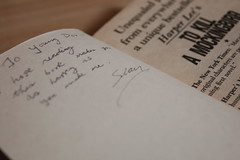
Recently I have realized there’s one argument in favor of print that perhaps we haven’t considered. I work at a used bookstore, where I am lucky enough to be surrounded by books all day. Part of my job entails cleaning up the books that come in, before they are re-priced, turned around, and sold again. This gives me a chance to sneak a look at the books I’m working on. Flipping through the titles, I’ve recently noticed that people like to write in their books. In Sam Bittman’s Seeds, for example, I found this:
Christmas 1990 from Alass & Garrett
In The Rough to the Himalayas, I discovered:
Charlie,
Thank you for being the rock when I needed you most,
Dave
2002
In Peter Mayle’s 1999 Encore Provence, Mayle had inscribed:
For Jennifer,
Vive la France!
These inscriptions are intriguing, and make me want to know more about the people who gave and received these books. I find especially interesting what’s tucked inside these books. Each receipt, torn article, and note is a clue leading me to learn just a bit more about the book’s previous owner. In 125 Cookies to Bake, Nibble & Savor, in the midst of a recipe for peanut butter cookies, I found a woman’s prescription for 15mg of Terazepam, a strong sleeping medication. In a first edition of Margaret Atwood’s Oryx & Crake, Nan Talese—the book’s publisher—had written a letter to someone in beautiful script: “Here with O&C, with great pride and pleasure. All my best, Nan. April 2003.” A postcard of William S. Burroughs was used as a bookmark between the pages of Gertrude Himmelfarb’s On Looking into the Abyss. And perhaps my favorite find, a long letter (tucked inside Markings by Dag Hammarskjold) written on Thursday, June 16, 1966, from one Mildred to her parents, in which Mildred gossips about the neighborhood and her upcoming baby shower.
Before I worked in publishing, and learned about things like first editions and galleys, I treated books like they were notepads, scribbling lists and phone numbers into them, stuffing articles between pages to read later. It’s these lists I flip back to now to remind me of who I was years before—a journal of sorts. For example, on an impulsive train ride taken one March, when my roommate Emily and I were living in Paris many years ago, we used my copy of Fitzgerald’s Jazz Stories to write down the list of ten people—living or dead—we’d invite to a dinner party. I chose Camille Paglia in my number one spot (Paglia, whom I had not even read at the time!); Emily chose Jack the Ripper.
What will eventually become of these books with their treasure trove of notes and inscriptions? Electronic books are just pixels on a screen. These personal connections to the past make physical books so much more than that.
I stumbled upon a copy of Updike’s Rabbit At Rest a few weeks ago, the familiar cover ribbed with thick black and white and purple stripes. I read the inscription within just as two men—presumably UVA students—walked into the store.
“Stop,” I told them. “Come here and listen to this.”
Though confused, they waited patiently as I read out loud:
For Ann,
Life is far too brief for us not to be surrounded by our favorite things.
All my love,
Wayne
Dec. 1990
The three of us stood there in silence for a moment.
“Wow,” one of the men said. “I wondered what happened to Wayne.”
What did happen to Wayne? Was he some businessman made rich in the eighties boom, spoiling Ann with her favorite book? Was Ann having an affair, this book a signal from Wayne to abandon her husband and surround herself with not just Updike, but Wayne’s love as well? Were they newlyweds, perhaps simply celebrating a Christmas? Did they eventually divorce, and Ann—frustrated with Wayne’s infidelities—sell this gift for a pittance? Did Wayne pass away? So many questions that would forever remain unanswered as I held Ann’s book in my hands.
Could the same be done with Rabbit At Rest on the Kindle?
4 Comments

Fabulous post. Thank you.

Terrific post. The idea of books are physical things, as artifacts, often gets lost in a discussion that often focuses on books as products for delivery of information. You can’t stuff receipts in an iPad and discover it ten years later.
Wayne: I’m guessing disappeared deepinthehearta to be country western singer, and after touring with a nouveau rock band in eastern Europe, ended up as a web designer in London. But I’m just guessing.

Brilliant post!!
I did a similar post, when I visited my local bookshop and picked up some poetry books. Some of the inscriptions were amazing.
For e.g. I bought 1000 poems book that had a very personal christmas note - asking the reciever to love themselves and to think of the person who wrote the note everytime the open the book. Its signed but the person its meant for is never named. all the top says is ‘Dublin, ‘98 and the signed name is definitely not irish and the written english is slightly broken.
Then on the next page a poem is written ‘the spirit singer’ by Mark Collins in the same hand writing with sections underlined for emphasis and 1000 is crossed out and replaced with 1001
another poetry book congratulates the receiver on winning prizes and also
its says ‘we’re never to old for poems or fudge magnets - enjoy these words of sense’.
Link: http://thechroniclesofemilycross.blogspot.com/2009/09/mysteries-of-secon…
I know personally, when i was studying, I came across a popper book with some very memorable notes in the side - from lots of different people and different times!!

As convincing an argument for print as any! I once found a first edition copy of “For Whom the Bell Tolls,” with the inscription,
“Merry Christmas, 1945, from your loving wife”
I found the “loving wife” part to be so intriguing. It felt like a timestamp of female identity. There was no name, just her role relative to the male recipient. How appropriate it should appear on a Hemingway novel…