Image

If forced to isolate the exact instant I became a criminal—the moment I turned to violence, as they say, the way one might tramp off a bright meadow lane into a darkening forest—I’d settle on the moment when I heard a scream in the world’s quietest room. I had been sitting there, naked, in blackness, for some indistinct interval (fifteen minutes? fifteen seconds?) when I heard it. Heard him, I should write, for the scream seemed to tear from the bowels of an old man. It was frantic and hoarse, as if this phantom grandfather had witnessed a beagle pancaked by an eighteen-wheeler. I felt it first, deep in my viscera, the revulsion traveling faster than the speed of sound. There followed a dull backbeat of horror at the realization that it should have been impossible to hear a scream from beyond the chamber, on account of all the redundant layers of noise-devouring melamine and wedged polyurethane. I was, after all, in
the world’s quietest room.
I had been assigned to write about this room for the Magazine, for which I was, as regular readers of this newsletter know, until recently a staff writer. My article would appear in a special number titled “America Sounds Like…” The issue would be sequenced from loud to quiet, beginning with a fireworks show at a NASCAR race that doubled as a political rally. There would follow stories about a family of Salvadoran immigrants living in a tin-roofed shack next to a runway at Denver International; a stray-dog kill shelter; a middle school hallway between classes; an Amish choir practice; a Hollywood voice-over acting coach; an overnight easy-listening AM radio program in Nashville; a treehouse, built by a monk out of salvaged Douglas firs, suspended fifty feet above the mossy carpet of the Hoh rainforest. My story would appear last.
How long does it take for a life to change? In my case, it took three and a half hours, if you count from the second I landed in Seattle. At Sea-Tac I skipped the taxi line and followed signs to the light rail. (My commitment to public transportation was a reflexive concession to atmospheric carbon dioxide levels—a hollow one, admittedly, given that my cross-country flight emitted the equivalent of three hundred taxi rides.) From the downtown rail station I hiked the final mile to Bell Harbor, the strap of my travel bag furrowing a trench along my clavicle. At the end of a finger pier I was greeted by a young woman with a sly grin. She introduced herself as Omni.
Omni seemed to have stepped out of a commercial for a wireless carrier: a bob like a gleaming porcelain bowl, sleek rimless glasses, black turtleneck, plaited chinos. She escorted me across a bamboo gangplank to a sparkling yacht with a cream topside and a navy racing stripe. As I sunk into a banquette, she handed me a compostable cup of chilled papaya water. I asked what she knew about the world’s quietest room. She put her forefinger over her lips, puckering in suggestion of a smile, and mimed shhh.
I was chosen for the assignment because my editors seemed to make an association between silence and environmental purity. I’m not sure why—perhaps semantic confusion over the term “noise pollution.” See, I specialized in reports about the global catastrophe that not long ago was described as dawning instead of the metaphors now commonly used, such as ripening or maturing or accelerating. Fires, floods, toxic airborne events—they called me. The quiet-room assignment seemed to offer a reprieve, the rare story for which I wouldn’t have to interview bewildered scientists, grieving children, or dead-eyed activists intoning that it was time to wake up. Rocky, my editor, would not force me to conclude with a pandering moral about how it was not too late to avoid the worst, if only we blah blah blah…
When Rocky first called, I had proposed something different. I asked to write about a figure important to me at the time, and even more important today: the French shopgirl Véronique Le Guen who, for a grossly unethical psychological experiment, spent months alone underground in a cave, chronicling her descent into madness. The cave had been so quiet that, apart from the occasional drip of water, the only thing she could hear was the sound of her galloping heart. Blind to the passage of the sun, her internal chronology grew unstable, as is evident from the data stamps on her diary entries: “I think it’s August 15…I’ve persuaded myself that it’s August 17…August 18? Surely not!” She began referring to herself as a person hors du temps—out of time. “I felt calm,” she wrote, on the eve of the experiment. “Too calm. I enjoyed the sort of lucidity that fills your soul just after—or is it just before?—a great catastrophe.” Upon surfacing from her swallow hole, seeing sunlight again and collapsing into her husband’s arms, Véronique Le Guen believed she had been underground forty-two days. It had been 111.
Rocky politely declined. Instead she asked me to write about a room in Seattle recently declared the Quietest Place on Earth.
The sound of silence measures zero A-weighted decibels. The reigning Quietest Place on Earth was an anechoic chamber built by the technology behemoth M—, which had embarrassed all previous records. That room measured -20.35 dBA. Yes, its ambient noise level was negative. In the room a quiet sound—such as that made by rubbing together thumb and forefinger—would be inaudible, swallowed by the room’s noise-canceling properties. This approached the limit of the theoretically possible, beyond the auditory range of even the keenest barn owl.
In preliminary interviews, however, I detected in the engineers’ responses a note of uneasiness. Under direct questioning they revealed their awareness of rumors, unverified but persistent, that their room had already been out-quieted by one just several miles away, constructed by a famous young billionaire on his island compound in the Puget Sound. I wrote the billionaire’s flack, or at least one among his flock of flacks. Within the hour I was invited to tour the Chamber.
Who was this billionaire? I suspect you can guess—he is one of the dozen tech visionaries invested with more awesome powers than any head of state. But since the incident has not been publicly disclosed, and I am facing a standard of legal jeopardy ordinarily reserved for radical extremists, I don’t want to take any undue risks. Let’s call him Narcissus.
When I told Rocky about Narcissus, the excitement raised the volume of her voice by an appreciable number of decibels. In subsequent emails it became clear that my editors wanted something less Samuel Beckett, more Robin Leach: an entrant in the lifestyles-of-the-rich-and-famous genre that might attract marketers of beach resorts and perfume (high-end advertising was the Magazine’s last major line of revenue). Narcissus was a global celebrity whose transformation from pudgy techie to tanned, bicep-forward mogul, with a teenage girlfriend and a monstrously overtraded stock that convulsed with his every public statement, had made him an object of continuous hyperventilation for gossip blogs and the financial press alike. I couldn’t fault the Magazine for its solicitousness. It is a desperate time: The Magazine’s holding company has recently launched its own tourism business, lecture agency, advertorial shop, podcast lab, and video game app. It is pathetic and depressing, like when a struggling record store diversifies into chocolate bars and novelty underwear.
No, I couldn’t fault the Magazine. I couldn’t even fault Narcissus. I didn’t take any of this personally—not yet.
“May you enjoy total fulfillment.”
At a private harbor on the far coast of Mercer Island, the yacht met the dock with a prim kiss. “If you need anything at all,” continued Omni, “just ask my guy Jimmy.”
She gestured to the end of the gangplank where there materialized a young muscular man of indistinct Balkan origin in matching black turtleneck and chinos. At my glance he clicked on a bright smile. The teeth were white, sparkling. Gorgeous.
“Been to Mercer before?” He gave a conspiratorial grin, an old pal making ironic chitchat. He led me through a red torii gate into the green grounds of Narcissus’s estate. A path of roughly hewn rock shadowed a lethargic stream, sheltered by a canopy of Japanese maple. I responded in the negative.
“Man, it’s just awesome. I know you’ll love it.”
How, I wondered. How does he know what I love? Before I could respond, Jimmy added, “My pal Jess here will tell you all about it. But if she starts babbling on—”
“Jim-my!” said another model—copper-blond, hoop earrings, vinous wrist tattoo—in the same black turtleneck and chinos, leaping from behind a snowberry bush. “He’s always giving me the business,” she confided to me with, I swear, a wink. Another lifelong friend of mine, she was. My girlfriend, probably. “Come! I want to show you my favorite view. Hey, cool pants.”
I looked down—they were beige slacks. They represented my best guess at West Coast business casual. I’d had them fifteen years. I could stick my pinkie through a hole in the back pocket.
“Thanks?”
“Pleats are coming back in style,” she reassured me, with a twinkle.
Jessica took my hand in hers (childish, dampish, soft). We skirted a grass tennis court, traversed an arched stone bridge over a koi pond fed by a gentle waterfall, and ascended a stair of sliced granite paving stones to a lawn of pale moss. A polished basalt bench overlooked the herringbone serration of Elliott Bay and the Emerald City skyline, the Needle standing off to one side at a decorous distance. I turned to Jessica. She trembled slightly. I had the distinct impression that she wanted me to kiss her. Nope, I thought, not professional models. Actors.
“But you didn’t come here for the views,” said Jessica, with a blissful smile. She gestured to Taz, who emerged, like an object in a hidden-picture book, from a black trellis encoiled by yellow hazel. Taz gracefully gave way to Tyler, who introduced me to his girl Jasmine, who was super pumped for me to meet Kai, who swung open the door to a ranch house the size of an airplane hangar.
The flack had told me not to expect Narcissus—not to “get my hopes up.” I was not disappointed. I was relieved. An encounter with Narcissus would add substance to the article but I would also have to withstand the indignity of interviewing a man much younger, substantially more attractive, and infinitely richer than me. Infinitely is not an exaggeration: My various channels of debt had rendered my net worth negative. (Not that Narcissus’s attorneys seem to care.) I had always expected to write about people wealthier and more distinguished than me, but by my early thirties I’d had the unsettling realization that my subjects were growing younger than me too.
“Nice pants, man,” said Kai.
“What?”
“Pleats. Dope.”
I followed him through a parlor and into a rainforest: dangling vines, tropical plants in pastel terracotta pots, humidifiers exhaling sweet lavender steam. Only the couches and chairs marked it as a living room. Kai left to fetch another papaya water. I consulted my notebook to make sure my notes were legible. Between my encounters with the actors, I had managed to scrawl a few observations: actors, 8(?) electric golf carts, koi.
Voyeurism was a perk of my job, and a necessity. I tended to write about desperate souls in trouble of others’ making. I spent about a week on location to report a story, often in environments in which I was a conspicuous outsider: in Tuktoyaktuk among a native tribe whose land was melting under their feet; in a town poisoned by its plastics factory in West Virginia; in a fishing camp perched on twenty-foot stilts at the terminus of the Mississippi River, one Category 3 away from obliteration. Without careful attention to mood, nuance, context—without a heightened level of intimate detail—such stories would collapse into caricature. A critical element of my job, I had come to realize, as important as the writing itself, was the ability to win the trust of strangers. The relationships I formed with sources achieved the intimacy of short-lived romances. I toured their offices and homes; I ate with their families; they confided in me their terrors, dreams, obsessions. I earned their trust, then their weariness, and finally their resentment. I had to do this, to isolate the details that made a story real.
I wasn’t curing rare diseases or exploring distant galaxies, but I believed that journalism, particularly journalism about the Collapse, was a noble enterprise, even—try not to smirk—patriotic. My job, I’d say with repressed pride, was to tell the truth. To expose the secrets of the powerful, corruptions of the public trust, and the oppression of the weak, the poor, the ignorant. But it wore on me. I didn’t mind being a vampire, but my subjects’ blood was making me sick.
He wore his familiar uniform: white T-shirt, black jeans, running sandals. His blond mop sat on his forehead like a crown. His skin looked as expensive as the house, coated in a botanical wax.
I stood to shake his hand. He responded with a proffered fist. I bumped it, gently, coating my knuckles with Ayurvedic grease.
“No one knows the Chamber like I do,” he said, by way of introduction.
I complimented his home.
He gave a throaty, histrionic cackle. “This is not my house,” he said, as if I had accused him of living in the Myrtle Avenue subway station. “My residence is…across the way.” Then he added, with indescribable composure: “I treat this more like my dojo.”
I began to explain the premise of my assignment.
“Do you hear that?” he interrupted.
I listened. Nothing.
“Listen harder.”
“Yes sir,” I actually said, feeling an instant repercussion of humiliation. That’s the power of charisma for you, I told myself. Though that was a lie. It was the power of money.
Who was this billionaire? I suspect you can guess—he is one of the dozen tech visionaries invested with more awesome powers than any head of state.
I listened harder. The house seemed airtight. I heard the whir of the humidifiers; an occasional internal creaking from within the nacelle of the ceiling fan, as it sent a pair of sleek wooden airfoil blades whipping the lavender steam; an ambiguous electric hum that might have come from a hidden vent or power strip.
“That,” he said, “is thirty decibels. As quiet as a residential home can be.”
He whispered something inaudible.
“I’m sorry—I missed that.”
“That,” he said, “was twenty-five decibels.”
I forced a smile.
“You better piss.”
“Excuse me?”
“Once inside the Chamber, you won’t want to leave. You won’t be able to either. It’s locked from the outside.”
In the bathroom I thought of Véronique Le Guen who, in her oubliette, developed a profound emotional attachment to her temporary home, going so far as to recite effusive odes to the elegance of the grotto’s stalagmites. When finally she returned aboveground, she plunged into a depression from which she never surfaced. Her husband later described it as “an emptiness inside her which she was unable to communicate.”
After a brief transaction with a waterless urinal and a glowing sink, I returned to find Narcissus before a speckled monstera, taking his own vitals. He performed a few dexterous swipes across the face of his watch, a prince dismissing his courtiers.
“A shame you can only stay an hour,” he said, without looking up.
I had been assigned “one hour—hard stop” by his publicist. “Actually—”
“It’s okay. There’s not much difference, in the Chamber, between an hour and, say, a day.”
“What is the optimal amount of time to spend in the Chamber?”
He squared toward me. “Eight days.”
I made a note in my journal.
“The Etruscans favored eight-day weeks. A nundinum.”
I revised my note.
“I do it at the end of each fiscal quarter.”
“An eight-day week?”
“A Chamber session. I find it helps me swallow the coconut.”
My bafflement must have showed. There were no coconuts in view.
“You don’t know the expression?” he asked, with obvious concern. “The coconut is, like, the life force. The wisdom of creation. Self-knowledge.”
M— had built its anechoic chamber to test new audio technology. Did Narcissus use it strictly for meditation—for coconut deglutition—or did it have practical uses?
“Those M— guys are virgins.” He winked conspiratorially.
I made a note.
“Not for attribution.”
I showily crossed it out.
He stood and left the room. I followed. A doorway opened to a dark, long cement hallway studded with dim red lights. Narcissus asked, without turning, whether I had prepared. I didn’t know what he meant.
“The auditory restriction diet. No loudness for a week, no music, no evenings out. You need to reduce your baseline threshold, or the juxtaposition will be too violent. My people didn’t advise you?”
They had not. A few minutes earlier I had sat inches from a heaving diesel engine, galloping over waves, amid tuba blasts of wind and spray.
“An hour’s more than enough, then,” he said. “I’d be surprised if you lasted that long.”
The hall sloped gradually, passing imperceptibly below ground level, and terminated at a door of shining steel. Narcissus pressed his index finger into a spongy touchpad and the door clicked open.
“Is this it?”
“Not quite, champ.”
We crossed a small gray antechamber furnished with two baggy chairs of plush orange velvet and a teak coffee table on which rested a woven basket. Three walls were rough-hewn concrete, the fourth was dull stainless steel. Encased within the steel was an oval portal like an airplane’s emergency-exit hatch, secured with bucktoothed airlock latches. Narcissus picked up the basket and caressed another touchpad. The latches popped.
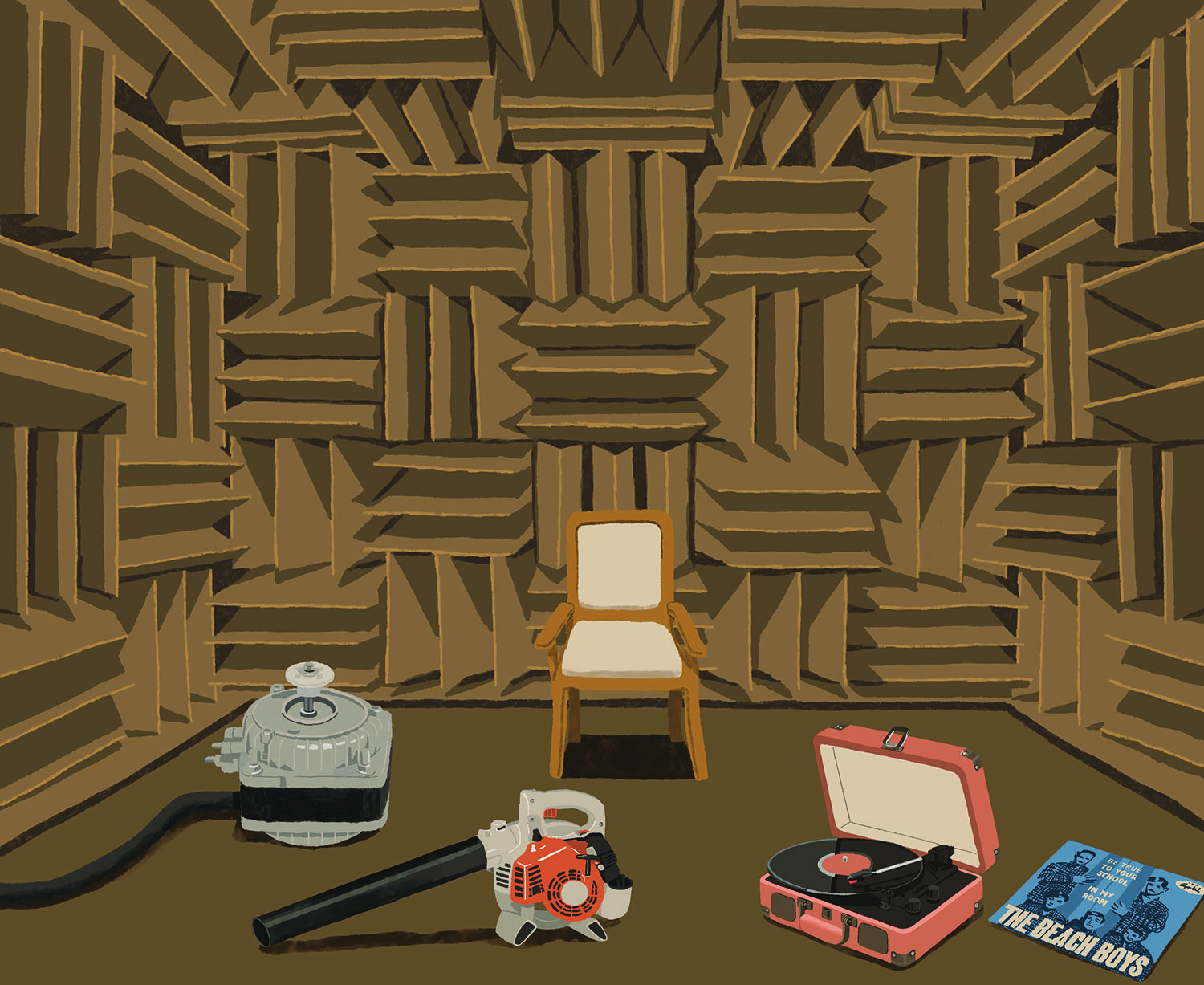
The Chamber was slightly larger than my studio apartment. The floor was a trampoline’s taut mesh wire net. The ceiling and walls were concealed behind the zebra stripes of mica-flecked fiberglass wedges. From a black wire hung a single bulb, casting a murky yellow light; torture-chamber chic. Narcissus explained that the light, which buzzed at a steady 20 dBA, would extinguish when the door closed. The room was not yet silent: air blew through unseen vents.
“After an initial period of disorientation,” said Narcissus, “you’ll hear a pumping noise.”
“…The AC?”
“Your heartbeat. You will hear your breath. The gurgle of your digestive system—though the papaya water acts as a suppressant. If you have particularly good hearing—”
He approached my ear very closely and inspected it.
“My God. Never mind. You can anticipate a faint hum. That will be the vibration of the hairs in your ear canal.”
Reflexively I reached for my ear.
“After a high-pitched hiss—the sound of your auditory nerve firing—you’ll enter the vapor zone. And that, my friend, is what this is all about.”
I asked if he could define the term.
“A person with whom you confide, a companion—”
“I mean vapor zone. What happens in the vapor zone?”
“Your physical being vaporizes. The world vanishes.”
“Because the room is dark?”
“You meet yourself. You meet yourself as you would a stranger, in a shadowless hall in the innermost vault of your soul.”
“You swallow the coconut.”
“If you’re lucky, yes. You swallow the coconut.” He handed me the basket. “Now, remove your clothes.”
“All of them?”
“Especially the circus pants. Can’t remember the last time I saw pleats. Dude.”
I did as I was told. The grazing of cotton against skin sounded like tearing cardboard. As I disrobed, he seemed to receive an urgent notification on his phone, occupying his close attention, though my own phone had lost service once we entered the cement hallway. After I piled my clothing in the basket, he brought it to the anteroom. I briefly cherished the image of Narcissus himself hauling away my underwear before he closed the door.
After a few seconds of puckered anticipation the air clanked off. Ten seconds later came a pneumatic hiss as the Chamber sealed. The light dimmed to nothing.
I waited for my vision to adjust. It couldn’t. It was too dark. I ventured gingerly in one direction until the foam point of an anechoic wedge brushed my forearm, as if trying to divert my attention. I reached for it, felt the foam soundlessly give and, after some pressure threshold, resist. I empathized with the wedge. When pushed, I caved until I reached my breaking point, when I resisted, meekly—just enough to maintain a minimum of self-esteem.
What I heard next:
A drone like the motor of a refrigerator. I figured it must have been some element of the building’s electronic infrastructure, though in retrospect I recognize that this is impossible. The room was designed to keep out incidental hums and whirs.
The wash of a distant wave, or something like it. On a rare ski trip, having veered off the chairlift landing to prepare my wrist straps, my eyes shut against the whipping snow, I mistook the repetitive flush of the emptied carriers whipping around the bull wheel for the crash of waves.
The grinding roar of a gasoline-powered leaf blower.
The lyrics of “Be True to Your School,” sung with hysterical intensity: I got a letterman’s sweater, with a letter in front / I got for football and track—
An urgent, incoherent female whisper.
The buzz of an electric toothbrush, interrupted at thirty-second intervals by a stuttered beep, notifying the brusher to initiate the next mouth-quadrant.
The slippery gurgle of water trickling down a mossy cavern.
A brief silence, during which the air seemed to depressurize, as in a diving airplane.
The slap of blinds, lifted by a breeze, against the frame of an open window.
The second verse of “Be True to Your School.”
The Chamber was slightly larger than my studio apartment. The floor was a trampoline’s taut mesh wire net. The ceiling and walls were concealed behind the zebra stripes of mica-flecked fiberglass wedges. From a black wire hung a single bulb, casting a murky yellow light; torture-chamber chic.
I observed the aural hallucinations with a reportorial attitude, trying to fix them in my memory so that I could write about them later. This required elevated concentration because I had terrible short-term recall and relied heavily on my notes, a crutch that after years of reporting had only accelerated the underlying impairment, as contact lenses hasten ocular degeneration. My internal soundscape, I decided, was tedious and unmemorable.
As I mentally catalogued the phantom sounds, my sense of the story I would write evolved from a wealth satire to an introspective essay about the noise of our modern technological life, how it threatens our capacity for reflection and higher thought and self-knowledge. But all that flew out of my mind when the old man started bawling.
I was certain that he stood beside me. I advanced toward the voice and was buffeted by a face full of foam. Eyes stinging, I proceeded more cautiously, arms extended. The urgency of his screams overcame any rationalizing signal my mind could hazard. It was terrifying, yes, but also oddly liberating—as if I had been shaken free from my old convictions and left to see the world as it really was. But of course I couldn’t see anything at all, in the total darkness, and soon I was screaming myself—screaming and crying and begging to be released, tearing hunks of polyurethane from the wall.
The Voice of God filled the room at excruciating volume. I covered my ears.
“Are you entirely certain that you wish to leave the Chamber?” asked Narcissus.
I replied in the hysterical affirmative.
“I’ve found that if you are able to withstand this initial period of paracusis—”
He was quieted by the strangled noise that escaped my throat.
The bulb sizzled and the noises stopped. Which is to say, they were replaced by actual noises: the pneumatic sigh of the pressure seal unclenching, the cough of the opening door, the nervous hiss of vented air. I bounced across the mesh floor and pushed into the anteroom. On the coffee table someone had left a compostable cup and a damp jug of ice water in which Dayglo-orange slices of papaya were suspended. I sat, naked apart from a thick layer of perspiration, on one of the plush orange chairs, and chugged the cold water straight from the jug, spilling on my chest. I didn’t see a camera, but I was certain I was being filmed.
“Dress, but don’t rush,” said Narcissus, through some hidden intercom. “It’s like coming up from a deep-sea dive. You can get the bends.”
In time I emerged into the sun-dappled living room, still cradling the jug. A new assistant retrieved it and exited, deftly navigating the heart-leaved tendrils of a hanging philodendron. I collapsed into the deep fold of a couch opposite Narcissus. He gave me a pitying smile.
“You heard something.”
“A man. Who was he?”
“My first time,” he said, “I heard snow.”
“He was an old man. Does he work here?”
“We have an entire research division devoted to the Chamber. Most of what they do is confidential. But I can share one general finding: the Chamber acts like a mirror.”
“The man. He was in distress.”
“You know who he was?”
“Do you?”
“The silence of the Chamber removes the outer levels of sensorial experience: the levels in which we spend most of our existence. It peels back the onion skin of consciousness.”
“I don’t understand.”
“Once external stimuli are blocked, the starving mind turns inward, as fasting causes the body to devour itself. The Chamber doesn’t cause hallucinations. It reflects what is inside you.”
Mind-eater, I wrote.
“The man you heard, of course—”
“Ah.”
“It was you.”
Narcissus raised his eyebrows, tapped his watch, and was interrupted a second later with an urgent reminder from an apologetic Kori, or Nori, or Xori—
What happened next was recorded by four cameras, two eyewitnesses, and even a thermal sensor. It started innocently enough—a handshake that was a bit too firm. That is much too firm, I remember thinking. Aggressively firm. I responded, without thinking, with a slap. Narcissus retaliated disproportionately, I think that’s evident. After that, well, I had no choice…Whether the charges are fair I won’t debate here. What I want to make clear, however, is that I was brought to this place by more than irritation or insult. It is not as simple as saying that his view of the world threatened mine, that his morality appalled me, or that I could see in his success the destruction of everything I valued, though all of this is true. There was something more to it—something that I cannot fully articulate, at least not better than the abject wail of that old man deep inside of me.
I find myself thinking often of a passage near the end of Le Guen’s account, at the height of her disorientation, after she’s slept for stretches of eighteen hours (what she mistook for an afternoon nap) and even thirty hours, and once stayed awake for fifty hours consecutively.
“My only horizon is darkness,” she writes. “My sky, emptiness. I am buried alive, trapped in an inhuman world.” She decides to revolt against the systems of her torture. She rips off the electrodes that monitor her pulse and disconnects the intercom that is her only mode of communication to her scientist-captors. Yet throughout this period, which lasts several days (or sleep cycles, to be more accurate), there is one activity she is careful not to neglect. She continues to open her journal each morning, and write. They had taken everything from her except the desire—unquenchable, inexpungible—to narrate.
I may have lost everything else, but Narcissus hasn’t been able to steal that from me. From us. We still have a story to tell: our story. And nobody can tell it more honestly than we can.
But wait, before you go. Please consider donating to my legal fund at the link below. Your support today sends a powerful message.

Nathaniel Rich is the author of Cloudthief (Macmillan, 2026) and three previous novels. A Statement, a film adaptation of his book Losing Earth (MCD, 2019), will be released in 2027.