Image


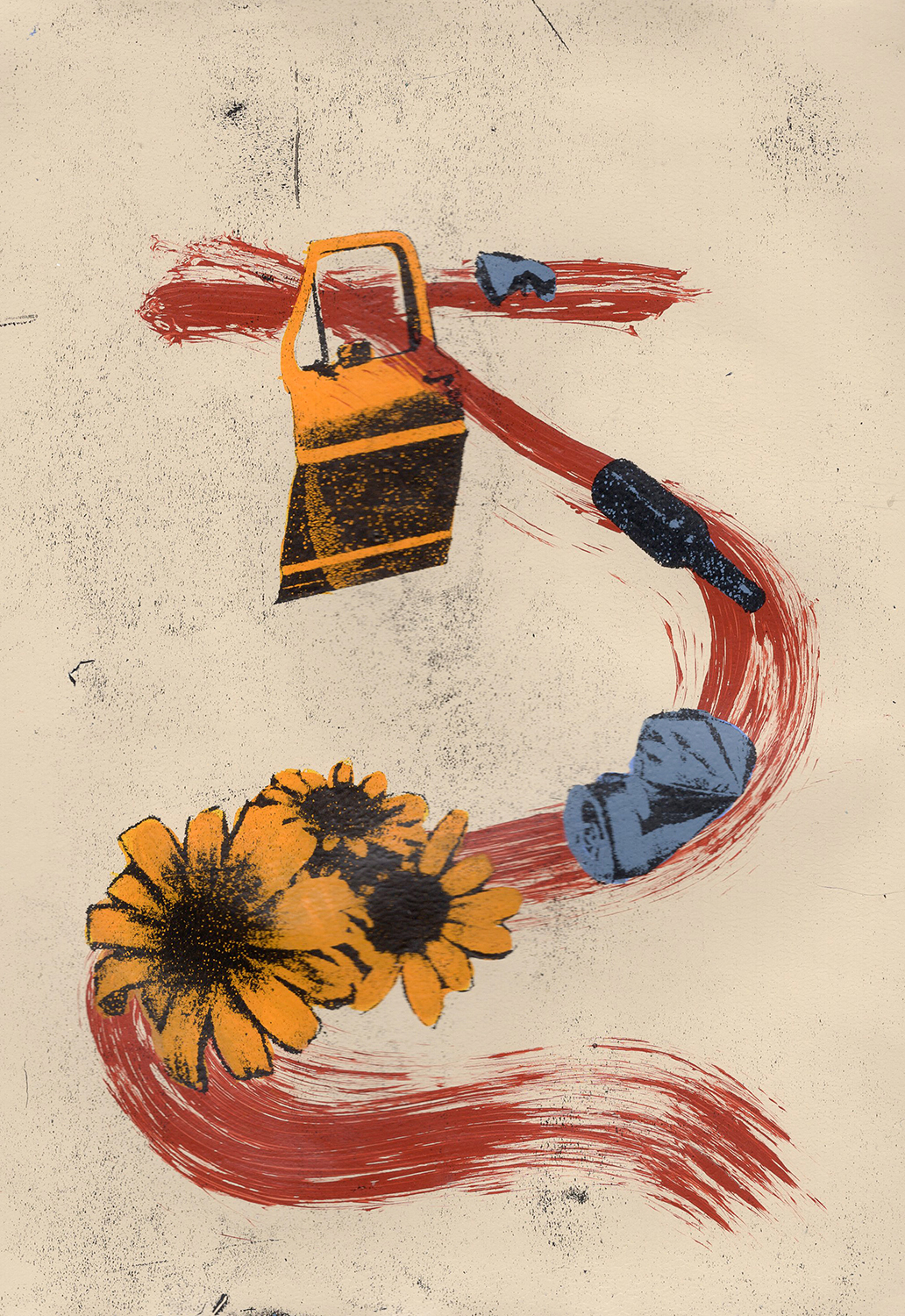
Although I’m disinclined to take bagged trash to the dump on Sunday, a day I reserve for worship and the fullest possible enjoyment of the pleasures that inspire it, I do spend part of most Sundays picking up litter along the dirt road I live on. Hardly my favorite pastime, it still falls within the bounds of pleasure because it usually involves a walk with my wife and because both of us are pleased to return home on a road free of trash. I know some passersby are apt to take our chore as one of civic-minded service to the neighborhood—or at least that’s what some will say when they stop and roll down their windows to offer a word of approval or thanks—but the truth is we do it mostly for ourselves. We dislike the sight of the litter, and so we have three choices: to put up with it, to get rid of it, or to give up taking walks. The first has proved impossible and the last unthinkable, which leaves us with the lowly remainder of choice number two, a garbage bag, and a glove. I grab both along with my walking stick, and off we go.
As for worship, it’s no exaggeration to say that roadside trash removal now counts for me as a spiritual practice. I won’t say that picking up an empty beer can amounts to a prayer or that I feel especially holy doing it. I’ll only say that it feels healthy for my soul, a way of reminding myself that something resides within me for which soul seems as good a word as any. What purely biological creature would bother doing something so far removed from biological need?
Part of why I call the activity spiritual has to do with the sense of liberation that comes whenever we take conscious hold of some annoyance and move beyond impotent complaint, when we acknowledge that our real enemy is not so much the annoyance itself as the soul-stultifying helplessness we feel in the face of it. There’s an imperative found several places in the Bible, “Gird up your loins,” a precursor of Jesus’s “Take up your bed and walk” or, if you prefer, of Bob Marley’s “Get Up, Stand Up” or Rilke’s “You must change your life”—all expressive of a move against futility, inertia, the reduction of the self to nothing more than a determined effect of implacable causes. When I used to teach school, I knew a custodian who would gather redeemable soda bottles and cans that students had thrown in the trash barrels or left in the restrooms or under the stairs and return them for the five- and ten-cent deposits. “That’s how I pay for my liquor,” he told me, with a note of self-satisfied defiance in his voice. The little wastrels were serving him, not the other way around.
Choosing to pick up the garbage on my road is no more a proof of free will than the custodian’s subsidized booze; both of us may have been moved by influences besides our own volition. I leave free will to the philosophers; me, I have a road to clean. In psychological terms, the oppressive sensation of being destined to live amid garbage and among the “slobs” who throw it is refuted by my decision to dispose of what I hate to see instead of pretending I don’t see it or simply stewing in my hate. To quote the Bible yet again, “If your right eye offends you, pluck it out and fling it away, for it is better for you to lose one part of your body than for the whole of it to be thrown into hell.” An extreme measure to be sure, but what if I can achieve roughly the same effect with a bit less literalistic bravado by simply plucking up what offends my eye? As for hell, I’ll get to that in a bit.
Of course, there is something instantly humbling about picking up another’s trash, and we are told that it does a soul good to be humble—a supposition affirmed by the idiocy we observe in the arrogant and the proud. They like to speak of “bottom-feeders,” a metaphor derived from aquatic biology and applied contemptuously to those who dispose or use what their hierarchal “betters” cast away. Calling garbage collectors “sanitation workers” does little to dispel the stigma that has attached to the job from its inception. One does well to remember that those Civil Rights protesters who famously carried signs proclaiming i am a man were garbage collectors on strike. Jo, the homeless boy in Bleak House whose blighted life and wretched death bring Charles Dickens to a white heat of indignation remarkable even for him, is a street sweeper. For generations in India, the lowest order of Untouchables, the Valmiki, have been assigned the job of emptying human excrement from the dry latrines on the streets, with most of the work predictably falling to the female members of the caste. The Zabbaleen, or “garbage people” of Cairo, Christian Copts discriminated against by their majority Muslim neighbors, have made a livelihood out of collecting, sorting, and recycling trash, tons of it piled in the reeking streets of their district, a virtual ghetto known as Garbage City. Bottom-feeders all.
Never mind humility; it is surely the height of absurdity for a middle-class husband and wife to walk a pleasant road in their L. L. Bean jeans and fancy themselves American Untouchables or North Country Copts, not that we fancy ourselves any such thing. Still, in the very act of bending down to handle another person’s discards, one forfeits a degree of pride—first having located it in the guise of indignation. Why should I have to be the one doing this?—a natural enough question whose best answer is probably, Why should it be anyone else? By accepting the task as my job, I have raised a tentative objection to the dubious idea that I am above such labors. Though I won’t be redeeming the bottles to buy my liquor or any other consolation, I am at least in tenuous solidarity with the people who do.
Most of those who go bottle-picking in our state are either poor, often homeless people in need of the deposits, or work crews of prison inmates, who presumably don’t get the deposits but do get some fresh air for their trouble. Both must feel poignantly conspicuous as the rest of us whiz by like aristocratic foxhunters on our various chases. I remember in my teaching years passing a student of mine who was bottle-picking along the roadside and knowing from the instant look of horror on her face that she had recognized me and was ashamed. I recall that look now and again as Kathy and I go walking with our trash bag, most recently when a car with out-of-state plates stopped beside us, its well-groomed driver wanting to know if we would like to have any of the plentiful supply of empty beverage containers he had stashed on his back seat. We politely declined, laughing in amusement after he’d driven away but not without umbrage at our mistaken identities. It seems our humility has its limits, but to recognize that is humbling too.
No less humbling is it to recognize that we can’t claim even a moral affinity with the recycling Copts or those others, the bagerezi of South Africa or the catadores of Brazil, over 200,000 strong, who, like the bottom-feeders of the natural world, perform a salutary environmental function. We do not bring our empty containers home to rinse out and recycle, or set them aside for the next high school bottle drive or the donation barrel that our local food shelf has at the recycling station in town. Essentially, we’re doing nothing more laudable than moving litter from the roadside to a landfill, hardly a claim to righteousness.
We’re not making one, though we might credit ourselves with a sane discrimination. We recycle our own trash scrupulously, but we do not recycle the trash of strangers riding our road. This is not humility; much less is it altruism, but it does amount to a kind of discernment not without spiritual implications. To put it bluntly, we will pick up litter but we refuse to allow it to litter our lives or consume too much of our precious time. We resist the scrupulosity that would trash a life in order to reduce the sum total of trash in the world. I’m told by a social worker who specializes in hoarding disorders that classic hoarders are often highly ethical people with a principled aversion to every act of waste. So they turn their dwellings into dumps to avoid dumping. They are probably better people than we are, so we are back to humility, but also to that insistence on free will that I mentioned before. For spirituality not to become precious, we have to negotiate our limits, pressing against them when called to, confessing them honestly when not. My house is also an environment, my body is also an ecosystem, my time is also a nonrenewable resource. I will not pollute any of them to prevent some other kinds of pollution. The declaration smacks of pride, true, but there’s humility in acknowledging your refusal to make certain sacrifices. The miser and the saint have each exempted themselves from the wearisome burden of financial stewardship; the rest of us are left with the question of how much to donate to the T-ball program and the ACLU and how much to keep for a new carpet, a decision almost certain to leave us feeling either stingy or profligate no matter what we do.
That our motivation for picking up litter has more to do with aesthetics than principle also carries spiritual import. Beauty moves the soul, sometimes in a good direction; needless ugliness seldom does. Making the road less unsightly for ourselves and consequently for our neighbors has to have some small benefits, not unlike those of going to town with the resolution to be as personable as possible to every beleaguered store clerk and fellow shopper we meet. Sometimes the most charitable office a person can perform on any given day is to lower another person’s blood pressure, to reduce the level of cynicism in her heart. I like to think that we’ve done a little of both for some of the more sensitive drivers on our road, although, as I said, we are mostly serving ourselves.
Hardly given to indulging anyone’s sensitivity, the essayist Edward Abbey had the notorious habit of tossing empty beer bottles and cans out of his truck window, a practice he justified in an often-cited passage: “Littering the public highway? Of course I litter the public highway. Every chance I get. After all, it’s not the beer cans that are ugly; it’s the highway that is ugly.” His boast loses some of its contrarian hauteur when uttered along a dirt road lined with black-eyed Susans and purple asters, bisected by a spring-fed stream and lined with tall cedars and lithe white birches. What would Abbey have made, I wonder, of the half dozen old tires someone tossed over the embankment and into a pool of that little stream? Was the stream uglier than the tires? Kathy and I fished them out and, with the mediation of a neighbor who works at a nearby farm, were able to give them a more seemly use in holding down the covering on a silage bunker. Our reward was nothing more nor less than the restored beauty of that stream, which we stop to enjoy, as though drinking from the same waters, whenever we walk by. No tires have been tossed there since.
In the very act of bending down to handle another person’s discards, one forfeits a degree of pride—first having located it in the guise of indignation. Why should I have to be the one doing this?—a natural enough question whose best answer is probably, Why should it be anyone else? By accepting the task as my job, I have raised a tentative objection to the dubious idea that I am above such labors. Though I won’t be redeeming the bottles to buy my liquor or any other consolation, I am at least in tenuous solidarity with the people who do.
One mark of my aging is the increased importance that aesthetics seem to have for me. I like things to “look nice,” not in any fussy way, I hope, but in such a way as fosters contentment. I work better in a straightened office and an organized shop; I’m more contented in a neatly painted house. In spite of road dust and cluster flies, we wash our windows every fall. I want candlelight and music when I eat. It follows that there are worship spaces in which I would find devotion harder to summon because they strike my Anglo-Saxon sensibilities as either too spare or too macabre. I suspect God is much less picky. In my preoccupation with tastefulness and order, I find as many reasons to repent as to rejoice: My concern for aesthetics puts me in danger of forgetting higher values like justice or some of the uglier realities that beauty has been known to hide.
If we walk our dirt road far enough we will come to a remote ridge-top cemetery on a little used lane, many of its weathered stones dating from the nineteenth century when ours was a farming community and probably looked more picturesque on the whole than it does now. I love the look of an old cemetery. I love reading the inscriptions on its stones, and in that love I am perhaps least aware of the mortality staring me in the face, just as in the presence of “great art” and “great books” I can forget the blood and cruelty that have been the bricks and mortar of all “great civilizations.” I bristle whenever some greedy developer or self-serving politician dismisses public objections to his ambitiously disruptive project as “merely aesthetic.” The aesthetic can never be “mere” to me, but I also ought to bristle whenever someone speaks too blithely of beauty and truth, of scenery or tradition—such as when we decry “all the garbage on our road” with no regard for the socially littered lives of the people who throw it.
I’ve little doubt that the most spiritually difficult aspect of my trash-picking is the struggle to think charitably of the people who throw the trash. It’s seldom an easy feat, harder in the cases of the grosser dumps, as with the tires in the stream or when someone emptied the contents of an entire refrigerator onto the side of the road. Given the types of garbage I usually find—beer and soda cans, empty chewing-tobacco tubs, bags and cups bearing the names of fast-food chains, candy wrappers, and scratch-off lottery tickets—it’s all too easy to sketch a judgmental caricature of the offender, an addict with multiple venial addictions to alcohol and caffeine, to sugar and chance, somebody with more money than manners and no concern for anyone but himself, some philistine who can’t see a tree without wanting to chop it down or a creature that moves without wanting to shoot it dead. Somebody who considers it a point of honor not to recycle a thing, whose first thought for economizing consists of not paying for a trash service so he can spend more on cigarettes and beer. You know how it goes, especially if you’ve indulged in the same repulsive snobbery. It hardly counts as charity to think that while the litterbugs are putting sugar and nicotine into their bodies, I am improving the cardiovascular health of mine by walking the road and thus increasing the likelihood of my “outliving the bastards” (another Abbey expression). There may be more charity in recognizing the paltry nature of the pleasures revealed in people’s garbage; I find no empty Chardonnay bottles, for example, no wrappers from artisan cheddar, no film tickets or receipts from the local bookstore. The garbage I find is merely the cast-off packaging of what was also garbage. A similar pathos can be located in the possibility that in some cases litter may be a form of protest, a way of sticking it to the squires or the flatlanders or whoever. Viewed with any sympathy, it’s enough to make a person cry, to imagine self-expression debased to the level of tossing shit out the window, class struggle of no more militancy than a Mountain Dew can bounced off a banker’s privacy fence. Workers of the world, unite; you have nothing to lose but a few French fries that got cold before you could inhale them.
The problem with some of the more “charitable” states of mind is that they almost always border on condescension. It may be more to the point to reflect that I have probably put more pollution into the environment by a single airplane flight than some of my neighbors have in a lifetime of littering the roadsides, to say nothing of all the greenhouse gases we’ve generated by our high-protein diet or all the trees that have perished to heat our quaint but drafty old farmhouse throughout the long winter and to keep my ever-active printer stocked.
It also helps to recognize that the majority of those who litter the roads do so with some sense of decorum. We rarely find litter on our lawn, for instance, or near the barn across the road from our house. Most of it is confined to the no-man’s-land (though it is of course some person’s land) between our house and the one half a mile up the road. Probably the placement has much to do with avoiding detection, but at least some of it might be a matter of relative courtesy and thus a challenge to the stereotypes I harbor.
And not the only challenge. Along with the beer cans and cigarette wrappers, it’s not unusual to find plastic water bottles, often partially full and glaringly out of place in the cartoon image of a ridge-running redneck swilling beer and tossing his empties as he goes. (I knew a local old-timer, a man fond of his beer, who claimed never to have drunk a glass of water in his life.) In point of fact, the worst period for litter on our road coincided with the operation of an exclusive private residential school for the troubled adolescent children of well-heeled parents. Tuition was in the high five figures and you could mark semester changes and holiday vacations by the string of Volvos and Mercedes Benzes churning up dust along the heavily littered road.
Still another challenge came in the form of small plastic bags, all bearing the logo of the same supermarket, each filled with household trash and neatly knotted. I opened a few in the hopes of finding some identifying information, and in one discovered an empty pill bottle with a neighbor’s name on the prescription label. I don’t know what he did for work, or if he worked at all, but his wife held a white-collar job requiring a college degree. I decided not to challenge the offender—put off in part by the pill bottle’s hint of illness—but I do allow the recollection of his middle-caste litter to challenge my assumptions when they fall into classist ruts.
The presumed offender soon passed away, followed by a telltale disappearance of those recognizable bags. The private school closed around the same time, accompanied by yet another noticeable reduction of trash. The largest reduction, however, has occurred since we began cleaning the road on a weekly basis. Some days we find nothing, and I confess that in a time of such national dysfunction as the one we’re currently living through, when the descent into fascism that “can’t happen here” seems to be happening more every day, my spirits are buoyed by almost anything about which I can say, “It’s gotten better.” Maybe the sight of two geezers fishing cans out of drainage ditches has shamed some garbage addicts into abstinence. My wife, typically more generous in her assessment of human nature than I am, subscribes to that theory. I think a likelier explanation is to be found in the imitative natures of the higher primates, as in monkey see, monkey do, with its corollary: monkey do not see, monkey might not get any ideas. A littered road invites litter; a clean one keeps the impulse at bay by removing the visual stimulus.
If we neglect our walks for a week or two, we will usually find more litter than we did on our last walk. I suppose one might go so far as to see litter as an ostentatious expression of that free will I mentioned before. Dostoyevsky said that even if the creation of a perfect society were possible, someone would still oppose it simply to affirm that he could. So I keep that in mind—only to catch myself sliding back into a smug reflection on the paltriness of “doing your Dostoyevsky” with a can of Bud Lite on a scenic rural road. (The light beer cans are what kill me, the idea of some rough-and-ready cowboy with one eye on the open range and the other fastidiously on his carb count, which has prompted me more than once to sigh aloud, “Oh, where have all the rednecks gone?”) Like all spiritual exercises, mine may have no better use than to convince me of the utter futility of all “methods” but the simplest kinds of prayer. After all my failed attempts at a kinder state of mind, the best I can manage is to ask a blessing on whoever tossed the thing I’m picking up, a benediction that may or may not have any benefit for him, but is a hell of a lot better for my soul than imagining taking him out with a shotgun fired from behind a tree, his crushed Bud Lite can flying out one window and his beer-buzzed brains out the other.
I’m often struck by the change in perspective that has come not from any conscious choice but from the simple act of the picking itself. Something primal attends any act of gathering, perhaps a vestige of foraging for food or picking bugs from a neighbor’s fur, what our chimpanzee relatives do all the livelong day. A certain rush comes with the sighting of a bottle or can, which I realize is not unlike what I feel when harvesting berries or beans. There’s another one! I almost missed it, but no, it’s in my hand. I can even feel a slight letdown when I walk our usual mile stretch and find nothing, when we come home with our empty bag flapping like a dormant sail. There’s a strangeness to this that feels like the gentlest joke on myself—yes, and a joke on the people who throw the litter. You may think you’re ticking me off by tossing your bottles, but I’m actually a little disappointed when you don’t. I wonder if I’m feeling some of what the Chinese felt when going after flies under Mao, hunting them obsessively and swatting them in fits of patriotic frenzy, so that the sight and sound of a fly, formerly such an annoyance, now prompted a dopamine rush. A revolution in attitude if in nothing else.
I suppose this might be seen as the other side of free will, or the complement to it, assuming free will exists: that we can choose to do something, but in that choice certain determining factors kick in, many of them, we can hope, as salutary as the choice. In this view, we act on what we can affect partly to activate mechanisms that are beyond our control. I used to tell my students that, just as the best way to get in the mood to dance is to start dancing, the best way to feel inspired to write is to start writing. One makes the first move and then is moved in turn. If, as William Carlos Williams told us, “so much depends upon a red wheelbarrow,” no less depends on taking the handles of that wheelbarrow and moving it the first foot past the white chickens. It will take as much decisiveness to stop the thing as it took to get it going.
It has occurred to me more than once that my own motion could come to a sudden halt while doing my roadside chore. I could be struck dead by a car. I could have a heart attack from too much rapid bending. “Get up slowly,” my wife will say when I’m the one who bends; she knows my tendency to get light-headed when rising too fast. Once when I was patrolling the road on my own in mid-winter, I foolishly went after a can lying atop a snow-filled culvert and sank to my waist with nothing but empty space below my dangling feet. I struggled for some time to get a foothold, simultaneously miffed and amused by my sudden helplessness. It crossed my mind that I might not be able to get out on my own. Then what? Would someone come by and notice my predicament? Would they assist me if they did? Eventually Kathy would notice how long I’d been gone and come to look for me, but what if in her attempts to free me she also became stuck? “Older couple freezes to death while scavenging along roadside.” “Deceased could never resist a piece of trash, says distraught widow.”
If death is always around the corner, the devil is too, so it’s no surprise that I’ve been tempted more than once by the thought of how bad someone might be made to feel discovering that a piece of his carelessly tossed trash led to my death. This is a thought as fond as it is mean, for I can easily imagine the tosser saying, “I never asked the old fart to pick up my trash. If he was idiotic enough to waste his time doing that, then I guess the blame’s on him.” After all, why would someone who feels no compunction about chucking bald tires into a stream feel any compunction if an old man drowned trying to fish them out?
I can think of worse ways to die than keeling over while trying to clean a country road. And I can think of greater concerns than when and how I die. More and more what concerns me is what will be my final thought when I go. What will I be thinking when the four-wheeler slams into me or the blocked artery bursts? Will I be reciting a poem or nursing a grievance, blessing my neighbors or calling them pigs? If only to lessen my dread of death, I need my mind picked clean of trash, and it will take a capacious bag to hold it all. What I do along our road is merely metaphor in the end.

Garret Keizer is the author of ten books, including Getting Schooled (Metropolitan Books, 2014) and Privacy (Picador, 2012), and a contributing editor of Harper’s Magazine and the Virginia Quarterly Review. His most recent book, Starting from Paterson (Eastover, 2026), is a wide-ranging collection of first-person essays.
Laura Weiler is a visual artist whose work has been published in The New York Times, The Guardian, and Cosmopolitan. Her art direction projects cover interdisciplinary ground, ranging from floral design to films screened at the Chicago International Film Festival.