Image

When was the first prayer? Was it immediate, a direct appeal, like Abraham’s plea that God spare Sodom? Or was it asymptotic, a request that the petitioner be somehow granted an exemption from the world’s sorrows? Did it require mediums—a waterfall, for example, or a body part, like the 160,000-year-old skull of a child from the Great Rift Valley that bears marks of intentional scalping and polishing; or rocks particularly arranged; or a space specially dedicated, a sanctuary? Was it one person beseeching in utmost concentration, like a monk who seeks devotional seclusion to focus on worship? Or did it require a congregation, a jummah, a liturgy of togetherness? Was prayer “absolutely unmixed attention,” in Simone Weil’s words, or, as Iris Murdoch says, “a form of love,” and was there a difference between the two, and what was that difference? Having been raised entirely outside of any kind of faith, and having spent all of my adult life surrounded by people for whom faith is paramount, I have a complicated relationship with prayer. I can’t help but wonder at how this specific kind of love and attention has miraculously sustained us since the beginning of the immense human journey, through epidemics and genocides and all the grief and suffering of history.
In his annotation to al-Fatiha, the first sura of the Quran, the theologian Abdullah Yusuf Ali explains that prayer is not for God—who is omniscient, who knows our joy and sorrow and has no use for our praise—but “for our own spiritual education, consolation, and confirmation,” which is to say that its purpose is to refocus us, extend us outside of our dailyness, to restructure our seeing and listening beyond ourselves and turn us toward miracle—just as the Hebrew prayer Eilu Devarim, recited during the morning service and known colloquially as the “Happiness Prayer,” exalts the intentional pursuit of joy amid community.
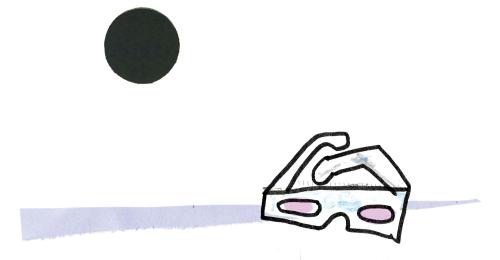
And so, on Monday, April 8, 2024, I turned toward the blessings in community: I grabbed the eclipse glasses I had picked up at the public library and walked half a mile from my apartment to Clark Park in West Philadelphia, where a few dozen of my neighbors had already gathered to watch the eclipse. From where we live, we were expecting to experience 90 percent totality, with a sliver of the sun’s crescent still visible on our star’s southern rim. But I was also looking forward to what happens after the moon has passed and the sun becomes whole again—a celestial gesture of potential upswing, a substantiated hope onto which I could then thread other hopes, ranging in granularity and specifics, starting with the most basic: less dying, less war, more love.
Before I had ever seen a solar eclipse, I had read Annie Dillard’s essay about the total eclipse of 1979. “The sun was going, and the world was wrong,” she writes: “[T]he monstrous swift shadow cone of the moon” came “hauling darkness like plague…. It was as though an enormous, loping god in the sky had reached down and slapped the earth’s face.” Before Dillard was born, Virginia Woolf wrote in her diary about the 1927 totality: “We had fallen. It was extinct. There was no colour. The earth was dead…. We had been much worse than we had expected. We had seen the world dead.” Woolf recounts Stonehenge; Dillard, Mesopotamia: Like most people, both see something primal and ageless in the celestial event. I have also heard people who had seen a solar eclipse describe feeling somehow reduced, even filled with dread, as if the world were about to end. But each time I have seen one, I have felt an elation, an expansion even, a marveling. Why have I never felt dread? Is it because, as a former war correspondent, I’ve witnessed the world ending again and again, sometimes during an eclipse but much more often not?
On the day of the 2024 eclipse, the world was ending for millions of people. The Israeli military was waging a genocidal war in Gaza; Sudan was on the brink of starvation; Haiti was devouring itself. A poet from Ukraine wrote, “They are simply killing us.” In the ancient clay maze of Djenne, in the heart of Mali, my old comrade Amadou Gano attended the funeral of two of his friends who had been murdered outside the city walls—maybe by al-Qaeda-affiliated insurgents, maybe by Russian mercenaries, maybe by the troops of the ruling junta: Mali had been in doomsday mode for years. All over the Earth, people were fleeing violence and natural catastrophes and the number of refugees continued to swell.
The word refugee—one who seeks shelter from persecution—first appeared in English in the seventeenth century, describing the hundreds of thousands of French Huguenots tyrannized by the Catholic Crown, and comes from the Proto-Indo-European bheug (“to flee”). Note how long the root for refugee has been with us, ever since the theorized ancestral language of a community that may have existed in the Neolithic period. One would think, given all that time and opportunity to get it right, we would have come up with a way to live with one another better.
Where are the refugees to go, to which sanctuary? Sanctuary, from sanctus, “holy”: originally a sacred place—a temple, a church—where fugitives were granted immunity, a reprieve. At its Latin root, a sanctuary, a holy place, is where we take refuge from hopelessness and turn to the miraculous, pray for kinder realms—for example, the Great Mosque of Touba, where, I can say with certainty, I prayed for the first time in my life. The mosque is a sanctuary in the original sense: a place designed for us to dream better, which is why, of course, most people pray.
I have a complicated relationship with prayer. I wonder at how this kind of love and attention has sustained us since the beginning of the immense human journey, through epidemics and genocides and all the grief and suffering of history.
But no designated, consecrated holy place today is large enough to contain the millions fleeing, and so sanctuary is sought under any cover available: a city; a tent camp half-drowned in the winter mud of Gaza; a stick-and-tarp village on top of a refuse field in Bamako; the cinder-block hive of Zarqa, one of the oldest refugee camps on Earth. Maybe it is time we rewrite our definition of holiness.
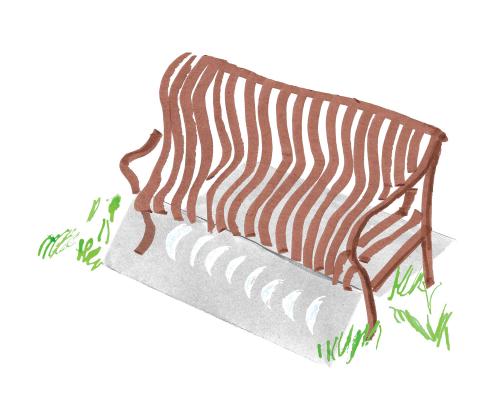
Clark Park was a sanctuary long before it became a park. For four thousand years, Native people lived here: When European colonizers settled what would become West Philadelphia, the park’s gentle slopes abutted the Lenape village Arronemink; back then, a creek ran through it. In the mid-1860s, a part of its nine acres was occupied by a Union military hospital. Established in 1895 as a recreational place for children, in the 1980s the park was, in the words of John Edgar Wideman, “a green oasis” where, on occasion, men and boys gathered for the Big Time, the best pickup basketball in the city; there is still a mean pickup game happening, on the same court. In 2020, white supremacists tried to host a rally in Clark Park—“Belly of the Beast,” they called it—and the entire neighborhood turned out in force: parents with strollers, millennials and elders and middle-aged college professors, Black horsemen, poets, bright-eyed Gen Zers handing out water and cookies, elementary school children with Black Lives Matter posters. Some of these people were back now, four years later, on beach blankets and towels spread on the park’s lawns, on park benches and foldout chairs and simply on the grass, to watch the eclipse.
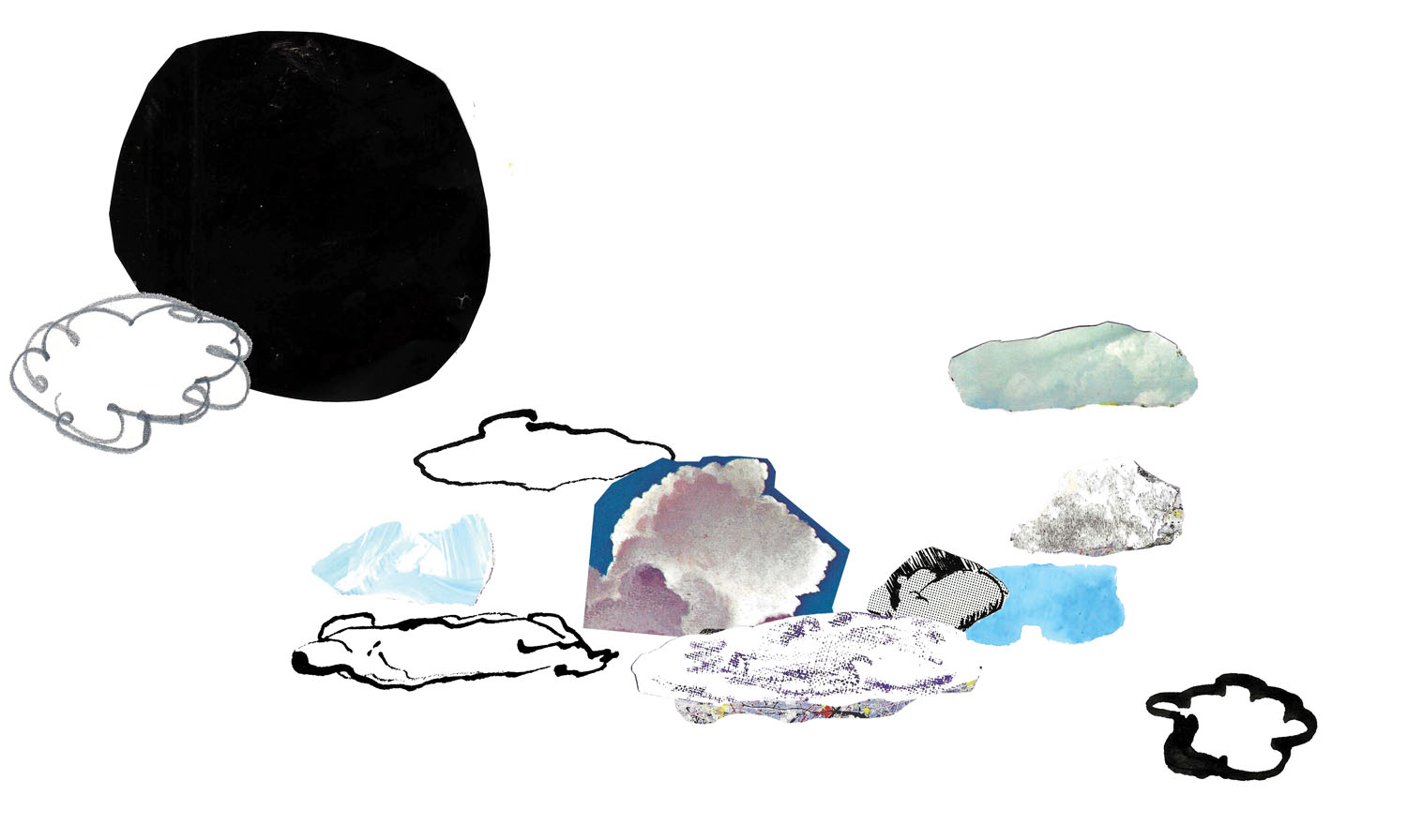
A windy afternoon, mostly clear sky. Then, fifteen minutes before totality, a cloud front rolled in. A Hopi-Tewa elder I know had written to remind us that in the Hopi tradition the eclipse is when the sun and the moon meet to discuss the state of the world, and that people are not supposed to interrupt the conversation; Philadelphia is very far from the Hopi homeland, but maybe the clouds were there to preserve the sun and moon’s privacy. Clouds bruisy and gray and so thick I could not tell where behind them the sun was. Then the park grew much darker, and cold. My neighbors and I remained on the benches and lawns until, fifteen or twenty minutes after the eclipse, the clouds dissipated and it was warm again and we could see the moon slowly slide off the sun.
I remembered how Czesław Miłosz described prayer, that it
constructs a velvet bridge…
Above landscapes the color of ripe gold
Transformed by a magic stopping of the sun
What is it to know grief? I do not think everyone does, but once we do, it is a condition we can never unhave; it is always there, shape-shifting, accommodating new losses. In The Wild Edge of Sorrow, Francis Weller writes: “sorrow works upon us, deepening and reshaping us through our many encounters with loss…. This art of loss is a tempering of soul, a gradual deepening…. We become more intimate with our surroundings and lean in to those we love.” I wonder if the work of grief, then, is to excavate within us room for all the other emotional experiences—love, joy, beauty—and whether those experiences can be bigger inside that hollow prepared by grief the more space there is. The more grief, the more joy. But why does joy never seem to overflow the hollow?
In 1851, the year the path of totality arched across Greenland and southern Scandinavia, Mexican troops attacked the camp where a band of Bedonkohe Apaches was staying near the town of Janos and slaughtered the mother, wife, and three small children of a man named Goyahkla, whom many now call Geronimo. He was twenty-one years old. “I did not pray, nor did I resolve to do anything in particular, for I had no purpose left,” Geronimo later recalled. But he did pray the following year, before setting out to take revenge against the Mexican army—“not for help, but that [the warriors] might have health and avoid ambush or deceptions by the enemy.” He prayed, I imagine, that his hope be substantiated; thus he began his new life as a leader of anticolonial resistance. After all, prayer is a reach for sanctuary from existing reality—but prayer itself is a sanctuary, a space where the door opens.
On January 27, 632, around the time the Prophet Muhammad’s youngest son died, age eighteen months, people in Arabia witnessed an annular eclipse. The Prophet dismissed any connection between these events. “The sun and the moon do not eclipse because of the death or [birth] of someone,” he told the faithful. “When you see the eclipse, pray and invoke God.”
We contain such amplitudes; just look at our ability to leap from the mundane to the miraculous. But how not to miss the real miracles that are before us? In Clark Park, satisfied that I was not going to see the maximum obscuration, I stood up from my park bench and started walking home, and—like Dillard and Woolf before me—I had nearly missed what the eclipse actually was: a sanctuary.
A block from the park, I offered my eclipse glasses to a young girl returning from school with her dad.
What does it look like, Luna? her father asked her.
Like the moon, she said.
Up the street, a man told me he had last seen a solar eclipse in 1999, the week the 7.4-magnitude İzmit earthquake killed more than eighteen thousand people. The man said he was still living in Turkey at the time.
I will never forget that eclipse, he said. One town got destroyed completely. It was a terrible tragedy.
I expressed condolences. Then we stood side by side and photographed the crescent sun through our eclipse glasses and smiled at each other before parting ways. In my photograph, the orange crescent in a burgundy sky is accented by the black moon and framed by thin, leafless veins of tree boughs. It looks like a retinal-imaging scan.
Four blocks from my apartment, a young man with tattoos on his face asked to look at the sun through my glasses.
Amazing, isn’t it? we said to each other, and agreed: Amazing, yes.
Then he ran off and caught up with me a block later with a younger friend, who asked to look through the glasses as well.
Amazing, he said, and we nodded. Amazing.
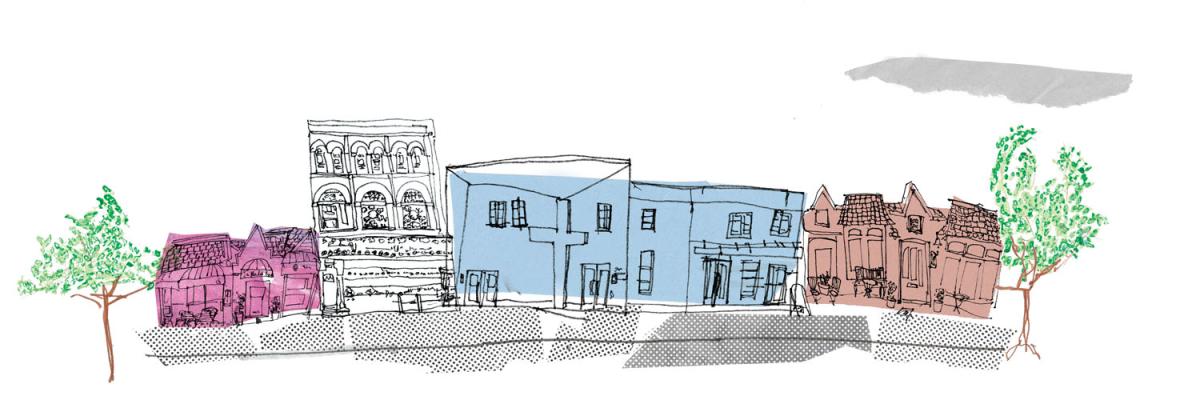
The two men left. I stood on a street corner between a church, a shawarma place, an Art Deco mosque, and a bakery, and looked and looked. The moon kept sliding off the sun like a lid off a cauldron. The owner of the shawarma place ran out of his shop twice and dashed across the street to talk to me.
Is it over yet? I’m afraid to hurt my eyes! he said both times, and both times accepted my offer to look through the glasses, and both times said, grinning: Amazing.
Amazing, I replied each time.
I finally left the glasses with a preteen girl with a melting ice-cream cone and her brother, who kept putting them on and looking northeast, away from the sun. He did this again and again, and he would say, I can’t see anything! And his mother would say, Turn around! And everyone would laugh.
That time in Touba remains, so far, the only time I am certain that I prayed. It was the first Friday prayer after Ramadan; there were so many parishioners that I stayed under a forest of umbrellas in the courtyard of the mosque. There were a lot of us women under the umbrellas who had come carrying our sandals and our hopes and joys and heartaches, maybe two or three hundred. Some women were my age, some younger, many a bit older. Many had brought children. To my left, a young woman in a white dress prayed on bare stone, then took out of her patent-leather purse a pair of patent-leather kitten heels, then a Salat, then a phone, made a quick whispered phone call, then settled in to read. To my right, a woman directed her two daughters to sit on either side of her nylon prayer mat, opened her Salat, traced the lines with an elegant forefinger. The younger girl was maybe five or six years old, restless; she brushed her hands against the white marble of the courtyard tiles, traced mottles on granite, poked at where the slabs seamed. Her sister, a teenager, assumed a posture exactly like her mother’s, but instead of a prayer book, she was holding her cell phone, and she used her forefinger not to trace the lines but to scroll. Just beyond the grove of umbrellas, men filed into the Grand Mosque, sandals in hand, in an almost unbroken procession, and whenever the loudspeakers paused, I could hear the whisper of their robes like wings and the hush of socks on hot stone, and mourning doves unclinging from their shadows to clap skyward like whirls of light and shadow.
The sermon at the Grand Mosque was in Wolof, and I understood almost none of what the loudspeakers broadcast. All I could pick out was God. God. God. Thank you. Thank you. Thank you: a prayer stripped of cartilage to its most mystical innermost prompt, the way a poem weathers language down to the most essential, fosters alertness to the infinite ways in which we know how to be full of marvel.

Anna Badkhen is the author of eight books. Her awards include the Guggenheim Fellowship, the Barry Lopez Visiting Writer in Ethics and Community Fellowship, and the Joel R. Seldin Peace Award from Psychologists for Social Responsibility for writing about civilians in war zones. Eclipse Season is adapted from Badkhen's essay...
Joanna Neborsky is a Los Angeles–based illustrator and animator. Her art has been featured in the Los Angeles Times, The New York Times, The New York Review of Books, and Vanity Fair, among others. Her books include Illustrated Three-Line Novels, with text by Félix Fénéon...