Image

The world is on fire. Across the seven continents of Htrae, an evil cadre of twisted nobles and their cultish followers, in their greed and their corruption, have begun to break down the best systems of an already imperfect world. It is a dangerous place for dissenters, a dark time for the different, for those with any hope to spare for justice or peace. Meanwhile, in the tiny hamlet of Garvaldia, nestled in the Scottish coastal hills, life stumbles on. The sheep may safely graze.
You are a human rogue, wrestling two petulant goblins into traveling clothes. An errant kick. You take three damage—not enough to maim, but certainly enough to make you raise your voice. You stifle a curse and continue trying to stuff the goblins into socks and trousers. One of them farts theatrically. You are disarmed, and goblin 2 lands another kick to your unarmored boob. Four damage. You fail to muffle your profanity and now the half-socked goblins are running amok, shouting “fuckssake!” in their little goblin lisps. You’re down to your last hit point, and it isn’t even nine a.m.
You are doing your best. These goblins have no sense of what is wrong out there beyond their little green and pleasant land. They only know their mum is kind of feral. You are kind of feral. And you shout a lot. (You’d shout an awful lot less if they put their fucking socks on the first six times you asked.)
You want to be a better mother. Roll a D20 for a Constitution check.
I failed at gentle parenting—and not for lack of trying. I just don’t have a gentle kid.
Not for him, the meditative sandboxes. Not for him, the array of lovingly selected Scandi toys. My eldest came out swinging, driven to adventure, drawn to electrical sockets and heights (or launching from them), possessed of a deeply ingrained love of sticks and slashing things with sticks. He never once responded well to validation of emotions (I see you’re mad; it’s okay to be mad); in fact, the affect of parental calm incensed him. He would only wail and scream and bash the harder.
He didn’t respond well to authoritative parenting either, the once or twice we tried, prompted by grandparents who told us we simply hadn’t held firm lines. His response to consequences was volcanic. There was nothing we could do to keep him from, say, belting his little brother, refusing to eat anything but Ritz crackers, or turning the most innocent toy into a weapon.
It was only when we threw the rule book out the window, on the advice of a child therapist who specialized in neurodivergent, hyperactive kids, and focused instead on building trust that we came to understand our kid. He likes what he likes. That list does not include: surprises, chocolate, scratchy jumpers, haircuts, sports, school, basic hygiene, doing anything he doesn’t want to do, or having to sit still. We’ve had to micromanage quite a lot just to keep him safe and healthy and keep others—animal and otherwise—unharmed. We love him, and he knows that, and on most days that’s enough.
Cut to: a bright and funny, if occasionally obstinate kid. He wears his blond hair long, pulled half back, and a bright-pink winter jacket—or, sometimes, a hand-sewn hooded cloak—and Docs. He’s survived many a schoolyard taunting and misgendering and now struts through his world a proud and self-styled weirdo. Who wants to be an artist-engineer, but also a dragon? I can’t know the amount of damage this kid has sustained from bullying, restrictive norms, and, yes, even his own exasperated parents, but it breaks my heart.
Cut to: his quenchless love of books. Books which I read to him—tucked like a spider’s lunch into his sensory-compression sack—for an hour every night because he is dyslexic and refuses to read for himself. What started as a love of knights, King Arthur, William Wallace, the battles of Robert the Bruce against the oppressive English, evolved into a love of mythical creatures (mostly dragons), faraway islands, Greek mythology, martial arts, wizards, and bloodthirsty immortal unicorns. Good guys versus bad. Sometimes even good guys who go bad but then go good again. And when I told him about Tolkien, who invented languages and songs and mythic worlds, it blew his little mind. He wanted to know if there was a proper name for all this magic swashbuckling in the stories he loved best. Yes, I told him. I told him it was “fantasy adventure.”
I was a closet nerd. Back in teenage bloom, in thrift-store maxi skirts and boots, I hung out with the gamers: the boys with the Warhammer minis and the Magic cards, the boys with duct-taped boffer swords, who loved an audience of elven maidens, damsels in distress. The boys. To my feminist discredit, I became their groupie. There were girls who gamed. I wasn’t one of them. Not because I didn’t want to be. I really did. I just didn’t have the pluck to ask. Nat 1 (a very low roll) on that Persuasion check.
I was, instead, a “gamer chick” (their term). These were my friends, my crushes, even an almost boyfriend who was handsome and tall but never took me seriously and so was just the boy who finger-banged me in the art room once. And when they waged their role-play campaigns in enchanted dungeons, or “boffed” upon the hill, I wasn’t there. I was the choir girl who deigned to decorate their lunch table. I’d read Tolkien with my dad; I could kick their butts in Lord of the Rings Trivial Pursuit, but I was never bona fide.
Now, a mum of two, leading a pack of village children through the local woods with a bag of polyhedral dice as they describe their efforts to barbecue the testicles of a sea monster lurking in our burn, I realize this is my second chance.
I have nothing against gentle parenting. For the most part, I practice what the Instaparents preach. Respect, repair. My kids know that their feelings matter. We give them choices, honoring their preferences, trying to learn what their behaviors may be telling us about their limits and their needs. But modeling—calm, compassion, please and thank you, gentle touches—was never going to be enough. My son was a one-way looking glass. You could put all the right things in, but he would only mirror back his rage.
Cut to: a local bookstore runs a Dungeons & Dragons intro night for kids. I bring both my boys, and they are hooked. Under the aegis of a stylishly mustachioed DM (“Dungeon Master”—a kind of narrator- referee who runs the game), they are given characters with skills and weapons, and their mini avatars are plunked onto a grid map where they fight some zombie skeletons and, finally, an owlbear. It feels like the beginning of the rest of our lives—or anyway, a new chapter in parenting.
All of a sudden, I have a superpower. I know stuff. I can’t understand my kids’ aggressive and bloodlusty play, but I can bond with them about the realms of fantasy. I can do the Gollum voice. I can remember the names, the lore, the metaphysics of the worlds they devour—what Brian Attebery, emeritus professor of literature and philosophy, called the genre’s “fuzzy set.” We’re in this together, my little weirdos and I.
And that was it. The tipping point. The call. My son had found his genre. I had found a new lodestar. A book of maps, perhaps, but more importantly, for both of us, a book of very different rules.
D&D is good for you. It’s good for neurodivergent kids. It’s good for growing up weird and good and even empathetic, or so say old friends whose gaming journeys helped them through their parents’ divorces, their gender dysphoria, social upheaval, adolescence, and all the ways the world failed to see them.
I asked a few, trying to understand what I had missed. “The thing I adored most about being a gamer girl,” says one dear friend, “is the same thing that all the Puma-wearing kids constantly hated on: We loved things deeply.” This was the ethos of our lunch table back then. Profound and passionate debate about the things we studied because we had to and the things we studied because we wanted to. “It didn’t matter whether they were real things: goblin hordes, molecular science, robot psychology,” she said. “To this day I am deeply grateful to have been surrounded by so many nerds who unabashedly loved things, rather than being too cool for them.” I was at this table; I was one of these nerds. And then I grew up, graduated, and lost touch—with my gamer friends, with fantasy, and with the love of unreal things. I can’t say I ever passed for normal, but I also cannot say I didn’t try. The result being: I’ve felt a little bit embarrassed all my life.
It’s not that I haven’t had wonderful friends; a beautiful, productive life; a scintilla of success. But I’ve had to navigate the world knowing, and occasionally hiding, my own oddness. It wasn’t until I met a bunch of Tolkien geeks at a rural pub quiz night in Hillsborough, North Carolina, that I realized how fantasy was always right there, waiting. I want my kids to learn this sooner: There is always this other lunch table.
Tabletop role-play is a Luddite’s game. It’s analog, and it takes time. Time and attention. Real live people sitting around a dining table with some grid paper and pencils, rubbing out and writing in their stats. For hours, for days. It requires active, unironic participation. There is no passive media consumption here. There are no screens. If there are maps and minis, great. The rest is always up to the imagination—something my kid has in spades.
We start with the board game Dungeons & Dragons Adventure Begins. My kid is acquisitive. He wants to “level up”; he wants to get the gold piece, convert it to a better weapon, better hit points, more, more, more. The game becomes a great big toy store that sells power. He wants to fight the baddies on his own. He dies. That’s D&D.
At the first bookstore night, he treats the other players with suspicion. He finds a treasure chest and tries to open it in secret so he can hoard the contents for his own. That’s also D&D.
At the second get together, there is a “player-versus-player” tournament—a giant free-for-all. He picks a fight with a pair of older kids who gang up and nearly obliterate him and his little brother, then “wins” on the final dumb luck roll. He has the audacity to brag about this. He still thinks that he can “win.”
He builds his character himself. For his eighth birthday, he requests a live-action D&D quest in the woods. He and three pals, plus his brother, dress up and try to save the forest of Garvaldia from the evil goblin king. I play a dying kitchen wench who brandishes a rolling pin. My husband plays a gnome bard with an off-key saxophone. Our neighbor DMs in a blue cape and a grizzled wizard wig. His wife is a vindictive witch. We pass their baby back and forth between the trees. My teenage goddaughter plays a stoical enchantress in a velvet cloak. There are papier-mâché ghoul piñatas and a showdown with a “dragon” (an inflatable T. rex with Zog wings that we rig to fly across the burn). The daring heroes save the day. But it is over all too fast; my kid bemoans the lack of dice-rolling, the lack of intrigue. His pals run rampant through the obstacles, all wooden swords and fervid searching for the scattered chocolate coins.
My kid loves dragons. I think he might identify with these creatures, so prickly and oft misunderstood. It makes sense, then, that he should choose a “dragonborn” monk character. Not a human fighter or barbarian (no matter how befitting of his personality in real life). That would be too simple, too transparent. The monk thing works for him, in theory, the only after-school activities to which he will consent being art class, drama, and kung fu. “Dragona” is a holy warrior—of some pagan order as yet undefined; this ennobles him in his adventuring. He decides he’ll carry a holy object, though he’s not sure what; there is a sword involved. He also wields a quarterstaff. In upper levels, he will harness “the mystic energy of ki,” a blatant cultural theft of chi. He will choose a monastic tradition, the way of the four elements, and wield elemental magic, just like his favorite teenaged hero in the Skandar books.
After a five-month break, a huge crowd gathers for the bookstore game night. Two tables—one full of self-consciously elven steampunk gothic teenagers in arcane jewelry and pink hair, one full of 8-to-13-year-old boys. A half dozen first-timers turn up, and the DM asks one of the older kids to sub in for him with the boys. The brief: a one-off run-in at a vampires’ ball. The motley party gate-crash, and it’s bloody chaos. My kid uses his “breath weapon” to belch black acid at the bad guys, but a couple of dismal rolls make for some comic misses, and his life dwindles. But when his little brother, a halfling druid bear named Bob who has been valiantly biting off the vampires’ ears, faces a killing blast, my selfish win-at-all-costs kid decides to leap in front of him to take the blow.
I tell myself that this is evidence of learning, that someday he will understand, from body memory, what it feels like to be part of something bigger, what it feels like to be on a quest. And, maybe more important, to rethink what it means to win. Someday, I hope, he can imbue that “holy symbol” in his inventory with something worth protecting, something worth fighting for.
On his next turn, his former nemesis, the kid-DM’s best pal, restores my son to health. The assembled take their payment from the besieged queen, and then they kill her off and ransack her palace for increasingly exotic artifacts: a teleporting helmet made of gems, a figurine that turns into a fire horse, etc. They demand I note these in their inventories. I’m pretty sure they’ve made them up ex nihilo.
I look around the table at these kids and at the teenagers and noobs at this suburban shopping center bookstore. Maybe some of them get bullied. Maybe some of them can pass as cool. But there is something pure in their expressions, something that has come alive here when they sat down with their juice and crisps and fellow traveling adventurers. They’ve pulled on the imaginary mask of character, right here in the Waterstones café, under the fluorescent lights, with parents lurking in the shelves, and they are free. It is as if, at first dice roll, they stepped into their truest selves. If only for two hours on a school night.
My kid sits next to someone his own age, a plump blond boy with buzzed hair and spectacles. At school, he might be nobody. The Penfold to somebody else’s Danger Mouse. But in this game, he is a rampaging barbarian. His catchphrase: “I AM HERE.”
We inaugurate a village-kids campaign, complete with character sheets and minis, so they can start to understand the way the game can stretch for months, the story deepening. It’s carnage. They’re all too amped to be there, without parents, at my neighbor’s dining table, that they cannot focus. One kid keeps rolling his dice and shouting out the number (“I rolled an eighteen!”) and “Expelliarmus!” unprovoked. Mine keep moving their avatars around and knocking over set-piece trees. The DM plonks down a forest dryad. They’re supposed to be looking for—and rescuing—two missing figures, but do they ask the dryad questions? No. Instead, my kid unearths his breath weapon. No more forest dryad. For this, he’s told, he receives “the curse of the forest.” He shrugs and play continues. Little does he know that the health berry he carries to restore his strength is now a poisoned berry. The curse is his surprise comeuppance, laid out like a booby trap for sessions hence, when he will smugly brandish what he still thinks is a boon and, well, it won’t go according to his plan.
This is not what gentle parents have in mind when preaching the gospel of natural consequences. But it’s what D&D can teach. On the one hand, my kid can have the freedom (dice willing) to do anything, however daft. But there will be consequences for his actions. Consequences that he will accept—perhaps with a guilty laugh, a little dawning recognition, followed by a charm offensive to convince his peers to pool their cantrips and uncursed health berries to bring him back. They probably will. That’s D&D.
I have nothing against gentle parenting. (I read the books. I was a calm, collected, super gentle parent before I had my kids.) And, for the most part, I practice what the Instaparents preach. Respect, repair. My kids know that their feelings matter. They know, deep in their little bones, that we will never raise a hand to them, that we will always try to keep their bodies safe. We don’t do punishment. We try not to shame. We give them choices, honoring their preferences, trying to learn what their behaviors may be telling us about their limits and their needs.
Still, we are fuck-ups. Modeling—calm, compassion, please and thank you, gentle touches—was never going to be enough. My son was a one-way looking glass. You could put all the right things in, but he would only mirror back his rage. It took me a long time not to blame myself for this. If I could only get my voice to flatten out like Janet Lansbury’s. If I could only flinch less when he yanked my hair. If I could only not scream Stop! on the occasions when he’d brandished a fire iron or climbed on something rickety and high. The books say my reactions taught him toxic co-dependency, not resilience, not intrinsic good. Then again, they also teach that rupture is essential for repair; and I’m the first to say, “I’m sorry, kid. Mama was wrong.”
Childhood—even a good childhood—is hard. Growing up is one relentless train of joys and minor traumas—scary things and separations, learning to squeeze into the structures of the world, seismic developmental shifts. Kids like my kid—odd kids, neurospicy kids—are made to mask a million times a day, to meet the norms. That’s hard. I can be gentle with that. I want to be gentle with that.
But there has always been the violence. Drawings upon drawings of medieval weapons. Avatars in armor, every action figure prepped for siege. (And when I say action figure, I include a pair of Barbies and a herd of Maileg mouses dressed in handmade paper battle garb, a beanie bunny in a ninja suit, a Squishmallow dragon in a helm, teddy generals with chopstick quarterstaffs.) We tried for a long time to—gently—pivot. “I love this drawing, but could you draw me something less fighty next time?” “Why can’t the animal armies go to a dance party instead of war?” “Why can’t Mr. Whiskers sue for peace instead?”
Gentle parenting says I’m supposed to see my kid, to meet him where he is, to validate his feelings. Well, my kid feels the need to fight stuff. I can shame him for his bloodlust, for this part of himself that he likes best, or I can play along; I can make it safe. Give him this space to do his worst. As my colleague put it, sometimes it can be fun, cathartic—even necessary—to be “just a little bad.”
What if, instead, I asked, “How would Dragona like to kill the zombie boss?”? And he could say back something about magic darts and make one of the myriad Oscar-worthy sound effects he can produce at will, most often at bedtime, playing out epic battle scenes that only he can see, while I am singing lullabies and trying to avoid an errant elbow to the face.
What if giving my kid this outlet, letting him do combat with imaginary orcs and werebats, is the gentler choice? To let him vent these urges, this instinctive drive. To let him play the way he wants to, without shame. What if I tell him: you are young yet—we can treat the world like an adventure? You can be noble and heroic, as Dragona, a misunderstood creature born of monsters, slow to trust, and out for nebulous revenge. Why not? And if you see your bully in that hobgoblin or gelatinous cube, you go ahead and whack him to oblivion and take his ill-got gold.
None of this, of course, has made my boys less violent. (The other day, I noticed, they’d come up with their own revision of rock-paper-scissors; they now play sword-shield-mace.) But it has given them a whole new register of play. The savage village children, after that first bumpy game, were taken to the park, where they self-mustered, almost immediately, to keep fighting imaginary blights and beasts in the adjacent woods. They ranged in age from nine to four. There was a girl involved. It felt as joyous and inclusive and as wholesomely outdoors as all play should.
I ask one of the boys I used to not play D&D with, way back when, about the gender thing. He answers: Gaming was great for him, and formative, but he grew out of it. As all boys ought. Yes, boys. He feels that D&D and RPGs were, for him, and perhaps ought to be, “a very male space.”
I decide this fantasy-adventure lark won’t work unless I learn to play. The Blue Wizard gifts me a Player’s Handbook and a little hemp sack full of seven resin dice, translucent forest green with little bits of moss embedded in the centers. Who, or what, I wonder, do I want to be? I’m drawn to high elf druids, scholars, the eighty-nine pages of spells and cantrips for the mystically inclined. The way of the perfected pagan pacifist. High on Wisdom and Intelligence, Insight, Arcana, Nature. Caring not a whit for Strength. Smart, weak, and wary of battle. Eating greens to harp music somewhere like Rivendell. I draft a character so nebulously idealized as to be no one, some high-fantasy fancy: serene and lithe and likeable and wise, haughty but humble, also not a wimp. This is such trait soup I can’t think of a name.
I start again.
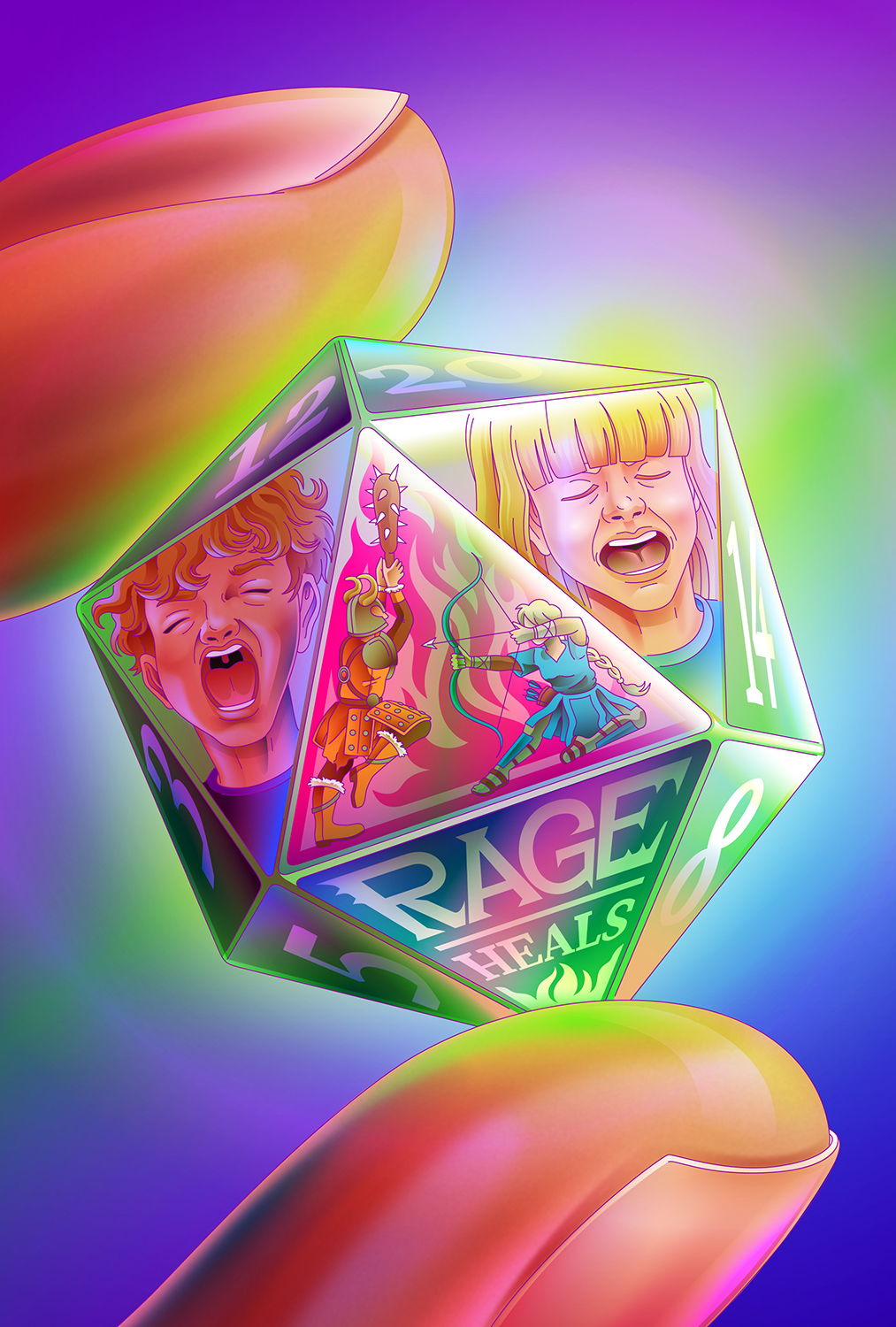
This time, I go off-type. A wood elf barbarian, with an acolyte backstory. Servant of the goddess Angharad, who’s got anger right there in her name. Thrown out of her temple for being too destructive, too quick to draw her glaive against the forest’s foes. She’s one part ecowarrior, one part #femalerage. She likes to hit stuff. Her catchphrase is “rage heals.” She gives zero fucks. She isn’t pretty; she’s maybe a little butch. She’ll wink at Tiefling warlocks, rogues of any gender. Cross her and she’ll pierce the patriarchy and your guts. I name her “Bitch Briar.” She has an elvish name, of course, but she won’t share that until you earn her trust. Or maybe never. She has negative charisma points.
Bitch Briar is glorious. Bitch Briar runs headfirst into hordes of zombies. Bitch Briar is everything I never knew it would be fun to be.
I ask this male gamer what it might have been like if his mum had played along. “I guess I wouldn’t have minded,” he says, “and probably would have appreciated any efforts she made.” But, he is quick to add, he thinks “a dad is better suited to channeling and marshaling that boyish energy and making sure that it finds fertile soil.” He wishes his own father, for example, had intervened in such a way with him. “You like playing Paladins, son? Well, the modern-day Paladin is the Athlete, or the Soldier. So if you admire the Paladin, do your best to become one; try out for wrestling, come with me to the shooting range…” To this man, his boyish love of sword and sorcery, of magic quests, was pure “male power fantasy.” A proto-urge that should be nurtured, shepherded through sport and physical dominion, out of fantasy adventure into manhood.
My philosopher husband has no interest in any of this; my boys are stuck with me. Add this to the list of ways I’ll come to harm my children. Like erupting, on occasion, in emotional excess. Now I will somehow thwart their masculine fruition. Their deepest little phallic drives.
“I don’t think that any parent should ever come between a boy and his Will to Power,” the male gamer says. My husband reassures me that our kid’s “Will to Power” has never been in peril. Whether killing orcs or knitting doilies, our boys will be just fine.
And if their mum becomes their Dungeon Master?
I wish it hadn’t taken me so long to get here. Then again, my life has never suffered for the lack. It has been rich and full of other, probably more palatable pursuits: whole thwarted acting careers, a decade of tango dancing, graduate school. I’ve written books, had children, traveled a decent sliver of the world. Do I wish I’d done D&D at fourteen and kept on doing it? Hung in like the guy in Ontario who has been running a single basement campaign for forty-three—plus years? (He holds the Guinness World Record for longest homebrew game, complete with massive model sets and 30,000 hand-painted mini figures.) Maybe. Had I but world enough and time. I’d do it all, be all these facets of myself at once. But does some part of me feel, now, like I’m coming home, ready to reanimate that tubby preteen kid with no pals but the hand-drawn Aurebesh alphabet hung up like bunting on her walls?
The male gamer says it’s necessary to outgrow it. Fantasy, and role-playing games. A kid should drop his sword—duct-taped, wooden, or imaginary—and pick up a baseball bat, a soccer ball, a rowing oar instead.
“For me,” says GamesMaster presenter Dominik Diamond for the BBC in 2004, “it’s the sheer time-devouring pointlessness of it. These are not stupid people. These are people who should have been out curing cancer…instead, they’re pouring their massive brainpower into whether they can use the Golden Rat Wand to get past the towers of Weetabix.” Kim Newman, the presenter of the program, asks whether adult D&D enthusiasts were, perhaps, “just boys who never grew up”? And that’s the worry, right? That our kids, once bitten by the necrotic ogre zombie, will live forever in their basements, obese and unfulfilled, becrumbed in cheese doodle and vitamin-D deprived.
But smart people have big imaginations. You won’t find a boring person or a dunce around a gaming table. The biggest intellectual snoot I know, another philosopher—a “model student” all his life who has, occasionally, even lifted weights—played D&D before he could read and makes time in his busy weeks of lecturing on Kant to DM his own online campaign. I have watched this man eviscerate an interlocutor. I have also watched him unironically inhabit the character of a bemused hag. He plays with academics and civilians, all very clever—though one who, like my kid, has both dyslexia and ADHD and was considered “thick as pig shit” all through primary school. They’ve all found something worthy in the dungeons and enchanted forests of the Forgotten Realms. It’s fun as fuck to banter, battle stuff, and in so doing tell a good tale of an evening. None of them, least of all the women, feels compromised in masculinity. “I played sports,” one says. “You can do both, you know.”
Fantasy doesn’t only have to be the province of the dorks. We all could learn a thing or two from nerds. As a fellow literature lecturer put it to me: “I think if a few more people had played D&D, we might be in a better situation.” Meaning, the world. “Because it says that choices have consequences, and you have to work together. It also says that winning or losing is less important than telling a good story. And that, despite all its many problems, is the fundamental thing about D&D.”
Maybe fantasy RPGs won’t sweep the hamlet of Garvaldia. (Though that same literature lecturer said he’d “absolutely read the novel where some young professionals move into a village and suggest D&D for a social night and Doris, aged seventy-three, who is the treasurer for the community hall, gets incredibly into it and ends up destroying Richard who lets his hedges grow too high with a level-18 night elf.”) But it can have its place in my house, on my kitchen table, with my kids.
My kids, with their rough-and-tumble inborn lust for sword fights, pillow battles, magic duels. I have failed, since they were tiny, to understand their little engines of aggression. Possibly to the point of shame. We fear most what we do not understand.
I see now I am on a quest for my kid’s soul. To convince him that being weird—as his bullies love to call him, and my bullies once called me—is a good thing, a worthy thing, and will always make a better story. A fantasy-adventure story, maybe, with a snazzy cover and a hand-drawn map inside. The gentle parents can have their mindful coloring. I’ll be over here, swinging my glaive alongside my battle-hungry little weirdos, taking it one monster at a time.
“That’s just boys,” I’m told, and bristle every time. I’m trying to be a good progressive parent here. Not for me, the gender-essentialist norms of a more ignorant age. I refuse to believe that my kids process their emotions via, as Ruth Whippman put it, “a vehicle-only narrative reality” downstream from “preschool masculinity norms.” Or “the implication that boy biology is so distinct and nonnegotiable that one must simply survive it.”
And yet my boys are walking, talking, truck-bashers. It’s possible that in nurturing their emotional intelligence, in making space for feelings and connection, in pivoting to “treat them more like girls,” I’ve been ignoring very real and very gender-neutral needs for rough-and-tumble play, for that release. Especially in my eldest, who spends a great deal of his life conforming so as not to get in trouble, not to fall afoul of comportment norms. In his words: “holding my crazy in.”
The male gamer refers me to The War Against Boys, by Christina Hoff Sommers, but I refuse to buy the argument that making space for my kids to feel and communicate emotion, to learn the nurturing complexities of care, will make them thwarted boys, and later incomplete as men. There are so many things a “real man” can grow up to be. With room for feelings and fantasy and bashing stuff with sticks.
I will never say my eldest likes to hit things so much because he is a male child, but I can understand it isn’t aberrant. It isn’t pathological. I can understand him. The irritating way he’s always ripped off every sticker label, snapped every craft material, de-handsed every Lego figurine. He feels a body need to break things. So, too, his aggressive play: “Pretend I stabbed you with my fire blade. Pretend you explode.” He feels a deep and rootless need for battle, for control. I have two choices: continue to try and course-correct him every time he uses combat language in imaginative play (“Why not just negotiate, consider the bad guy’s feelings/childhood trauma…”), or gift him a multiverse of bugbears, mummies, manticores to fight, all from the safety of the game table. Even, perhaps, to join him there.
“Mama, remember that time you did a backflip off the cliff and stabbed the zombie in the head? That was so cool, Mama.”
It’s possible, I think, through fantasy, through RPGs, that I can come to know him better. To meet him in the epic battlefields of his imagination and learn to fear them less.
Besides, D&D is good for you. I said that, right? Role-playing games increase creative thinking, assuage social anxiety, and can help autistic kids connect. Dr. Wayne Blackmon used D&D as a treatment for a suicidal young person in 1994 and argued that the gaming structure gave his patient the chance to “explore their mental dungeons and slay their psychic dragons.” The imaginative structures of role-playing games can even, according to research led by Dr. Jennifer Cole Wright, “function as an engaging, interactive ‘moral training ground,’ a medium that promotes moral development, and highlights the difference between antisocial and prosocial violence.”
To quote Bitch Briar: “rage heals.”
D&D is violent by design. The game telos is generic-medieval-but-make-it-late-stage-capitalism. You fight to win (or die), and then you get stuff: gold coins, treasure, “points.” Combat is embedded as the primary mechanism of the plot. Critics say this encourages building characters mostly for their battle stats (how hard they can hit, how much damage they can sustain), and that it can lead kids “to relish ‘killing the bad guys’ as fun, exciting, and satisfying.” (The twisted sister of my barbarian might say: violence rewards.)
Licensed clinical mental health counselor Katie Lear, also a registered drama and play therapist, disagrees. She cites a “play-fighting quota” in kids and notes that there are few opportunities for safe “aggressive play” (intellectual, emotional, or physical). She sees D&D as a fertile space for kids’ expression, particularly neurodivergent kids, and particularly for “paradoxical intervention”—which is a fancy way of saying: prescribing more of a “problem behavior” rather than proscribing it. Lear runs therapeutic D&D campaigns for kids and finds the game invaluable for building social-emotional learning, giving kids “a skill set they can use to connect” in other contexts. There’s safety in the structure of the game, with its fixed patterns and roles—not to mention infinite, encyclopedic reservoirs of lore. There is also social and creative freedom to be and do the things that most kids often can’t.
“D&D is great for a kid who feels a need to be in control,” Lear says. And often, when a kid gets permission to, say, belch black acid or wallop every character they come across, the impulse (to express violence) lessens, broadens out into a “wider repertoire.” Kids break out of the typical roles they “play” in real life and the burden of those expectations. The fantasy at work is maybe not the violence but the agency.
But, yes, in Dungeons & Dragons, you kill monsters and then take their loot. Katie Lear herself runs one group she and her patients lovingly call “Murderhobo Island.” That’s D&D—perhaps not for the gentle or the meek. Ideally, these kids would play a different game (and there are others out there), but for now, it’s this. It’s gold and gory death. (The heart wants what it wants.) But even in the melee, there is goodness, growth. There is “genuine play.”
Most people who played D&D when they were young will tell you it was formative—nay, a force for good. Most will admit its flaws. D&D is deeply problematic. As fantasy scholar Emma French writes: “D&D…endorses and secures certain perceptions of genre. It presents presumed universal touchstones, that in their very assumptions of universality, entail a set of biases.” Namely: white and male. This, of course, is downstream from the genre greats. I can’t read Tolkien, for example, to my children without explaining how darkness is a clumsy metaphor for evil. And how even the good guys get it wrong.
Progressive homebrew campaigns have always tried to sidestep the racism and misogyny baked into D&D, working around the structural issues, leaving the game shape and the stats intact, all things crucially comforting to kids who like that feeling of control.
Even a game that, according to DM Brennan Lee Mulligan, was supposed to be “the evil one,” Dimension 20’s Escape from the Bloodkeep, an actual-play parodic spin on Tolkien featuring the six most loyal, loathsome generals of the fallen Lord of Shadows, broke good in the end. French describes how Bloodkeep’s focus on traditionally unplayable genre-culture antagonists “challenge[d] the innate morality within D&D, cultivating sympathy through assigning subjectivity to the besieged monstrous Other,” most notably the female drow drider played by Erika Ishii. French writes, “the presentation of female agency as a positive force…enables the story to subvert its presumed conclusion, swapping competition for collaboration,” and turning the envisioned player-versus-player finale into an oddly tender moment where the players just refused to fight.
French cites Jessica Hammer’s framework of primary, secondary, and tertiary authorship in role-playing “texts,” and documents many instances of secondary (DM) and tertiary (player) “authors’” influence on the primary text (the game itself), changing it for the better. The most recent Player’s Handbook, for example, edition 5.5, replaces race with species, and reallocates ability scores to background, removing the eugenical mechanics of character creation. She argues that “subversive” and “actively progressive” readings of fantasy genre-culture do exist in D&D, “and may even be radical, challenging the white privilege and hegemonic masculinity which has characterised both vocal parts of fantasy fandom and the white, Westernised-US hobbyist communities from which D&D was conceived.”
There are real issues in this game, as there are real issues in the world. D&D cemented and perpetuated some of these issues and wrote them into lore. But lore can be rewritten. The game can be rewritten. The DM is important, sure, but a game is only as good (or evil) as its tertiary authors—as its players. The task, then, is to raise good players. The kind of players who will write a better version of the world.
The bookstore DM calls my children “chaos gremlins.” He’s not wrong.
“They’ll grow out of this, I hope?”
He shrugs. Maybe they will. Or maybe they’ll be problem players who blast through walls of narrative with wanton violence, embittering their fellow players and DMs. To play this way would be to side-punch the collaborative point of D&D. The gameplay built on consent and consequences, where there’s no winner, no real end of play, and where the stakes on paper may be life-and-death, but all that really matters is the story being told. The story you and half a dozen friends (or strangers) write together, like little novelists, or improv actors. Where the right answer is always “Yes, and…” where the and doesn’t always lead to killing stuff. The game can teach this, helping kids with “main-character syndrome”—kids like mine who need to be the center of attention—to learn how to, as the DM put it, “yield the floor.”
“You hope that all their characters will have an arc,” he says. (As does every parent, of their child.) A good DM will help to shape that arc, giving each kid a chance to feel useful or significant—and, above all, to have fun. There are terms and mechanisms for this, in the game as in parenting. In D&D it’s: “Shoot your monks.” In parenting, we’ll see.
I don’t like Bitch Briar. She is fun, but equally uncomfortable to play. She’s not my id and not my fantasy. But she helps me understand my kid. I chose her for her violence. I chose her for her rage. And as I play her, as I get to know her more, as I slit a zombie with my kill shot stern to stem (genitals first), I think maybe it does feel good to be “a little bad” (sometimes).
I’ve spent a lot of time in the Forgotten Realms of late—with kids and adults, indoors and outdoors, in books and on the internet. I knew stuff about fantasy and now I know stuff about D&D. If nothing else, the game has brought me closer to my inner preteen and my eight-year-old.
I see now I am on a quest for my kid’s soul. To convince him that being weird—as his bullies love to call him, and my bullies once called me—is a good thing, a worthy thing, and will always make a better story. A fantasy-adventure story, maybe, with a snazzy cover and a hand-drawn map inside. The gentle parents can have their mindful coloring. I’ll be over here, swinging my glaive alongside my battle-hungry little weirdos, taking it one monster at a time. Maybe this, for us, is what “sensitive, attuned parenting” looks like. (Roll a D20 for a Wisdom saving throw.)
Maybe D&D will teach him moral understanding. Maybe it will teach him to take turns, to cede his ingrained urge to win. Maybe the dice will teach him to accept the things he can’t control. Maybe adventuring with other little weirdos will help him feel more loved and seen. For the deep, sweet kid he is. He has a whim for mortal combat…so what? Maybe battling these pretend monsters will help prepare him to resist the very real ones in the world, beyond the borders of Garvaldia and much closer to home.
Maybe it will teach him to stand up for what is right, protect his friends, and learn, hour by analog hour, how his generation gets to write their own collective narrative in the dungeons we’ve wrought and stocked with evils under every corner of the Earth. He is free to choose his calling, choose his quest—even if it scares me, even if it looks different from my own.

Meghan Flaherty is the author of Tango Lessons (Mariner, 2018). Her essays have appeared in VQR, Hinterland, O, The Iowa Review, Psychology Today, Parents, and online at The New York Times, The Paris Review, Slate, and elsewhere. She is a lecturer in creative writing at the University of Glasgow.
Ari Liloan is a Filipino Italian illustrator based in Berlin and Hamburg, Germany.