Image

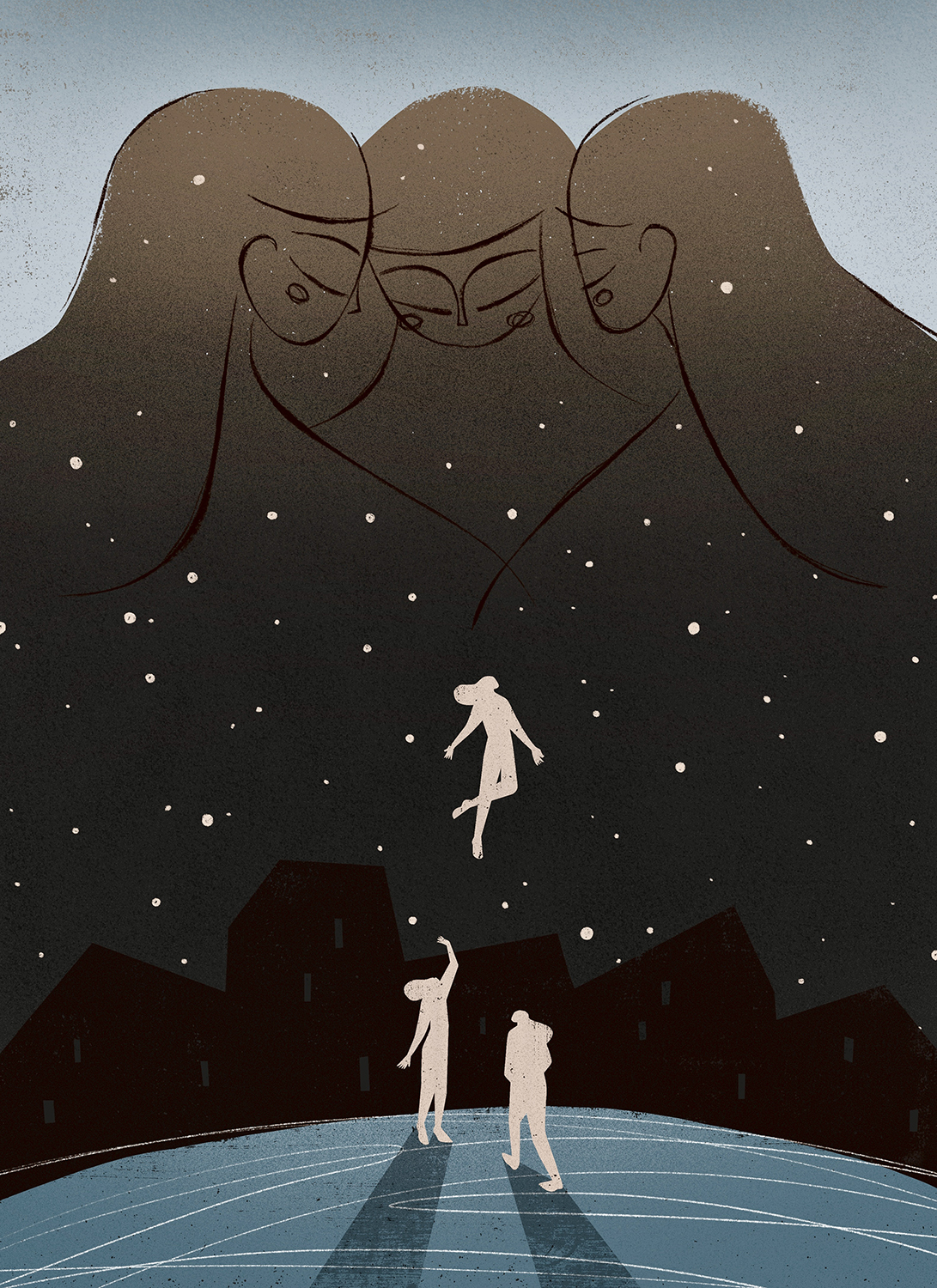
The first thing I must tell you is that all three sisters are born on the same day in December. Every other winter, without fail, out they come, like a foot stamped three times in the dark. When the third sister, Anna Ivanovna Bondareva, emerges just before midnight on the 16th of December 1987, the mayor himself is notified. His sleep interrupted, he is moved to tears by such coincidence.
“Impossible,” he murmurs to his wife lying next to him. “What are the chances?”
The polar night is endless; one must celebrate life’s little impossibilities. The mayor orders half of the fireworks reserved for the New Year’s celebrations to be set off at once. Little fistfuls of fire pop and tremble against an infinite sky. People peer out their windows. The future has come early this winter.
In Siberia, north of the Arctic Circle, it is always winter. Always, always, always. Until suddenly it isn’t. For nine weeks a year, the tundra grows thick with mosquitos, and the sun beats down upon a black-and-blue landscape devoid of trees. The winter isn’t the dangerous time; during the dark months, there is a sense of purpose, of belief—to resist death is to embrace life. No, it is that brief window of summer: relentless, manic, without reason. Everyone believes in their own superpower. I can swim across the sea. I can touch the stars. What stars? There are no stars, for the sun never sets.
On summer nights, as the sun hovers low in the sky, the Bondareva sisters lie on the roof of their apartment building—the light smeared across their bodies, everything moving in slow motion. Particles from the factories drifting like tiny spaceships. Their building has just been painted a horrendous shade of pink by the city administration. The government says it is to prevent color blindness during the long winter. Their father says it is an act of greed.
“It looks like a dick,” says Masha, the eldest. They lie head to belly.
Katya laughs. On her stomach, Anna’s head bounces like an egg.
“What’s a dick?” says Anna.
Katya laughs again.
“The dick,” says Masha, “is the dick.”
A new word. Is it one of their own? They possess a secret language. A private tongue of clicks and vowels only they can understand. Every word both a noun and an adjective. A thing and the thing around a thing. Zlēēslo means “perfect,” means the whole world fits inside this moment. Tikālima means “itchy.” Hēēso means “You are the worst person alive, possibly ever.”
They find the sounds in their pockets, beneath the peeling plaster of the stairwells, inside the drup drup drupof a leaky ceiling into a bowl of cigarette butts. The sounds are quick little things, eyes rolling in sockets, something in between the mew of the feral cats that haunt their courtyard and the puckered caw of a crow.
“Nikō nikō!” they say, and laugh at such truth.
Around them the country emerges from its own sixty-year winter and becomes Rossiya. Перемен требуют наши сердца. Our hearts demand changes. But are these the changes we demanded? Men become rich. The shops fill with Montana blue jeans and Kinder Surprise and vacuum cleaners and high heels. Anyone can be anything.
Only their language remains theirs. Pillskā, they say. It means: “Everything, everywhere has always been fucked.” They say it with great confidence.
Pillskā, they say. It means: “Sing loud, because now will never happen again.”
Anna is their protector. It should have been Masha, the eldest sister, but she is turned inward, like a flower never bloomed. Masha carries a small inhaler for her asthma, made worse by the poison air of Norilsk.
One morning, Anna comes into the bathroom and finds Masha sunk beneath the water. Anna waits. Her sister will not come up. Her fingers blue like eels. Anna grabs her head, pulling. Masha rising, gasping, furious.
“You should have left me,” she says. Then: “Hēēso.”
Katya is the wolf. She lopes, she leaps, she pants. Everything effortless. The world parts for her beauty, and so she grows lazy. She does not bathe. She mixes truth and fact. She is twelve, fifteen, nineteen years old. She is Chukchi, Swedish, Japanese. She is the child of a swan. She lies so she can feel where her skin ends and the world begins.
There is never enough distance between the three for them to grow apart, and so they are never apart. Together they run through the empty lots filled with piles of black dust and broken glass, out past the city limits, pounding across the tundra. The soil wet, waiting. Dig with your hands and find the earth frozen beneath, even in summer.
Above, plumes of smoke. The rivers and streams crimson with minerals from the factories. You can swim in the lake any time of year; the pipes beneath keep it from freezing. People say the water is filthy, unsafe to enter, but the girls do not listen because the future is no friend of theirs.
There is a place only they know about. They discovered it the previous summer, in the hills outside of town. A cement egg, half-buried in the ground. Huge—large enough for a full-grown dragon to live inside. The egg has a large “82” painted on it and is shattered at the top, as if a giant has tapped it with his giant spoon. They find an underground tunnel into the egg hidden by a few rotten boards which they smash with masterful kicks. Inside, a circle of water, strangely warm. A pool. Their own private world.
“This is Muzhitō,” says Katya.
And who is anyone to argue? They quickly establish the rules of Muzhitō: Everyone can fly; there are no queens; at any moment the dragon may come back to claim what is his. They spend the rest of the summer in their egg, and when winter comes and the snows grow impossibly thick, they wait for the next summer when they can return again.
They sing songs of Muzhitō. Listen to the wind. Listen to cassettes of Kino. Listen to their mother yell at their father. Listen to their father’s cough. Listen to the heaters tick and hum. The rustle of paper. The sizzle of their neighbor’s radio, left on since their birth.
It is late May. The darkness is almost all gone, but the tundra is still cool to the touch. Winter backing out of the room slowly. A guest overstaying his welcome. They make a picnic of bryndza and black bread, bring their novels and head out to the egg. Humming the first notes on Earth. The factory smoke like long signatures across the sky.
It is as it always was, except for a thin line of sloppy blue graffiti: Невыносимая легкость бытия.
This is not their language. They duck through the tunnel, push aside spring cobwebs, fold their clothes next to their boots, then underwear, books on top. Bodies naked and pale. Anna braces for the bite of the water. Katya slides in like a seal.
“It’s nice!” she says. Anna wades in. It is nice. Warm in ways she will not think about. She looks back at Masha shivering on the cement bank.
“Aren’t you coming?”
Katya begins to sing Kino’s “Группа крови.” The words echoing off the side of the egg. Light spilling through the crooked opening above. After a moment, Masha joins in, Anna too. They jump. Beating the water with palms, Katya is singing into a microphone, pretending she is Viktor Tsoi, Kino’s lead singer.
“Группа крови—на рукаве,” they sing. (“My blood type is marked on my sleeve.”) Eventually they grow quiet and soak in the water.
The egg gives life to all who enter.
Anna feels a sting across her chin.
“Agh!” Her fingertips come away red.
A splash…another. Stones? She looks up and sees heads peering down upon them. The heads duck behind the cracked edge of the egg. More stones come raining down. This secret is no longer theirs alone.
“The dragon!” she says. “Run!”
They grab their clothes. The heads above them are back. It is not the dragon, but boys. Night creatures.
“Шлюхи!” yells one. Whores.
“Pозовая!”
A sharp thump. Masha cries out. She stumbles, holding her forehead. A stone the size of a lemon at her feet. A thin tendril of blood slides down her forehead, curling into her eyes. She looks up at Anna, her expression blank. Anna knew this moment would come: Masha will disappear into the water and never come back.
Anna feels every hair stand on end. Her vision clenching. Her legs suddenly feel light, no longer tethered to the earth. She looks down. She is rising up. Beneath her, Katya squeals in amazement. Anna is rising up and up, up to the top of the egg, through the opening, the clouds white and wandering above her, and there are the boys, scrambling down the smooth side of the egg like flies on a carcass. They slide onto the ground just as she lands beside them. She is wearing only an unbuttoned shirt. They see her, fall silent, drop into formation.
She takes a step.
“Never come back here,” she says.
The boys shuffle nervously, stealing glances at her body.
“I will break you,” she says. “I will tear you open.”
Certainty. Like stone. She can tell they believe her. They have seen what she has done. They want to laugh but they cannot. Finally, one of them spits.
“We go wherever we want,” he says. Then: “Suka.”
She runs at him, hits him so hard she can feel the delicate ridges of his teeth beneath his skin. His cry is a wet, young sound. She is on top of him, beating his face. She is lifting him into the sky, breaking his bones. The boys scatter in all directions. He is weeping like a kitten as she takes him higher and higher, into cloud and smoke.
“Please,” he whispers.
They enter the atmosphere. She pounds him and pounds him and pounds him until she feels hands upon her. Masha yelling, “Stop, Anna! Stop!” and she is pulled back into herself, back to what is left of this Earth. On the ground next to her, the boy whimpers.
Masha’s face is smeared with blood. A shirt is wrapped around her head like a turban. She looks of the wild, of the deserts beyond. Raised without kith or kin. Anna’s first thought: I have never seen you with such life.Masha helps her up. Anna stumbles. She can barely stand, her body suddenly heavy. Katya holds her steady. Masha in her turban touches the boy’s forehead once, like a wartime nurse, and then leaves him.
They walk back in silence, bleeding, winding through slag heaps and the carcasses of old factory trucks. Above, hawks dive into the scrub. Katya begins to hum. The rows and rows of buildings coming into view. Pink, gold, and blue. A fever. There is the river, the smokestacks, the wishbone of the mountains.
Finally, Anna says, “Did you see it?”
She can tell they are scared of what they saw. She does not ask again.
Masha needs stitches. The cut on Anna’s chin leaves a little scar the shape of an eye. Sometimes, she strokes it, absently, and remembers what it is like to rise.
They never return to their egg. Muzhitō is dead. Later, they hear it was built to launch missiles into the USA but was never finished. They don’t believe this story because Norilsk is too far from the USA, too far from anything at all.
In winter, the snow is stitched with black from the nickel dust. Sometimes it is so cold you cannot open your mouth, or the spit will freeze against your teeth.
One winter, the snow is deep enough that the city has to dig tunnels. A city within a city. Air holes punched every ten meters. Little windows to the sky. The curve of streetlights humming at all hours.
Somewhere in the snow tunnels, a man plays an accordion, his hat filled with a few coins. A woman in fur walks by, murmurs a blessing. The sound of ice in the bellows. The crinkle of snow beneath her boots as she continues on her way. He finishes his song and the tunnel settles back into a stillness within a stillness.
Each year, their collective birthday signals the beginning of the beginning. Soon, the calendar will turn. This is the time when the sun does not rise. When the morning is blessed only by a gray-blue glow leaking from the horizon. Take heart! You grow to understand what the darkness wants from you. The polar night is a mood. A motion of the hand. A dance done in front of the mirror. Light the lights. Stay warm. Slap the thighs. Keep moving.
It has become a custom for the sisters to stage a play on their birthday. Then cake. The cake is never very good, but they pretend to enjoy it because this is what one does. When they were very little, they used to dress up like foxes and march beneath the streetlights, and the people would come out and wave at the Bondareva sisters who had blessed their town.
One year, their father points to the sky and says, “There, there is the archer.” And they squint and squint, and Anna says she can see it when the truth is she can see nothing.
They no longer march; the people no longer wave. But each year there is still The Birthday Play. No one is invited to these plays. It is only the five of them, huddled inside their living room. Masha is the playwright. Her plays are based on Krylov’s fables: “The Eagle and the Bee.” “The Stone and the Worm.” “The Fox in the Ice.”
Katya is the leading lady. She requires her own dressing room: the bathroom. Anna does as she is told, but she is the engine. Without her the curtain will never go up. The curtain itself is a blue-and-pink sheet from their bedroom raised and lowered by shoestrings. The five chairs of their apartment arranged into two rows. Now Masha and Katya are arguing. They will not play a Kino song at the end. The play will end in the question mark of silence. Katya quits, pouts, joins again.
Curtain up. A forest scene. Out comes an Eagle (Katya). Out comes a Bee (Masha). The Eagle is haughty. The Bee is generous. In Masha’s hands, Krylov becomes very dark. Every play ends like this: The Eagle dies. The Bee dies. The prince dies. The queen dies. Curtain down.
“How about a fairy tale?” says their mother, drunk, drinking. “Everyone is ready for a happy ending.”
Ivan Ivanovich, their father, sitting on the couch, smiling.
“Happy birthday, girls,” he says. Out comes the cake that tastes like it was found in a closet. Their father gives them each a perfect copper cube.
“It is worth money,” he says. “But this is not the point.”
They stack the cubes with the others.
Their father is the one who teaches them to read. He reads them the fables over and over: “The Wolf and the Cuckoo.” “The Fox and the Marmot.” “The Monkey and the Spectacles.” His scent upon them, the animals peering over their shoulders.
“Again!” they say because they know he must go.
And he begins: “Very early one winter morning, during a hard frost, a Fox was drinking at an ice-hole, not far from the haunts of men.…”
He is rarely home. The whites of his eyes always pink from the smelter’s dust. He is missing the tip of his thumb on his left hand. When he reads, Anna caresses the little stump left behind. He doesn’t seem to mind.
“I gave it away,” he says when asked about it. This is not true. Before he came to Norilsk to work at the smelter, their father used to push cargo at the Saint Petersburg docks. His thumb crushed to smithereens by a shipping container. At least this is what their mother says. Smithereens is her word. She has been wrong before.
During the night, they can hear him hacking into the darkness. In the morning, Anna looks in the sink and finds a black thing suspended in a pool of blood. A little snail of a creature.
I have come from inside him, says the snail. There are more of me.
“No,” says Anna, sluicing the water, and the snail and the blood slip down the drain.
In the smelter, their father uses a tube to breathe. He brings it home each Friday, and their mother washes it with a special brush, leaving it to dry on the rack. One day, Anna steals the tube, still dripping, and hides it in a secret space behind their bathroom wall. If her father does not have his tube, he cannot work. This is how a story works: “The Wood and the Fire.” “The Frog and Jupiter.” “The Father and the Factory.”
Their mother is furious when the tube goes missing. She threatens suffering beyond their wildest imagination. Their father is calm. He will get another.
“Things disappear,” he says, holding up his thumb, generous in its absence.
On Monday, he is back at the factory again.
He reads to them because he does not know what else to do with his girls. Sometimes he reads to them in English. They barely understand, the words like a dream. He is the youngest of five boys. He was born the day Stalin died, has always felt somehow responsible for his death and so, in spite of himself, he loves the man like a lost uncle. He has survived like everyone else: by thinking one thing but doing another.
He works because he does not know what else to do with his country. He has seen the slow descent of time. He believes in God but has never prayed. He knows the names of all the constellations. Sometimes he draws pictures of birds in a little book he keeps by his bed.
In the winter, he takes his girls skiing. The sky is dark, like a bruise. The slope lit by lights. One of them blinks. Who will ride in the chair with Papa? They alternate for the pleasure of his silence. The wind blows so hard the man at the top says they must close the mountain. The air thick with snow. Snow in their lungs, snow filling the little bowl beneath their brains.
“Follow close,” he says. And they ski like a snake, making tiny turns until they are down.
In the afternoons, they go to gymnastics practice. Katya has the talent to be a professional but can’t be bothered to practice. Masha is stiff. She is good at the bars. Sometimes she spins around and around and does not dismount until the coach blows his whistle again and again and scolds her for not paying attention. Anna is too busy watching the others to ever come in first. She would make a good coach, she thinks, blowing her whistle again and again.
They get home before he does. They hear the click of the door. He hangs up his coat, slides on his slippers, heads to the shower. When there is no hot water, they hear him swear, very quietly, and they are afraid. When he is in a good mood, he hums, pushes at the hollows of their cheeks, touches their teeth.
He tells them he was in the Navy. This is how he met their mother. The ladies were getting a tour of the ship in Saint Petersburg.
“And she found what she was looking for,” he says.
“I wasn’t looking,” says their mother.
“She wasn’t looking,” he says.
He shows them how to tie knots. Double Overhand. Lark’s Head. Rolling Hitch.
“Stop fooling around,” says their mother.
“Again!” the girls say.
When Anna turns nine, they get a new color television. Their father is reluctant.
“This is what we have traded our souls for,” he says and switches on the box. On comes Yeltsin waving to a crowd, and their father snorts. There are six channels, one of which is a live feed of the nickel plant. Trucks move back and forth.
They watch quiz shows. Documentaries about swans and jellyfish. American films and sitcoms dubbed into Russian. Rain Man. Friends. Full House. Married… with Children. Lips do not match words. Even the laugh track is changed to Russians laughing off-screen. She knows this because when Russians laugh, they do so with great effort, as if they are lifting weights.
Anna plays with the aerials, sweeps the dials and one night stumbles across something miraculous. A hidden channel. A film in English. The new language flaps like a bird trapped inside the house. Their father acts as translator, though his English is shaky. This is what he tells them: A young man and an old woman drive around in a hearse, attending funerals. The old woman gives the young man a banjo. The young man falls in love with the old woman. The old woman commits suicide.
The credits roll.
The girls weep and quiver.
This secret channel becomes Anna’s refuge. It only works when the weather is clear and the wind is just right. On most days, the signal cannot penetrate Norilsk’s shield of pollution. But every now and then they get lucky, and from out of that fog of static figures appear, a line of dialogue surfaces.
“It’s on!” she will yell. She decides the channel must be for the American scientists working in the Arctic. These scientists like kung fu films and especially old comedies. The Marx Brothers. Three Stooges. Buster Keaton. Cary Grant. Lauren Bacall. She learns to talk like Humphrey Bogart, out of the side of the mouth, like a bear. She has always been good with new languages. They come to her easily.
“Oh, he’s just like any other man, only more so,” she says in English, and, for a brief moment, anything seems possible. This is Zlēēslo.
Anna will never forget the time their father lets them visit the factory. He tells them Norilsk is a nickel town, so the copper plant doesn’t get any respect.
“But we are more profitable,” he says. “And look at the periodic table. Nickel is number 28. Copper is number 29.” They already know this. Every classroom in Norilsk has a periodic table of elements on the wall. It is what you stare at when your brain is tired of questions.
They take the bus out of town to the plant. The air is tangled with soot. Outside of town they pass a new building with no windows.
“The blood bank,” says their father. “In case we ever need more.”
It looks like a large, black cube, descended from outer space. Like one of their copper birthday cubes.
“I’m a universal donor if you ever need some,” he says. “You know your blood type, right? Everyone gets a card when they’re born.”
Masha nods, but it is clear she doesn’t know. Anna has never seen her card. What else is on this card?
“The curse of the universal donor is that he can give to all but can only receive from one of his own.”
“I’m a universal donor,” says Anna, and it may have been the first lie she has ever told. Or not.
He shows them the train that comes in from the hills, full of black and yellow rocks. These are from inside the Earth, he explains. There is copper inside, but they must find it.
“Nothing is for free,” he says very seriously and then sees their expressions and laughs.
“Rocks!” he says, and they try to laugh too.
Anna looks at her father. He is smiling, but a part of him seems invisible, as if he is fading away. He is not a thing. He is the thing around the thing.
At the factory, they put on blue suits. The suits are too big for them, so they must roll up the sleeves. Their helmets come down past their eyes. Anna can only see people’s feet. Their father shows his daughters off to the workers. The men cluck and whisper to themselves, pointing to parts of their own bodies. Anna hates these men. She hates their feet.
They shuffle through tunnels, duck beneath pipes. The machines clunking with great gusto. It becomes clear the factory is a giant animal that must be fed. Their father is very proud. He points to valves and levers and says words they have never heard before.
“This is where the rocks are crushed to dust,” he says. “Don’t breathe.”
They do not breathe.
He takes a little dust from a basin and puts it into each of their palms. Katya recoils as if she has been stung. Anna’s vision swims. She breathes. She hopes this is okay.
In the next room, the dust is put into a soup that bubbles and churns. The factory is filled with these pools. The smell is terrible. Dragon farts.
“Don’t breathe,” he says. “Sulphur gas.” He hurries them along.
He shows them the smelting floor. A huge room. Big enough for a whole town of dragons. The dragons would like it here. They could fart as they pleased. He gives them glasses so they can look into the depths of the furnace. So hot it moans. The noise is unbearable. Katya claps her hands on her ears and begins to whine. Masha looks strangely happy. Their father says something they can’t hear. A large bucket on a chain is lowered into the molten ore. It lifts into the air above their heads and then pours its lode down the chute. Steaming, white organ-blood of the earth. They cannot look away.
In the cafeteria, they eat ice cream.
Men sit with their helmets on the table, staring at the sisters. Anna’s eyes still hurt from looking into the white of the furnace.
“I don’t like it here,” Katya announces.
Anna squirms. She glances at her father to see his reaction. Masha is silent.
A big man with a patchwork beard and black eyes comes over to them. “Very, very beautiful girls,” he says.
“Thank you, Grigor Illyich,” says her father.
When he leaves, Katya says: “I don’t like him. He’s practically a criminal.”
Their father smiles. Anna is just old enough to know that one day she will miss his patience.
“This is a strange time in this country,” he says. “I make more here in a month than many people make in a year.”
“We could live in Moscow,” says Katya.
“Moscow is expensive,” he says. “We would never have such a big apartment in Moscow. You could not put on your plays.”
“We’re not going anywhere,” Masha says to Katya, almost violently. As if to prove her point, she slips out her inhaler and takes a quick puff.
“How about we take a holiday this year to some place warm,” says their father.
“Italy!” says Katya.
“We’re not going to Italy,” says Masha.
“I read about an Old Believer who took his family to Tuva and never came back,” says Anna. Tuva is beyond the beyond.
Everyone looks at her.
“Is that where you want to go for holiday? Tuva?” Her father loves her. She can tell by the spaces in between his words. “My youngest, the Old Believer.”
“We don’t believe in anything,” says Masha.
“We believe in Kino,” says Katya. “‘Our hearts demand changes!’”
Their father smiles. “Well, I’ll go anywhere,” he says. “As long as you three come with me.”
“Promise promise?” says Katya.
“I promise,” he says.
A bell sounds. Once, twice.
“My girls,” he says. “I must get back to the rocks.”
Sometimes he will put on his records. It is unusual to have western records in Norilsk. You can buy some CDs these days, but most music is passed around on cassette. Copied and then recopied and recopied until the tape begins to wheeze and wobble. He says the records came by boat in the ’80s. Down the Yenisei River from the Arctic Ocean as though this is where all records come from. He won’t say who brought them. They are jazz, boogie-woogie, R&B, Elvis.
If they are lucky, he will dance. He will swing his arms like a baboon, like a man in love, and they will roll their eyes, and their mother will cluck at him from the kitchen. She does not approve.
“Come,” he says, motioning to his girls.
“I’m itchin’ like a man on a fuzzy tree,” he sings in English. “I’m in love, I’m all shook up!”
And they rise, reluctant and wooden. They stand there complaining about the music, but soon they are bopping around with him, they cannot help it, they are screaming and giggling as he swooshes them between his legs and, when it is her turn, Anna watches his hands, still soot-stained, even after washing. The half-thumb dances too. The cat, terrified, joyous.
At the table, they eat their mother’s attempts at cooking. Their mother is the person they will all become, and for this they quietly hate her. Her name is Anastasia Yuryevna Bondareva, but everyone calls her Snegurka. The girls call her Mama, but this is not the right word for her. Russian does not have a word for what she is.
In their own language she is Hoslā or Susēētus or Gōbt. They search.
She is beautiful. Long dark hair, like Katya. No: She was once beautiful, but she has been busy pouring water on her fire. Some mothers fall in love with their children. Some mothers resent their children’s innocence. Perhaps this is harsh—their mother did not mean to come undone. She teaches them everything they know, how to be a woman. How to get what you want, even when you aren’t sure what you want. And for this they are grateful.
She is an alchemist. She trained in chemistry in Saint Petersburg, but she has not worked in years. Or: She is always working because every day at 11:00 a.m. she makes her first drink. Their house is a negotiation of fluids. She goes through a bottle of vodka every eight days. This is the one truth. Anna counts the bottles in her notebook. Page after page of marks. These marks will one day be useful, she thinks. These marks will be used to solve the great mathematical problems of our time.
Once, when she pours out the vodka and replaces it with water, her mother becomes so angry she begins to scream in tongues. She blames Masha, slaps her as hard as she can. Have you ever seen someone slapped this hard? A transfer of energy so powerful that the frozen earth trembles, breaks apart, and the whole city falls into the magma that simmers beneath.
Masha’s eyes are watering, but she says nothing. She enjoys all of this. Masha and Mama are like sisters.
Their mother fears the night. Sometimes she dreams that her girls are coming to strangle her. She knows Russia depends upon its women. All of its men are drunk and dying, but she resents the men. Why are they the only ones who are allowed to drink and die? She wants to drink and die too.
There is a time in early evening when the balance is just right, when the drink comes into focus and she is not too cranky and not too cross. Sometimes Anna will tempt the fates and crawl into her mother’s lap. In an hour, she will be spiteful, but now she is like a lizard, happy and warm.
“Tell me about Saint Petersburg,” says Anna.
“It’s a pretty city,” says her mother. “Everywhere you look, there’s water. I used to love walking through the streets. Any house you see has a novel written about it. You can pretend to be whoever you want. I’m the czarina, bow down to me!”
Anna smiles, touches her mother’s hair.
“And the museums!” says her mother. “Even if you spent the rest of your life looking at everything in the Hermitage, it wouldn’t be enough. There’s a museum inside the museum.”
“We should go sometime.”
“Maybe,” she says. “But the city is cruel. They kill their czarinas.”
The girls turn thirteen, fifteen, seventeen. Boyfriends come and go. They buy an old Lada, which only their father is allowed to drive. One century rolls over into the next. Yeltsin resigns on New Year’s Eve. Vladimir Vladimirovich Putin, a little-known former KGB lieutenant, becomes president. Their mother claims she went to school with him in Saint Petersburg.
“Those cheeks haven’t changed,” she says. No one knows whether to believe her or not, just as no one quite knows what to make of the new president. He is firm. He doesn’t drink. He has a black belt in judo.
“I like him,” says their father. “He’s in the old style.”
Their father promises them a trip. To Saint Petersburg. Halfway between Tuva and Italy. The city might be cruel, but when Anna looks at her mother, her mother nods. She will show them the Hermitage, the museum within a museum.
In her mind, Anna packs her bag each night. She will bring her notebooks. She will bring the TV. She will bring plenty of rope. She will be the only one on Earth who knows everything inside the museum.
The second thing I must tell you is that their father gets sick. He coughs until he cannot breathe. An ambulance with a broken headlight comes to take him away. It is the middle of the night, but the sun has barely set. The light is neither here nor there. Anna imagines the ambulance with the broken headlight ushering him to the windowless blood bank out near the factory. Flushing him clean. Giving him a new life.
“He’s a universal donor. He can only take blood from someone like him,” she says to her mother. “I hope they know.”
Her mother doesn’t answer. Her eyes are dull but full of dread, like the eyes of a rabbit. She is looking for the keys to the car.
Their mother drives the Lada, fast then slow then fast again, the sisters’ heads jerking back and forth. Their father is not in the black blood box but a great big new hospital in Oganer, a giant cream-and-blue tower with endless hallways. They find him in a room that he shares with another man from the mines. The nurse informs them that half the hospital is filled with men from the mines.
“Will he be okay?” asks Katya.
“He’s a fighter,” says the nurse. “They all are.”
“Iskalōō,” says Masha. And this means nothing to them. Their language is gone. All language is gone.
Their father is pale and weak in his small bed that crinkles when he moves. He smiles when they enter. Coughs.
“Hello girls,” he says. “I’ve missed you so much.”
Their mother goes to him and hugs him for a long time. Longer than the history of time. Her cheek against his forehead. The sisters stare, shocked. The laws of the universe crumple. Love is possible.
The roommate coughs. Their father coughs. A machine beeps. Their parents disentangle. The universe returns.
This, then, becomes their life: the crinkly bed and the coughing and the tiny paper cups. The hallways that smell like old tea. Anna brings her father’s notebook of birds and gives it to him. He smiles.
“No birds in here,” he says.
“Draw me, then,” she says.
The girls circle and spin around him like moons. They sing him boogie-woogie. He taps his hand against the sheet. He itches like a man on a fuzzy tree. Language might be gone, but there is still this.
Their gravitation heals him. Maybe it is the boogie-woogie. Or maybe it is the air in Oganer, which is not downwind from the factories. After one week, their father is released. He must take three pills each day. The factory allows him to take two weeks off to recover his strength before he must come back and tend to the magma.
Two weeks! They cherish this time. Masha writes a play every day. Their father is cast as the Woodsman, the Bear, the Beaver, Time Immeasurable. Always the hero. Always the one who brings order to chaos. Anna thinks of showing him their egg, but the egg is no longer theirs, just as their language is no longer theirs. They speak the words, but the words no longer carry meaning. The sounds they make are blown like dust across the tundra.
“We’re still going to Saint Petersburg,” says their father.
“Promise promise?” says Katya.
“Promise promise,” he says.
One day that spring, Anna is in math class. Her teacher, Ms. Nekrasova, clacks out numbers on the chalkboard as she tries to teach the class calculus. Anna already knows calculus. She studies a hole in Ms. Nekrasova’s stockings. She tries writing a sentence in English:
Every time a bell rings… A line from her Arctic station. An angel gets its wings.
On the wall, a periodic table of the elements. 28: Ni, 29: Cu. Above the blackboard, an ancient, yellowing map of the USSR. They have not bothered to remove it. Maybe this is because Ms. Nekrasova herself is ancient and yellowing, and if she climbed a ladder she might fall down and break into several pieces. Or maybe this is because there is no difference between the future and the past.
Every time a bell rings… When they get to Saint Petersburg, she will become a poet.
There is a knock at the door. The principal enters. She is the type of woman who wears makeup in a way that you cannot tell she is wearing makeup. Her jacket fits exactly right. She is someone to admire. She is the beast that comes for you in the night.
The classroom goes quiet. The principal whispers something to Ms. Nekrasova, who nods, frowning. The class looks on.
“Anna Ivanovna.”
Anna’s blood stops. She puts down her pencil, hears the click it makes against her desk. And then she feels herself lifting out of her seat, floating up to the ceiling. The students in rows, staring up at her with gaping mouths. Ms. Nekrasova, grabbing at her desk in shock. Only the principal is unmoved. She reaches up and seizes Anna by the ankle and pulls her down.
They are out in the corridor together. The principal gives her a pat on the back and guides her to her office, which is filled with ceramic pigs. Inside, Anna sees Masha and Katya. Katya’s face is raw with tears.
“I’m sorry, girls,” says the principal. “My father went the same way. Our bodies are not meant for such work. But it is necessary work, and we honor them for it.”
This moment is happening, but it has always happened. Anna has been waiting for it to happen, and now the wait is over.
“Your mother’s on her way,” says the principal.
They are served tea and stale cake. No one eats. The pigs watch them. The principal says some soft words and then goes back to filling out a form.
Anna unwinds. She is getting up. She is in the corridor, floating past classrooms. She can feel the other students staring at her. She pushes through the doorway into the sunlight. The air, cool against her cheeks. The dust all around, drifting, invisible. She feels herself rising up. This time, she will not come back.
“I was like you once,” says a voice.
Anna’s feet are on the ground. The principal is standing next to her.
“For you,” she says, and hands Anna a card. There is kindness in her eyes.
Anna’s name is at the top. Her birthday, her weight, her eye color. Her blood type. Inside her shoes, Anna’s toes curl.
O-. She is a universal donor, like him.
“It is a gift, this life,” says the principal, looking at the sky. “But we must all come down eventually.”
Fernando Cobelo is a Venezuelan illustrator based in Italy. His work, which has been featured in The New Yorker, Netflix, and The New York Times, has received accolades from the Society of Illustrators and Communication Arts.