Image

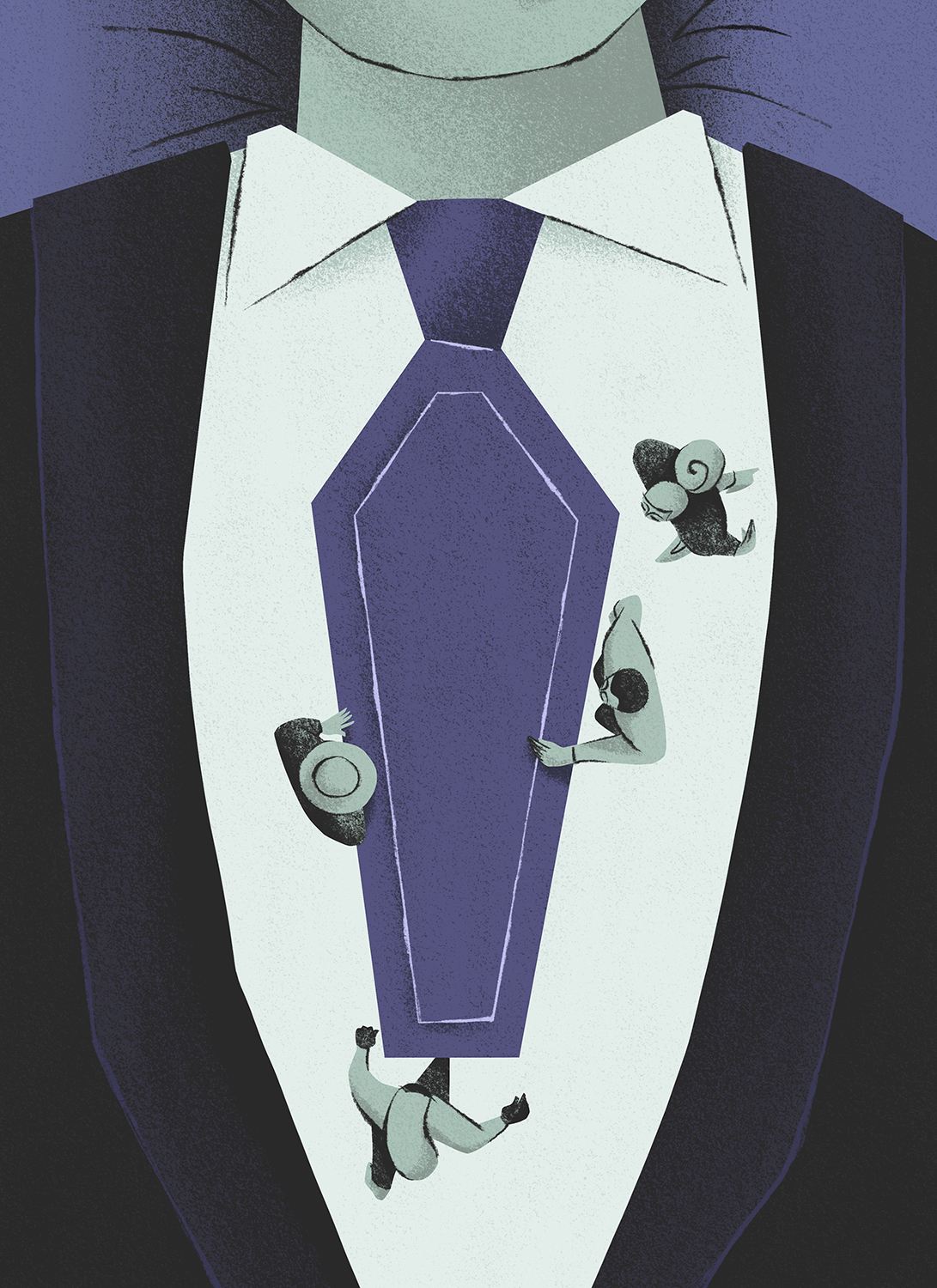
A cheap suit announces itself. You can spot one from two hundred yards away, easy. Woof! it says, with that scalding cheapness that blasts from its fabric like dog breath, hot and right up in your nostrils, Look away.Don’t even get me started on cheap shoes.
I’m sure Uncle Cliff sports both, but the coffin lid obscures his feet. This church is jam-packed, and somehow, we couldn’t pull together the extra $75 that would have this man looking like the G he once was and not a Roots extra. No way these are his clothes. They had to have found this suit in an evidence locker.
If I can hug Aunt Eema tight enough, I might be able to squeeze out any suspicion that I’m judging her, which of course I am—every single screaming cell in my body. A $5,000 Gucci dress? A Chanel clutch? She even smells of luxury, notes of wood and spice wafting from her skin. So yes, Aunt Eema, I’m sorry for your loss, but seeing Uncle Cliff dressed like that, and you dressed like this, drags the whole family into your opera.
I’m hugging her like a cub hugs a leg. An existential hug. An “If I fall off, I die” type hug. I’ll hug until this leg resents me, and then I’ll keep hugging because I can live with her resentment. That’s still living.
Aunt Eema releases me, and by the time I get to the family pew I can see I’m supposed to sit next to Launa. She gives me a blank look that’s anything but empty.
I’m not surprised. We’re beefing, though I don’t know why anymore. It’s been a whole decade of no contact, and I’ve only thought about this beef when I had to. On holidays, birthdays. At funerals. Life’s too tedious to track beef that doesn’t even produce bangers. And I really don’t remember. Thinking about it just thrusts my mind into the sweep of time. Decade is such a deceptive word. So neat, so compact until you actually try to parse ten years, one hundred twenty months. Enough time has passed since we spoke that there’s new jeans, and all the jeans she and I wore for the past ten years have been unraveled and rewoven into an omni-denim, 2010s Jeans. All those ass-checks we did in just about each and every mirror we passed. She once even checked her ass walking past a puddle. All those squats and deep breaths to make pants fit. All those belt loops we threaded and unthreaded. The crunches. Weighted, body-weighted. Legs raised, legs lowered. Second set. Reverse. Bicycle. I still feel the burn.
All that work is now 2010s Jeans.
I’m pretty sure the last time me and Launa spoke was at Great-Aunt Hattie’s homegoing, and she died ten years ago last Thanksgiving. Uncle Davey marked the occasion with a toast he couldn’t finish. A death on a holiday kills the holiday too.
Launa stands as I mosey down the aisle, and I can’t tell if she’s going to greet or slug me. I think our beef is the on sight type. What did I do? Or what did she do? I need a briefing. But I’m pretty sure Launa remembers, and I know that if she knew I’d forgotten, her boner for this beef would manifest a full new inch. She’s that kind of older cousin, a blood enemy. I’ve felt it since we were kids.
My fists are balled by the time we’re close, but she hugs me like I hugged Aunt Eema. She’s warm. Her torso is like Destin sand, her arms a sun-soaked beach towel. And in an instant, I’m receiving this love and (hopefully) giving it too. Launa doesn’t squeeze, she just holds and holds, letting go gently.
We sit close. I can still feel her warmth and find my eyes settling on her thighs. We’re still the same size, looks like. People used to think we were sisters, and a few said I looked more like Uncle Cliff than she did. We’d swap clothes all the time in embrace of that confusion and just the alien familiarity of cousindom. Friends but closer. Maybe it was my imagination, but hers always felt so warm when I tried them on, like she had just peeled them off, especially the jeans.
Without looking, I find her hand and grip it hard, like a weapon.
I put $26 into my outfit because that’s all I could afford to see Cliff off, and I look better than half the bitches in here. We must be losing recipes at a catastrophic rate because I ain’t never seen this many midriffs at a funeral.
I’m liberated, but damn—have some class. We already suffering in this raggedy church with this funky-ass carpet smelling like coochie and feet. God, why, oh why, do you do your children like this?
Cliff, why you do Eema like this? College girls. And with the audacity to show their faces. How you wooed these young freakniks is knowledge I will gladly live without. I can only conclude these young ladies were desperate.
Cliff had game, but I know that bama wasn’t on those dating apps Launa keeps whining about. Sweet thang, what you drinking? he asked me the night we met. How you know I’m sweet? I replied. I don’t, but I like sour too. That’s all it took, talking, not typing and picture-taking. No way Cliff changed tactics. Before me, that fool didn’t even know how to work an ATM.
I’d heard he was doing well for himself, was a pillar of the community or some other corny bullshit you say about people who lived like Cliff: around. That’s the standard these days, with so many people just up and leaving. Ghosting, they call it. The flux makes the people who stay seem committed, rooted like statues in the town square. But ghosts can stay still, I know.
Not that anyone here will admit that. The whole time we were married, he told people to always spread good news about him anytime he came up. It was never anything outrageous like he’d won the lottery or become a chess grandmaster. People would say he’d lost ten pounds or got a nice haircut or learned an instrument, little myths that would find their way back to us when we were out and about. His buddy Mendel—the Lord’s already reclaimed him—used to call him Mr. Good News.
And meanwhile Cliff was waist-deep in coeds. He was a pillar, all right.
Same old Cliff. Eema’s younger than me, and she wasn’t young enough, apparently. She looks impeccable, though. You could tell the quality of that dress from a city block away, maybe farther. Tell, not see. You would literally view it, of course, but vision would just kickstart that sensation beyond sight, an uncramping that rivers through your soul like good cake. Money was spent on that dress, money I know Eema ain’t got because Cliff wasn’t shit but a good time until he was a bad time, which was most times. But girls, you don’t know that!
And that’s the gospel. Look upon that fabric and that veil and that handbag and know that Cliff got around, but Eema got hers.
It’s my fault for taking money from any place that’ll have me. I’m the cheapest organist in the DMV, and this gig is beneath even me. Church can’t even afford new fans, it’s so broke.
I can relate. When you sell cheap, you live cheap. I’d quit if I could, but I need the money. And I enjoy my Saturdays too much to commit to one church, if one would even have me.
But it’s good work. These poor families pay in cold hard cash—no checks, no Zelle, no QR codes.
It feels wet in my hands sometimes, cash. A distinct and benevolent wet. Cleansing, like I’ve just lathered my hands with soap, run them under hot wash, then flicked the excess off.
And man, it’s godly, that flick. Imagine your wrists winding, and then just exploding outward. All of the moisture is gone in one incredible stroke. Flick, that’s it. Money shot. That’s how the notes feel in my hand.
The organ they got in here feels like boneless, skinless chicken thighs. A nasty wet.
My fingers keep slipping, bumping, sliding. Sad, little out-of-tune thing. The tones I’m producing are awful, groaning terrors scratching at the walls. The pedals are sticking as bad as the keys. But the cash is in my pocket, so I do the job.
“All right now!” somebody responds to a little go-go vamp—and, man, that feels good. Nobody expects funk or style at these send-offs. America’s a fair country in at least one way: You get what you pay for.
Hood families got bad credit and compounded shame. They think because there’s no wealth getting passed along and I’m all they can afford, the deceased has no right to a joyful goodbye. Nah, fam, this the least you deserve. We’re going to do some clapping and stomping and hollering for your boy. Cliff was his name? Rest in peace, brother. I know the tailors in heaven are setting you straight. They better, cause the organ is warming up now. Maybe she was always warm, these ghetto mourners got me humming up in here. Mhm. They singing too, and they don’t sound half bad.
I sidle into some Mahalia to raise the temperature a little bit.
They pipe up, so I get into some McClurkin.
They’re stomping now, so I play them some Fred Hammond, see what they really about.
Okay, we got some dancers in the house. They’re ready for their blessing, so I hit them with the Mannie Fresh like the son requested. What these niggas really on?
Ain’t got no job, but I stay shive. They chant it back at me like it’s scripture.
Can’t think grief. Gotta feel that evil fucker radiating through us—a flick won’t do—and vibrate it out, shake your whole frame.
Funerals should be all music. No speeches, no verses, no prayers. All rhythms. I never seen Dad even hold a bible. He would bow his head at Great-Aunt Hattie’s house, and he would pray if she (and only her) called on him. She did that every few years, just to remind him she knew how he was raised. I remember those prayers, the way Dad’s arrogance would suspend. He’d thank God for the hands that prepared the meal, the bodies that worked to pay for the groceries, the suppliers that shipped the groceries, the farmers that grew it, even the chemicals that ensured fertility. Eventually, all the praise would wind back to the Creator who flicked that first domino of life. Mom always said he was showboating, but I never thought of it as a performance because he would get grateful like that in normal life sometimes. He’d ask me for money, and whether I gave it to him or not, he’d thank me for succeeding him, for learning from his mistakes. I hated that word, succeed. Made it seem like he had failed. Chill, Dad, I’d tell him. He was a fuck-up, yeah, but he was there, and not just visible. He was present—cooking meals, walking me and Launa to the store and the park, puzzling over algebra with us at the kitchen table or wrestling with wet socks at the front door when we came in from the snow. I understand why Mom can’t stand him, why she’s sitting in the back like she might have to dash out. The cheating was inexcusable and plain dangerous considering all these diseases. I was honestly shocked a heart attack got him and not drug-resistant gonorrhea. Cliff did right by us, though, in the small ways. Maybe that doesn’t matter if he couldn’t treat Mom or Eema right, or keep from overdrafting. I hope I can fill a church like this one day—a better one, of course, one where you can feel the music without having to bend it to your needs. Because that’s what we’re doing with all this swaying and shouting and subsidizing of that organist’s sorry ass. Dad would have loved for Big Tymers to soundtrack his funeral, but he’d want the real thing, Mannie Fresh and Birdman getting their roll on, project bitches screaming from the pews, oh yeah. But this is what we can afford—or rather, what we’re willing to pay. Because you were there, Dad. Still, I’d be lying if I didn’t say you could have been more there. The lack of money never bothered me, honestly. Everyone I knew was broke, so why would I care about us being the same? It was the haunting that fucked things up, the depressant way you were here and not, tripping, throwed, gone. I’d see you there smiling at us, hear you tell us not to play with matches or sockets, feel you watching to make sure we complied. Then I’d speak and words would just drift through you. Like smoke, like prayers. Like music.
No one loves like an old-timer. I mean, maybe that’s a dramatic statement for someone who’s only been with a few, but Nana always said experience is the best teacher.
Take this reverend. He’s actually crying up there. Maybe it’s rehearsed, maybe he weeps over all the dead and gone and gives this same sermon at every service, week after week. But I don’t think you could fake-cry to this crowd, the way they carried about. You could see the music in here, taste the pain.
And honestly, I’d take fake-crying over none. These little boys I gotta deal with? They don’t cry when they’re sad or hurt. They just get silent, dark, expect you to syringe the emotion out of them like you some kinda mama-nurse-nympho wonder bitch.
Cliffy would talk about his mama all the time. I thought she was alive at first, the way he’d mention the things she said or the songs she liked, the way he’d gasp when I’d tell him I’d never heard of some TV show he used to watch with her.
The reverend’s talking about me now—not me in particular, but the idea of me, of most of the women my age in this church, maybe even his relatives. I don’t think Cliffy was a freak like that, but maybe he was. There’s only so much you can know about someone when you communicate mostly through strokes, bites. I know it wasn’t the love he gave that beautiful wife of his, but it was some variation. It had to be, the way we threaded schedules to meet up.
I steal some glances at the other mourners as the reverend gets going about the strength of a God-fearing man. I’m impressed I wasn’t the only one. Cliff exalted me, called me his elixir. But I guess I always knew, given how we met. I was headed to campus and some old-timers outside a package store yapped like they always do. Happens so often it might as well be part of the Howard curriculum. I have strategies for these encounters. One, if they’re sitting as they catcall you, stay out of reach and subtly quicken your stride. If you run outright, they might get weird and chase you, but if you go faster than you come, you’re just another bitch they can’t touch, which they understood when they first hollered at you. Two, never make direct eye contact, but catch them from an angle, remember their voice or gait or shoes in case you see them in some other place, which always happens. Chocolate City’s small. And if they’re standing, locate the nearest woman and be ready to summon her if the man escalates. She might not help, and in fact may be watching you for the same reason, but she wants the same thing you do, deep down: peace.
Just a few blocks from this sorry excuse for a church, I had passed a sitting group consisting of Cliffy, a wino in a cheap suit, a woman in multiple coats, and a gold-toothed man. Goldie liked me and let it be known. That would have been well and good, but then he followed me, his voice sweeping down Georgia Ave: Want some mayo with that bun? I locked eyes on a woman walking my direction and clutched my bear spray, ready in case he got handsy. But then I heard him shout and turned around to find Cliffy on top of him and a gilded canine lying at my feet. Run along to class, baby, I got this fool. Despite rule number one, I ran all the way and thought about Cliffy the whole time, even during the lecture on the mating rituals of orcas. He did what he should have done. But he also did it for me and not any of the other hundreds of girls that passed by on their way to the Howard campus or work or wherever. Why?
I asked him after class, when I was headed back to my apartment. I could have, maybe even should have, taken another route. But I wanted to know. That’s why I’m all these states away from home, more or less. You learn things one way or another.
Goldie and the multi-coated woman had gone to my university’s hospital to get his tooth sorted, an irony none of us acknowledged when I sat next to Cliffy. The wino watched me silently between pulls of his bottle. He seemed less drunk than when I first saw him. Violence is clarifying like that.
Cliffy said he just felt wrong seeing Goldie talk to me any old way and wanted to feel right. I invited him back to my place and fixed him real right.
When I was sliding my jeans back on, he asked me where I got them, and I said I didn’t know. Jeans are jeans. They come, they go. Like you, I half-joked, gesturing at his shoes. He’d been an okay lay, more experienced than my ex, but not yet what he would become. I could tell he’d been doing the same tired moves for a long time. He fucked like he was Electric Sliding.
He smiled demurely and stood from the couch. But then he plopped back down crying, blabbering about the first pair of jeans he bought with his own money and how his mama patched them up every time they ripped, and how now he couldn’t wear them anymore because no one could make patches disappear like she could. The retired seamstress had maintained a whole room of vivisected jeans and skirts and blankets, organized by color, from which she would restore any tear to what appeared to be its exact material. She hated “that patchwork look,” he said.
My first thought was, Fuck you for being the same size your whole life, mama’s boy, but what I said was, “I do too. I call it the ragamuffin look.” He laughed, and he looked so cute when he smiled, eyes alight, his neat teeth beaming white. So I peeled my jeans back off and joined him on the couch, spreading the denim across our laps like a blanket. They were from PacSun, the tag told us, a brand Cliffy’s mom had no respect for, he said.
I told him don’t nobody over fifty know anything about no damn PacSun. But he swore she did, and we talked, communicated, for hours.
There’s an art to hugs. Who gets them, how long they’re held, the placement of hands, the motion of hands, the pressure of arms, the positions and angles of legs, the moment and timing of the release. Sometimes people talk after they pull back, hold limbs and gazes and reflect on good times or plan more. Other times they step back, talk business, return hands to pockets or sides as if wiping off the contact. More rarely, they hug again, nestling chins into shoulders and foreheads into chests, unsure when this moment might come again, unwilling to risk regret.
I watch Eema cycle through the repertoire, conscious of my gaze. We deacons are supposed to carry ourselves a certain way, even at Ghetto Rock. The reverend hates the label. But he’s stiff—just look at him blessing Cliff Junior with a perfunctory hug at best. Most churches don’t get a nickname, so I embrace it. I hope Eema remembered to put Rock of Faith on the check and not Ghetto Rock. She calls it that often enough that she could easily forget. Maybe we’ll get married one day far from this one, but I don’t know if I could bear the shame. The church budget can’t take any more scandal.
I leave the vestibule and start my rounds, putting Bibles and fans back in the holders and checking the pews for belongings. Churches are little magpies. Well, it could just be this church, as it’s the only one at which I’ve vacuumed, mopped, and laid rat traps. But it’s not always the same congregants, so I think the point stands. We get all sorts of newcomers for funerals and the occasional wedding: distant cousins, mistresses, great-aunts. Sometimes complete strangers book us, folks unrelated to anyone on the member rolls or even in the city, our prices just too good despite the humility of the space. And they leave as many earrings and crayons and peppermints and scarves as the regular flock. That’s why I figure all churches must be like this. Must be.
Besides some leftover programs from Cliff’s service, the pews are in order. I almost hurl into the cleaning bucket when I see the restrooms. They’re just two stalls each, but people have left a mess in both. A foul and chunky green liquid lingers in the women’s sink, and someone appears to have emptied an elephant bladder on the floor of the men’s.
It’s quiet back in the sanctuary. The bereaved have gone to the cemetery to set Cliff into the ground, leaving just fragrances, Eema’s being the most distinct. Her scent washes out the sharp mildew funk we can’t afford to cure. And we’ll never get out of this fiscal spiral if the reverend won’t admit it. Tithes dwindling, maintenance deferred, and the people still paying feel like they’re getting a worse product. The reverend would not want me to call it a product, but he’s not here.
Just me and the vacuum, working the aisles, back and forth, under and between the pews, the machine’s motor purring against the floor. The carpet curls like warped metal in many places, but if you roll over it just so, it will flatten, at least until kicked up again.
Bouquets surround the space where the casket was. I turn off the vacuum and just stare at it, that blankness. It could be anything. Eema and Cliff got married here, as did Roxie and Cliff. I attended the former, as deacon, and have seen pictures of the latter. That day, I’d hoped Cliff was ready to settle. He tithed dutifully, so I knew he could commit. And he and Roxie had been broken up for years at that point. I saw him often in those days, up and down Georgia Ave, sometimes down in Shaw, where he carried the mail. I always suspected that was where his wandering came from, all that walking and talking. He was born to be a mailman. He just felt like someone you could trust, put you at ease when he spoke, like a deacon. America’s deacons is how I think of postal workers, though I’ve never shared this with Eema. She hates the post office, hates booze, hates hip-hop—old and especially new—and hates this church. Except for his kids, anything Cliff-related gets her boiling.
I want to hate him like she does, but sometimes when I’m in their bed, or at their table, or talking with Junior or Launa, I think I could be him. My mom was a seamstress like his, worked at the same dress shop off Euclid. And I almost got a job at the post office, back in the day, took a test and everything. Pepco just called me back first.
“D’Angelo, you’re still here?”
I turn around to see Launa. She’s changed out of her black dress into baggy jeans and a T-shirt with Cliff’s face airbrushed on it, 1966–2025 painted beside his cheek. That’s the other similarity between us: born the same year. All that separated me and Cliff, I think sometimes, is that I can’t stomach alcohol.
“Yeah, just cleaning up,” I tell her.
“Looks as clean as it’s gonna get, no offense.”
“You’re right.” I start winding up the vacuum cord. “The burial go all right?”
She shrugs. “He’s in the ground, so yeah.”
“I’m glad.”
“I’ll bet you are.”
I feel my face flush. “I meant I’m glad things are okay.”
She smiles like her father. “I know, I’m just teasing.”
“And your mother, how’s she?”
“Confused. She wants to be friends with Eema now, gave her a big long hug after the casket dropped like they just finalized an armistice or some shit.” She covers her mouth and gazes up at the vaulted ceiling. “Sorry,” she whispers.
“I think you get at least one cuss on the day of your father’s funeral, even on church grounds.”
“Thanks, D’Angelo. You coming to the repass?”
“No, no, I’m done with church business for today.”
“That’s more reason to come, is it not?” She starts gathering up the flower baskets, her apparent reason for coming back.
I watch her. “I really don’t think I should, to give the family space.”
A titter erupts from Launa. “You old folks are something else. Everybody from U to Upton know you and Eema been sneaky-linking, D’Angelo. Neither one of you is sneaky, matter fact. All that door-holding and eye-averting, ‘Deacon Brown’ this, ‘Sister Eema’ that. After how my dad did her, I wouldn’t be surprised if Eema had a whole roster of deacons.”
I don’t know what to say and find myself easing into a pew. I thought we were being so careful. I hope this doesn’t jeopardize the insurance policy, or Eema’s house. She’s just got a year of payments left, Lord willing.
Launa slides next to me, the good book in her hand. She flips through it, searching. “Deacon, Cliff knew one Bible verse by heart, just one. He quoted it at me my whole childhood, would make me and Junior quote it back at random. I know the words, but the scripture number? Hell no.” She covers her mouth again.
“Two cusses is perfectly within reason,” I assure her.
“When I feel like I’ve done something wrong, this always picks me up.” She continues flipping.
“What is it?” I ask after she’s been at it for a spell. “I might know it.”
She looks up. “The eyes of the Lord are everywhere, keeping watch on the wicked and the good.”
Easy. “Proverbs 15:3.”
“Fuck, no wonder you’re a deacon.”
I laugh, and she does too, our mirth rocking the pew.
I offer to help her carry the flowers to her car to save her a trip, and we gather them up. Bunched in my arms, the fragrant plants dilute the smell of Eema.
We pass through the front doors, and I stop to secure the church.
“Are these the doors you two installed?” Launa asks me.
“They are.” I twist the lock closed with one satisfying swivel. The glossy French doors are the church’s newest feature. Cliff funded them. I don’t know why, or how, given his financial issues. But eight months ago, doors were delivered, and the night I was to install them, Cliff was there on the steps waiting with a toolbelt snug against his gut. “I’m surprised you know about that. Cliff made me and the reverend swear to secrecy.”
Launa shakes her head. “Cliff kept secrets about as well as he managed money.”
A wind assails us as we walk down the chipped steps, sending petals aloft.
“Why do you call him Cliff?”
“One day when I was in high school, he had to work late, and I ran into him on his route after school and walked with him for a few blocks. Everybody called him Cliff, so I did too. I think he liked it more than ‘Dad.’”
“That sounds like him.”
The flowers bob as we load them into the car. Little nods.
“See you at the repass?” Launa asks as she turns the key over.
“Yeah,” I decide.
“Thank God.” And she slips into traffic.
Passing the church as I head to my car, I see I left a light on, but I keep walking.
The building sits like a rock as bodies alloy and river past. Eyes glance and fix upon it, the mouths beneath dispensing questions and complaints and Amens. It listens as buildings must, absorbing the undulating shudders of the city. Sirens and honks. Birdsong, catcalls, barks. Go-go and crank and gospel. Silences brief as kisses and long as death.
The sounds bounce off the building and seep through it like the ants the deacon cannot vanquish. The reverberations settle into the carpet and walls like dust, but the listening building grasps them tight. It must save these peals for the congregants in their black and gray and vermillion and periwinkle, must match their cries and rhythms with those from its collection, harmonizing. The work is endless. The pilgrims flow and flow, entering the building in great herds and small parties and alone, seeking audience. As they stir its air with their weary breaths, the structure of wood and brick sometimes wonders why they choose its meager chambers over those of the towers of metal and glass that surround it, over the conifers that predate its foundation of stone and dance in the winds that carry the sounds and drink the waters that plummet from above, growing as the building cannot, metabolizing time and space, furnishing rather than collecting life. But in those moments of doubt, the church listens deeper, hears their relief and its most treasured name. Cliff coined the sobriquet years ago, his voice low and mocking: Ghetto Rock. He repeated it many times, spread it up and down the block like the rice grains visitors scatter across the front steps on wedding days, the church’s favorite. But the mockery fell away, replaced by a stentorian fondness that cut through the city din, sharpening the building’s focus. It listens as buildings do, but records as only it can, attuned to the lowest frequencies.
Fernando Cobelo is a Venezuelan illustrator based in Italy. His work, which has been featured in The New Yorker, Netflix, and The New York Times, has received accolades from the Society of Illustrators and Communication Arts.