Image

Thinking about him now, I realize Juho spent most of his time trying to tell me something. Our communication tended to fail us in important ways. It was mainly my fault. We were forever running into these little word-to-word problems. We had one in our first conversation after he got out of jail, when I visited his new apartment and he explained to me the latest method he’d discovered for making money.
“What’s a redemption net?” I asked. “Like, is that what you catch it with? Or do you mean redemptionette—as in, you know, a petite redemption?”
“Redemption dot net,” said Juho. “It’s where I find them.”
“The women.”
“Well, there have been men.”
“Really?”
“It doesn’t matter. It’s not about what I like,” he said. “It doesn’t matter who they are.”
“What does that mean?”
“I can do it without thinking. Without even really seeing them, or them seeing me.”
“Sex?”
“No, my God. Who said sex? You’re not listening.”
“I am,” I said. “I’m trying.”
Juho used to be a dog thief. It was an honest-to-goodness profession for him. The last time I’d seen him, before he went away, he’d said it was only getting easier. The big parks were full of the kind of people who stuffed their pets into purses and hiking bags and those special bags just for holding living things. There appeared to be a booming market for this kind of portable imprisonment. Juho could just take them in one unsupervised instant, prepackaged, wholesale. Nobody looked twice at a grown animal hanging from a grown man.
“It’s disgusting,” he told me then. “The way they fucking björn them around, you know? Disabling, is what it is. What kind of dog is supposed to go its whole life without stepping foot on the earth? I once saw one strapped in this kind of harness, midair, pissing a long gleaming arc directly off some guy’s back. Like the man had a blowhole. It’s all so unnatural. These people don’t deserve to own anything.”
On an equally lucky day he’d put a JanSport filled with Blue Buffalo face down on the ground, and something wearing a collar would simply walk into it. But if Juho grew impatient, he could bag one himself, headfirst, in seconds. For years when he was young, his parents were chicken sexers on a farm; a puppy was nothing compared to picking up an angry mother hen. The key, with your backpack full of kibble, was to find one young and small enough that you could zip them in before they knew what was going on. It was funny how quiet they were when they looked up from their meal to find themselves floating in the dark.
After that, all you had to do was relax—an animal can sense when you’re nervous; you didn’t want to scare it. You just left the thing at home and walked around the neighborhood, waiting for the signs to go up. Sometimes there was no telling what was more obscene: the way the owners treated them when they had them, or the piles of cash they promised to get them back. When making the return, you’d say you found the dog at the underpass of some distant freeway. It didn’t really matter—through their kombucha tears, these people barely noticed you. L.A. was turning out dangerous and cruel; it was time to go running back to Portland. They kissed the reward into your open hands, and right away you’d be at the park again, working.
But you never can tell what’s going to bring a business down. Juho was about three weeks clear of probation by then, after ten months in county for misdemeanor burglary and animal abuse, or one of those, or both.
“This lady went into the bathroom holding her stomach, limping, the whole show. I stop watching her for a second, and she’s back. You should have heard that scream! I think my ears are still ringing. Bitch was simply a quick pooper. That’s all it took.”
A laxative; a strip of funny taco meat. A backpack with a tail, running every which way like some kind of fucked-up horseshoe crab from the spot where Juho dropped it. His new place was dirty and old and small, and the orange couch we sat on—his only piece of furniture besides a pair of lawn chairs—looked and felt as though it might have started out a different color. He ran a hand through his hair, which was a little gray in the corners now, a little gray across the cheeks. This was something different. Every other part of him seemed just about the same. Sudden eyes like those of a flightless bird, I mean, but then this kind of classic all-American handsomeness, which fit him even though he was Korean.
“I’m not a whore,” he told me that warm day in April, slouching forward on the sofa.
“Okay, but I’m just a little confused, man,” I said. “Without thinking, without seeing them—what are you doing? What is it that you can do?”
It took longer than I want to admit for me to get the picture, and then even longer to understand that he wasn’t kidding. He really was going out with seniors he met on a site called redemption.net and robbing them while they were indisposed. Being under thirty, he was a rare commodity on the site, as you can imagine, and it was easy for him to get dates. He used some bullshit name. Just walked out the door with their pocketbooks. He had a car now.
“They’re rich! Every one of them, paying to get the skin stapled back onto their faces. Westwood, you know, the Hills. And they take forever in the bathroom. It’s better than dogs. It’s perfect.” I wondered what kind of car it was. I hadn’t noticed it on the way in to visit him. “I mean, you’ve gotta switch it up, of course, alternate, but my favorite place to meet them is this big diner up around Los Feliz, on Western. It’s set up all weird, and there’s always a ton of people there, so even after they’ve done their business, it takes them a while to find their way back to the booth.” He laughed when he said that. “I unmatch them before I even leave. You can’t find someone again after they delete you on redemption.net, ironically. I wonder if some of them think I was a hallucination.”
“Jesus. I mean, to be honest, that’s super fucked up. And men too, huh?”
“I told you, sex is not a factor. Men pay just like women do. There’s no difference.”
“Jailhouse rules.”
“That’s good,” he said. “You’re a pretty funny guy. I feel like people forget that about you. Me, I’m still catching up.”
I thumbed a little label off my Corona. “They all carry a lot on them?” I said, looking up.
“I mean, between what you’d expect, cashed out social security, retirement allowances…but you wouldn’t believe some of this extra shit. Jewelry. One lady had a whole stack of Pokémon cards that all turned out to be super rare on eBay. Must have been her grandson’s or something. That kind of thing happens all the time. The opportunity to supplement cash with, as they say, real assets.”
“I just—wow. I can’t—”
“You don’t have to,” he said. “But it’s starting to feel like you don’t believe in me, which—ouch, you know?” He patted his heart. “You could’ve come to see me in there. Last year. It wouldn’t have killed you. It wasn’t like I wasn’t going to get out.”
“I know,” I said. “I just, was working. You know how it is.”
“Where do you work?” he said.
“Nowhere yet.”
In fact I was living with Umma again at that point, still sleeping in the garage. My unemployment had run dry. I was hungry, and in the months since he’d been out of jail, Juho had gotten fatter. I could tell. I shifted my weight, trying to find a more comfortable way to sit. I almost asked a question, the one I’d wanted to ask all this time, but I decided to keep going easy.
“I’m back cleaning the church on Beverly,” he said, nodding his head, his eyes darting one place and then another. “On the side.”
I sucked down a little beer. “But what about real girls? You don’t use any other website, the way it’s intended? I’m on OkCupid.”
He shook his head in these slow, swooping motions. “Too—many—white girls,” he said. “You know I speak fluent FOB, baby. That’s why I don’t mind the church.” He pinched my shoulder and laughed again, a whole arm’s length away from me. “And you thought I turned fruity.”
“I don’t mind white girls. They treat you like you’ve already said something smart.”
“The last one I went out with really scared me,” he said. “Turned me off to the whole idea. I brought her out to a drive-in movie, right? Some goofy shit. We head back to her place after. I told her to put something on TV. I said it without thinking. You know, how everything you do or say in a situation like that is just action, dialogue, action. That’s the way it was all happening. We went out to watch something, came in to watch something else. Whole night I kept having this same thought. During the movie—I don’t even remember what movie it was now; this was a while ago, I guess—but I kept thinking: You’re my opposite. You are the opposite of me. In Mira Loma, there was this guy down the hall who would holler the same words every night for hours. Hollering his head off, hollering at someone who wasn’t there. I used to think that sentence, my sentence, over the sound of his—opposite, opposite, you are my opposite. So now, the way I remember it, that’s what he was saying, even though I know he was saying something else. Anyway,” he said.
“Doesn’t sound like the girl’s fault, really,” I said. “You being freaked out, I mean.”
“Man, I haven’t even told you. We’re at hers, right? I say put something on. And I don’t even know how she does it, but she puts on, like…a slideshow.”
“What, like a presentation?”
“Yeah, kind of, except it was just on her TV. As if some station was showing it.”
“Oh. And what did—what was it of?”
“Well, that was the strangest thing. For almost an entire hour, this girl and I watched just a bunch of different pictures of Barack Obama. It was a slideshow of him—and not even funny pictures, like very normal pictures, like portraits. But I swear to God, she watched it like an actual show, like it had a story, and pretty soon she’s laughing so hard she’s in tears. She acted like it was odd that I wasn’t laughing too. But I didn’t get it. We didn’t have sex, or anything, I just went home after that.”
Juho cleared his throat. “Do you?” he said. “Get it, I mean.”
He sort of swiveled to me then, set his empty bottle on the floor. He looked tired. It was a funny story, but I wasn’t laughing. It felt like he’d left something out. I told him I didn’t get it, which was the truth.
Eventually I got around to what I’d been trying to say. What was I supposed to do? There was my life to think about. And here was Juho, a few weeks free and already living in his own apartment, a job, two jobs. But I still tread softly, didn’t ask for very much. My place would get hot come summer, and then I figured I’d have to ask him to crash. When I came out with it, he sat there nodding and pressing his fingers across his mustache. I remembered in ninth grade how he used to shave his upper lip even when there wasn’t anything growing there, how the naked follicles got all purple and raised. He said you had to irritate them first if you wanted the hair to get started, as if there was a piece of our actual biology that couldn’t be aroused except in anger. I always thought he would’ve done something major if he’d ever gotten further in school.
“Thank you,” I said, stuffing the bills into a pocket of my dryer-stiff jeans. “I mean it.” He smiled at me. Then I said, “You should get some furniture in here. You know, some good social security furniture.”
“I kind of like it how it is,” said Juho. “Nice and open. Feng shui whatever.”
I nodded, then I walked to the door. There was nothing in my way.
Umma, that same April, had increased the hourly rate I paid to use her car, a dark blue ’89 Subaru Justy she seemed to think would outlive us both. I fought her on this a little, the rate, but what did I really have to say? “You’re so smart, and then you’re so stupid,” she told me, et cetera, each word of her English chasing the next down as if it was a rolling penny. There was a perfect bowl in the driver’s seat depressed by the ass of my father. It was bigger than her, and she never got up so much as climbed out of it, exiting the car. I wondered how it felt for the man’s impact to be so measurable. But then Umma probably didn’t think about it like that. She had a job to do.
And I kept having this “waking vision,” you’d have to call it, of walking around a big Hollywood lot, or soundstage, like the ones from Singin’ in the Rain. A professional desert of plywood and canvas, all made out to look like you were really there, the long cracked plains meeting the hard clouds behind some distant mountain range. In the vision I was trying to find the door. The walls always seemed a little farther apart than I remembered. They were painted so well, my eyes couldn’t square the hollowness I heard behind them. Each time I imagined this, I felt like it was almost there, the door, under a bed of cacti or a tumbleweed, some slightly paler zone of the horizon. On the other side of it, I could hear men talking. Sometimes I felt like they were talking about me. I thought about saying something just to see if one of them would open the door, wherever it was, duck his head in, and feed me a line, whatever I’d been supposed to say instead of what I’d said. But I don’t think I ever got up the nerve to speak at all.
With the end of the government checks, something else had started to set in. It was the feeling of too long an afternoon. The sun was everywhere, but the sky was still completely unoccupied. It was always exactly the same: The clouds were absent from what seemed to me assigned and immovable positions, totally identical, from one hour to the next, even in their failure to appear. One day, not long after I’d caught up with Juho, I thought I’d drive Umma’s car to Big Sur, go up and see what was happening there. I saw myself working at a library or museum, teaching myself things, having a radiant idea, and never coming back.
But before I even made it out of K-Town, I looked across the intersection at Wilshire and Normandie and saw Juho sitting in his own car, which turned out to be a beige Mercury Grand Marquis. It was clean. I stared at him. We were across the street from each other, but Wilshire is a wide street. He turned right. I pulled into the left lane when the light changed, and people started honking at me, but by then he was too far ahead to notice.
There were a couple other cars between us. I got closer to him at a red light on Harvard Street, and when it turned green, I just kept following. That’s when he took a right on Western, and I understood where he was going. But it was only after he parked outside the diner that I wondered what I was doing there. I took a turn around the block. Juho and I hadn’t gone that far north, but it was strange the way Western crawled out of Koreatown before you even realized it, and here were all these people with their dogs whose feet you could eat from. Everything seemed to be wearing a hat. I parked as fast as I could and walked back to the diner. He was already inside, which I knew because his car was empty, and I didn’t see him anywhere. I stood on the street, a few feet from the doors, which were red, the kind that swung for a while after you pushed them open. People kept walking past me.
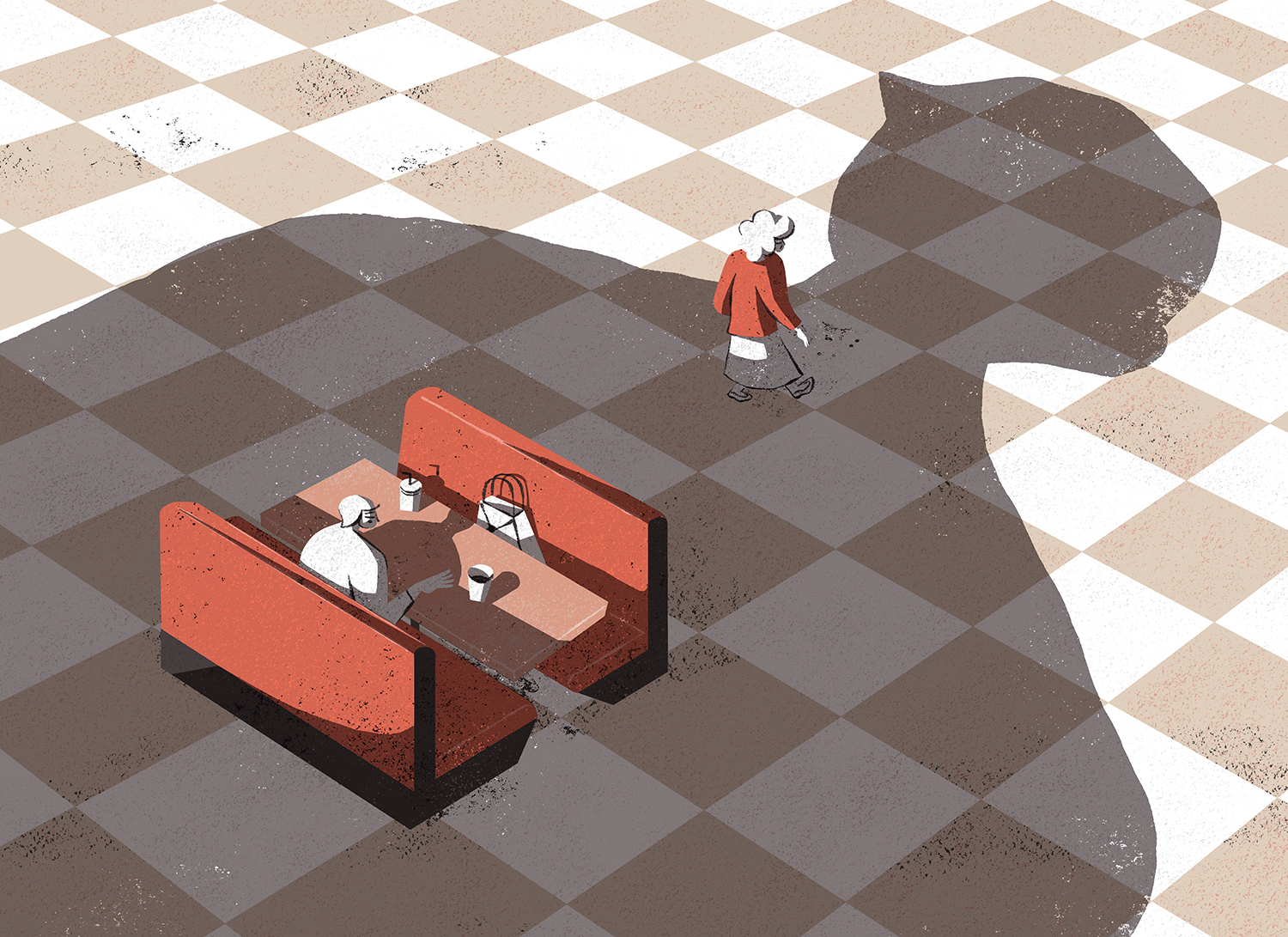
The diner itself had enormous windows all along its facade. The glass muffled most of the sound inside, but to see everything it showed you, it still felt intrusive. It made me feel the way heart surgeons must feel, looking at everyone eating there, asleep to my presence, and flinching together in the desperate naked ways that were the wordless motion of their thoughts. There were two couples in a street-facing booth, right up against the glass, teenagers on a double date. The diner floor was elevated above the sidewalk, so that I was kind of looking up at them where they sat. Below the table, right at eye level with me, one of the guy’s hands wrapped itself around the thigh of the girl sitting beside him. Her thigh leaned into him a bit, and briefly, the hand did this fluttering motion, almost a spasm; it seemed elated to have a place to stay there. Beyond this I could see Juho, but there wasn’t any way he’d see me unless he was looking for me. He was sitting at a table in the middle of everything, talking to someone. I followed his eyes. There was a tiny old woman with Coke-bottle glasses and a hedge of colorless hair sitting across from him. The purse in her lap was leather and bulging, and I could imagine jars of Kennedy half dollars inside it, or a golden brooch collection, or any number of rare precious Beanie Babies. She said something with her tiny mouth. Juho threw his head back and laughed.
Standing there, I thought of other things about him I’d always known. He could make things become what he said they were. He called anything a job and there you went. I went to college. It wasn’t a good one, but it was something. He barely finished the eleventh grade, but somehow, he’d still found a way to retire early. I couldn’t be surprised. I did believe in him.
In junior high, my mother gave me all kinds of hell for knowing him. She said Juho was a bad habit. We weren’t supposed to go around together if I wanted anything good to happen in my life. But I remembered how, once, he came to dinner. I was stunned when Umma said he could, even though I’d made something up about an emergency when I asked. I thought I hadn’t heard her right. I was expecting to have to call him and apologize, saying he couldn’t come over, that there just wasn’t any talking to Umma, and it would have been kind of a relief.
He came over a few hours after school. He worked at the church even then. It was where he was supposed to go, but it was also where he did almost everything Umma was so worried about. Right there in the parking lot before it even got dark, I used to watch him share cigarettes with girls who laughed sweetly at his ugly cowboy ripoffs of their language. I was so nervous he’d turn up smelling like something evil that I didn’t even see what Umma was making. When he got there, she told him to put his things anywhere. He bowed to her and shook her hand. He said my name when he greeted me as if we hadn’t just seen each other.
When we sat down at the table, Umma brought stuff out of the kitchen and then went back to bring out more. She had all types of food prepared, bean sprouts and eggplant, coleslaw, cucumber salad. Things I didn’t know we had in the house. She set down a plate of pajeon right in the middle of it all and then said the beef would be ready soon. Spooned us each a big helping of rice. Coca-Cola, out of nowhere, one of those jumbo bottles of it, she just opened it up and started pouring it into both of our glasses. It felt like somebody’s birthday. Juho was sitting there looking pleasant. I wanted to cry out to him, to say, You’re lucky! or something like that. But I kept watching Umma. She was watching him. You could tell he was hungry even though he was trying to pace himself, and while he was eating, the look she had on her face was a look of pity. She was smiling a little. And I knew that if Juho asked her for something, she’d give it to him.
There were ice cubes in our glasses. The Coke hissed and sparkled around them like it thought it was in a commercial. I started gulping it down; I wasn’t going to let it go to waste or get watery. After a while Juho tilted his glass against his bottom lip and poured all his ice cubes into his mouth. Umma and I both watched him do this. He sort of swirled them around in there for a while. You could see them moving behind his cheeks, making this sucking, gravelly noise. But then he started to spit them out. I put my chopsticks down. He didn’t seem to notice us looking at him. He screwed his face up a little, like the cold was hurting his teeth, and then he dropped the ice cubes one by one. He pursed his lips around them so they fell softly back into his cup, but they still plopped against that shallow circle of Coca-Cola hard enough that it echoed like the water in a toilet bowl. Sure, I’d played with my ice before, but I got scolded for it, and I hadn’t done it since. I got older. They fell—four of them, or five—shining with his spit. The thing about it was Umma didn’t do anything, didn’t say anything, even though, instead of thanking her for her home-cooked meal, Juho had just decided to make little poop sounds with his ice for his own entertainment. She looked at him, not eating, with that same look like she owed him an apology. It was a couple seconds, a minute at most, but he was doing this all very slowly, and without really thinking about it. The ice cubes came sliding from his mouth, but I thought about laying my head down on the table where his cup was and opening my own mouth and catching one. He probably would’ve spit it out just the same. It was like he was in a trance. But then maybe Umma would have had to say something.
The old woman stood up, winked at Juho, and started heading toward the back of the diner where the bathroom must have been. He said something to her, and then it was her turn to laugh. It took her a long while to move out of sight. When she was gone, he pulled her purse from her chair, set it right in the middle of the table, and started slipping through it with his fingers. There was something patient, almost bored, about his attitude. He picked out a few bills, put them on the table, stood up, and slung the purse over his shoulder. This was his stroke of genius, I thought, paying for the meal: You didn’t do the restaurant any harm that way, and for a minute it looked like the only crime you’d committed was leaving somebody alone. I walked across the street and stood by a telephone pole in front of a gas station and watched Juho leave the diner as if it was a long day at work. He had on a tired expression, like the last one he’d shown me. Then came the aftermath.
I found it kind of spooky, the way he could set it in motion like a play or a rerun on television. The three, four times I saw it, though, there were little details that kept things—how else could you put it?—interesting. I saw it twice at that diner on Western. My friend was a creature of habit. One week to the next, I drove to the intersection of Wilshire and Normandie, and even though he didn’t always show up, when he did, he was right on time. I still don’t really know why I came to see them so much, these scenes he orchestrated. There sure wasn’t any money in it for me. I guess it felt good to know what was going to happen before anybody else did, in his absence. First there was confusion. His dates were puzzled by the money he’d left behind, but for some reason, at first, they didn’t think too much of it. Then patience: They sat back down at their table, assuming he’d gone to the bathroom too.
Finally, they’d get up and walk around the perimeter of wherever they were, wondering if he’d come out from any end of it. Some of them asked people if they’d seen him. But then they all returned to their table, and slowly, they realized what he’d done. They admitted it to themselves. Not only that he was gone and that he wasn’t coming back, but what he’d taken from them. Coke-bottle Glasses sat in this understanding for ages. I’d crossed the street again as she was puttering around the diner, holding the bills in her fist like a bunch of dead flowers. She’d gone all the way around about ten times before she gave up. I know I must have seemed crazy, standing on the sidewalk, peering into those nice restaurants without moving at all for minutes on end, but the people closest to the windows weren’t alarmed, even when they looked right at me. I could have been hidden by the sun, hitting the windows at some particular angle. Or maybe they decided I was crazy, which made me easier to ignore. All I know is none of the customers ever seemed to complain, and none of the staff in those places ever came outside to remove me.
I stood at my place on the sidewalk while Coke-bottle Glasses kneaded together her spotted hands, hunched over in her chair wearing a look I’d come to recognize, a look of what do I do now, how do I get home? I got closer to the window now that Juho wasn’t there. Then the waiter came with the bill—the waiters would always come at the worst time—and she handed him every last dollar she had, not ready yet to tell him anything. Juho left them with what looked like a lot, but really it was just enough. Old people have a way of putting stakes down in places like those, ordering big salads, ordering dessert, carving personal imprints into their leather cushions.
One thing about the places Juho chose was that they all had a pay phone hooked up to the wall. It was the kind of thing where if you paid for a meal, you could make a call for free. There was no telling if this was an accident or some kind of mercy. The final act came as the old folks hovered around those phones, trying to remember their children’s numbers, or anyone else’s who might know what to do. It was uncomfortable, seeing people who’d lived so long look so unprepared. Some of them spoke to the hostesses or the managers, but nobody had been paying attention. In the end, most of the time, they walked away.
The only one who actually called the police, at least right then, at the scene, was the only Asian I saw Juho take out and also the only man. I guess I could see why he said that kind of thing wasn’t important. To the eyes of any stranger, he was out to lunch with his grandpa. He actually drove the man there, opened the door of his Grand Marquis and let him out at the curb and everything. Touched his back on the way into the restaurant. It wasn’t the diner on Western, but a nicer, older-looking one in Studio City made out to look like an Airstream, all silver. They spent the whole time laughing too. The old man wiped his eyes beneath his big square glasses. He cupped one of Juho’s hands with both of his own, and Juho let him. He didn’t have a purse, so Juho looked through his jacket when he was gone.
His wallet must have been in the breast pocket, because then there was Juho standing up, thumbing bills onto the table and walking away. It happened so fast, I had to sprint across the street and get back in Umma’s car. I felt silly. I wondered again what I was doing.
I was even sadder than I would’ve expected to be when it was over. He blew his head off all over his orange couch, and by the time I saw it, the color had bled so much it looked like it came that way. The extra sadness came afterward, when I realized they were over too, those sequences I could watch from my hiding place on the street. I missed that, those, them, on top of everything else. I couldn’t see a gun anywhere. I saw he’d gotten a coffee table. There was a row of objects on it I knew he hadn’t put there; they were too neatly arranged. There was a little red bone-shaped chew toy with some bite marks on it and a stack of Pokémon cards. There was a piece of yellow paper, creased a couple different ways, with my number written on it in pen. I wonder who they thought they’d spoken to on the phone, because they seemed confused when I showed up. It turned out they’d been looking for him already. I guess that made sense. When I got there his body was gone, but the TV was still on, muted.
I knew even before then, no matter what, that I’d have to find a job by the summer. I knew as I watched that old man take his laps around the little silver canteen in Studio City. It had been a month since I’d seen Juho, since I’d first followed him, and standing there I noticed the onset of June. The back of my neck was wet, and the air was starting to smell a little like sand. It was going to be hot in Umma’s car and even hotter in her garage, and I wondered if it wasn’t time to ask Juho my big question. I would get a job, I’d tell him, and pay back the money I owed him, and then I’d help him make his rent. His new place was small, but not too small. He and I could go month-to-month together.
I walked into the diner and sat down at a table by the window. It was even nicer on the inside, molded ceilings, built-in velvet booths.
His table was in the middle of the floor, his chair facing the front. I’d gotten closer to this old man than I’d ever been to any of them. For a split second it was like seeing somebody famous. At the same time, when he looked at me and seemed to take in nothing, I got the feeling I was not only crazy, but invisible. No bell rang when I opened the door; nobody moved, nobody reacted. He was just then sitting back down, counting the money out in front of him. His jacket hung from the back of his chair. He glanced around for a minute, turning in his seat, and then I watched him reach into the empty inside pocket. He made a huffing sound while his hand was still in there, like a cough. He put the other hand on the bald crown of his head, and then he took his glasses off. A waitress finally came, and I ordered a cup of coffee, but after she brought it to me, I didn’t touch it. He looked at me again, once, and saw me, but it didn’t mean anything. He sat there for the longest time, staring out the window, and then he went over to the phone.
The light in there was starting to get red, even though it wouldn’t be sunset for a few more hours. It was reflecting off the buildings across the street. I wanted to order some food, a sandwich, but I’d paid Umma too much for the car that day to afford one. I thought I’d order a beer. His jacket was tan, Ralph Lauren, with a green-and-red checkered pattern on the inside. It was a jacket for old men. He’d finished his call, and now he was sitting there again, rubbing the lenses of his glasses with his button-down shirt. He could’ve been a handsome man when he was younger. I couldn’t really look at him anymore.
The light in the diner turned a deeper red, and then it turned blue. I followed it out the window. There were two police cars outside. Their sirens were on, but they weren’t making any noise. A couple policemen came into the diner, and everyone started looking at Juho’s date. They started murmuring. He had stood up and was talking to the policemen, and one of them was writing what he said in a notebook. All I was thinking about was whether I was in trouble or would get in any. Rationally, I knew there was no reason I would, but that didn’t matter at the time. Even though I couldn’t exactly hear what he said, I could tell the man was speaking to the police in perfect American English, which is always kind of surprising to hear come out of somebody that old.
I was worried. I sipped my coffee as some sort of cover. I should’ve been thinking about Juho, hoping he’d already unmatched the man on redemption.net. But that isn’t what I was thinking. When I think about him now, I realize there was something I wanted to say to him too, and I still don’t know exactly what it was, but there was a time, that whole time when he was right there, that I didn’t even know it existed. All I was thinking then was that Juho was lucky. I put some money down on the table and left my coffee behind, and then I walked right past the police and got in the car. I was breathing hard, rocking back and forth on the driver’s seat. A few days later, when I answered my phone and those voices went up on the other end, the first feeling I had was fear. It was the worst fear I’ve ever felt, but it wasn’t the right kind.
I couldn’t rent Umma’s car anymore. It just didn’t make any fiscal sense. So I stayed home all day, cooking up my life in Big Sur. I started to depend on the things I imagined happening there. Every night, the way Umma set down my bowl made me wonder if she loved me at all. I kept my mouth shut. For a while, so did she. We were the immovable object and the unstoppable force.
Then she said I could have the car for free, but what I was going to do was drive it from place to place, handing out my resume. Otherwise, it was off limits to me. So was the garage and the rest of the house, right along with all the food she bought to put in it. She told me a story I’d already heard, about eating dinner with her own family, except dinner was a belt boiled and cut into pieces. Her mother carefully measured the belt into four even sections, then made three cuts, dividing them, with a pair of scissors. My mother and her sister fought over the last quarter of the belt, opposite where the buckle had been. That part was easier to chew up with your teeth because it’d also been burned somehow before their mother boiled it. Umma won, she got that brittle piece; it only had one belt hole in it. She could still remember holding it in her mouth, running her tongue over the hole, its little divot.
I said, “I know.”
She said, “Do you want to know how I won?”
“Okay,” I said. “Enough.”
Eventually I was valeting in the parking lot of a strip mall, wearing a little red blazer. Not valeting, actually, but looking after people’s car keys. I sat behind this kiosk in front of a beauty salon called Gimme Nails that was always full of Armenian ladies in tights. Their cars were all pretty much the same, and I had trouble keeping the keys straight, though later on I guess I got better at it. Gimme Nails had a pink plastic sign above the door, and I sat in the window of my kiosk, which was just a big wooden frame with a chair behind it and everyone’s keys hung all over the back, glinting at me with the sun. It was like living in a piece of jewelry. The other two guys drove the cars and mostly spoke Spanish to each other. I don’t know why that parking lot needed three guys. But I didn’t care; I was glad for the work—I had some walking-around money. I was going to move soon, but there was less pressure now. I could start paying Umma some rent. I could have drinks again, here and there. I kept something in the kiosk and nipped at it while the other guys were parking.
After a few weeks of this, I went on a date with a girl from OkCupid. We hadn’t chatted that much on there, and what we did say we would have said to anyone. I suggested a restaurant in the same strip mall I worked at because I’d already be there. All I had to do was tell Umma not to pick me up. There was an Italian place on the second level that looked pretty good. I paced across the parking lot for the time between the end of my shift and the beginning of our meal. I was sweating a lot; it was hot. They let me use the bathroom at Gimme Nails, so I went in and put deodorant on and played with my hair. I folded up my red blazer and stuffed it in the bottom of the kiosk and finished the rest of what was in there.
Somehow, she’d gotten to the restaurant before me. I hadn’t seen her drive up, but I recognized her as I walked in. She was uglier than her pictures, but who wasn’t? I made my way to the table where she sat. The restaurant had this jumpy music playing, and all the walls were painted to look like you were on a terrace at the end of some rolling countryside. My hands were shaking; I put them in my pockets. “You’re Anette,” I said, still too far from her for it to really make sense. There was a bad crack in my voice. She turned to me. Her face was square and blond and kind. I get the sense that if I’d told her what was happening to me then, the whole thing might have worked out differently, but instead I just waited for her to say yes.
Fernando Cobelo is a Venezuelan illustrator based in Italy. His work, which has been featured in The New Yorker, Netflix, and The New York Times, has received accolades from the Society of Illustrators and Communication Arts.