Image


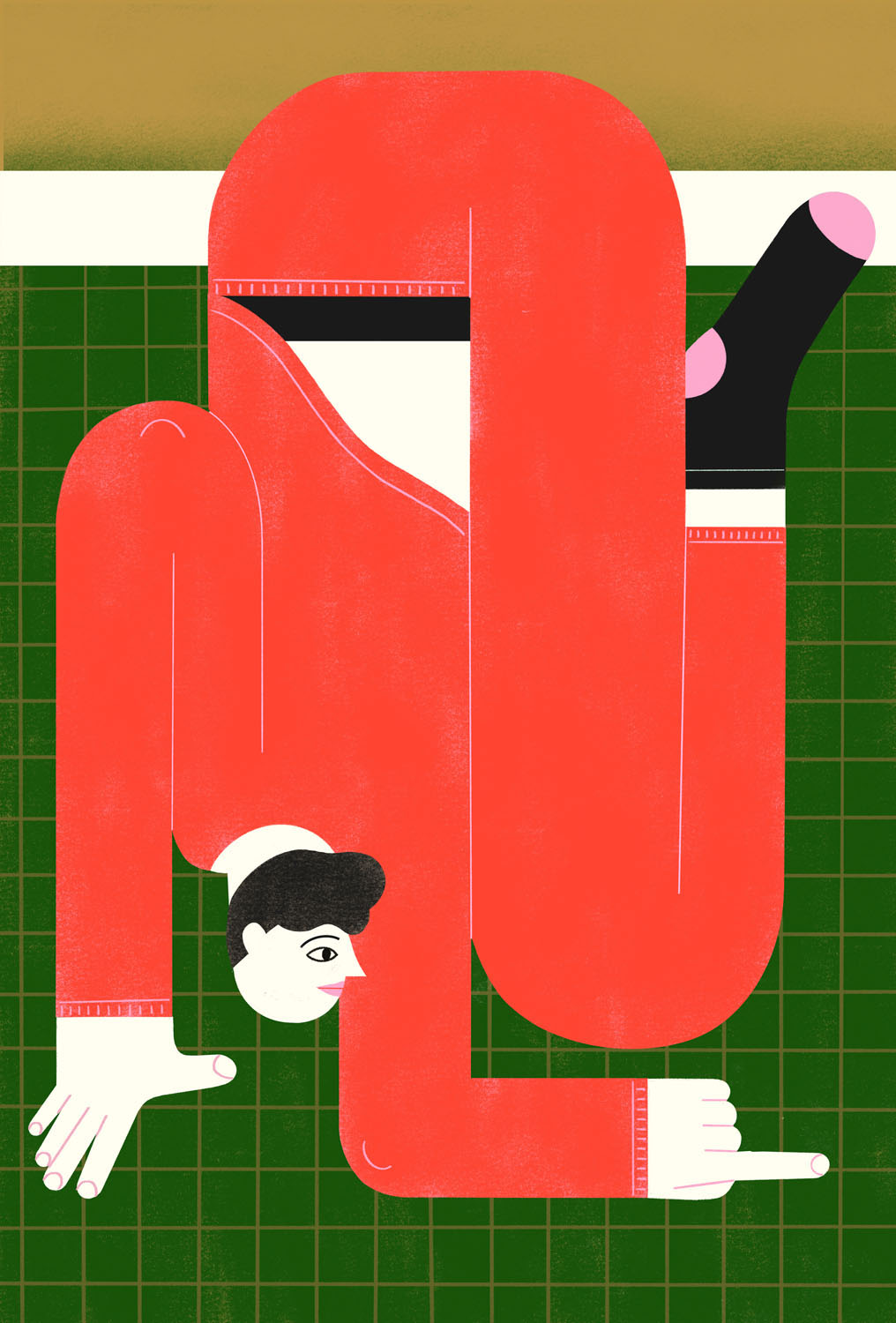
Today I count the number of times I unlock my phone. I have opened my phone 473 times today. Is this a lot? Do other people count how many times they look at their phones? What does this mean? What does this say about me? Often, I unlock my phone to open my Notes app, where I record things I count when I don’t have my actual notebook.
I walk to school counting steps, then counting squares on the sidewalk, then counting the number of cars that pass, then breaking down the cars by color: How many red cars? How many white cars? How many silver cars? When I finally get to school I am eighty-three minutes late, and when I check in at the main office, the secretary looks my name up in the computer and discovers this is the twenty-fifth time I have been late this year. This number triggers a punishment. She calls a security guard, who escorts me to a classroom that is empty except for the detention monitor, a sad-looking man in sweatpants at the front desk, and two boys in the back row, in different corners, whose faces are behind their phones. Eight desks in each row; six rows; a few desks on the sides of the room. Fifty-two desks in total. I identify these numbers right away. It’s easy to intuit such things when you’ve been paying attention to them all your life. When I was younger, I had memorized the answer to every two-digit number multiplied by a one-digit number. I’d spend hours each day memorizing the answers and I’d ask other kids at school to test me. 43 × 8, a kid would bark at me, and immediately I’d bark back: 344. 74 × 7, and immediately I’d shout: 518. Was this math or was it simply memorization? For a few weeks my classmates were intrigued, but like all good performers I needed to innovate to keep my audience interested, and so I moved on to two-digit numbers multiplied by two-digit numbers. It took some time before I memorized each answer to each combination. By that point, however, no one cared about my mathematical acrobatics. Instagram and porn were more interesting.
There are so many things to count. It’s impossible to stop counting things. When I go to the dentist, she counts my teeth and tells me I have extra ones hiding in places the eye cannot see. How many? Four teeth that haven’t descended, which reminds me of a cat I once knew. I found it at a car wash and brought it home. I thought it was a girl because I couldn’t see testicles but then the vet told us that they hadn’t descended yet. How many? When a baby is born, the doctors count fingers and toes to make sure they are all there. Sometimes, however, there is an extra finger and sometimes there are missing fingers. There are ways of calculating what life means by adding up all the money that has ever been spent to make you into a functional human. How much money has been spent on soap, shampoo, and toothpaste? How many pairs of underwear have I owned in my life? How many socks? How many pants? How many thousands of dollars spent on swimming lessons, soccer, piano? How many thousands on dentists and doctors and therapists? How much toilet paper, toothpaste, shampoo? How many pills do you put into your mouth each year? These things keep me up at night and keep me in bed in the morning. Why get out of bed when there are so many things to count? Of course, outside of bed there are even more things to count. There are things to count on the walls and carpets. There are sounds to count. Insects to count. I’d like to devise a method for counting light. I count clouds, bricks, cracks on the sidewalk. I dream of hospitals, and I wonder: How many steps does a doctor take each day as she makes the rounds? How many X-rays are taken in an entire day? How many rounds of anesthesia does the anesthesiologist administer each hour, each day, each month, each year? How can anyone do anything else in this world when there are so many things to count?
As I’m ushered into the high school’s detention room, I start running numbers in my head. I find a seat, and I’m told that as punishment for my excessive tardiness I will have to spend the entire day here. I will be given a bathroom break once in the morning and once in the afternoon. I can take ten minutes to pick up lunch in the cafeteria before it fills up with kids.
I open the apps and count faces. There are so many faces and under each face there are words and the words are used to lead you to more words and to more faces and I wonder how many more faces are inside the faces that are inside the faces and over the words that live in one single second on the portal. I open the apps and count faces, and also, I look for my brother’s face. I don’t have a brother. I have no siblings, in fact. But when I look at the apps, I feel as if I need to have a brother, as if I must have a brother, as if all my life a brother has been hiding from me, preventing me from understanding who I am in relation to what I might have become. My brother’s face normally pops up right away. His name is Steven and he lives in Bayonne, New Jersey, and when I open the apps, I see a picture of him sitting by a river. He’s getting into a kayak with some cousins. They eat things and share things and occasionally burn things. He wears white sneakers and a red sweatshirt I have never seen before. Where did he buy these clothes? Does he know how many shirts he owns? Does he know how many seconds it takes for him to put his clothes on in the morning?
In detention I try to do some homework. We have a writing assignment for English: Imagine it’s the year 2041. What is your life like? What is the world like? Who are you? Where do you work? Who do you work with? What are your job and family like? What are your dreams and desires?
2041 is fifteen years from now. How did our teacher come up with the year 2041? It’s a strange number. It looks like it might be a prime number, but it’s not. It’s composite. It can be divided by 13 and 157. 157 × 13 = 2041. There are no other factors (other than 1) of 2041. What is the word for a number whose only factors are other prime numbers? I do not know the answer to this.
It’s not healthy, my mother says, to always be counting things. But she provides no convincing reasons as to why not counting is better than counting. There are so many other things you can do, my mother tells me. You can play things, read things, walk, bike, run, jump. You can help people, volunteer, be of use to society. This last one really irks me. I am helping people, I tell her. My records, my notebooks filled with all that I have counted will ultimately help other people understand what it means to be alive. And there are places I like to go. The supermarket, for instance. I like to count the brands. How many kinds of cereal, how many kinds of crushed tomatoes? Lemons. I love counting lemons. Apples, pieces of meat at the butcher’s counter. I do go places, I tell her. I go places and count things and I write down everything I count, and one day my notebooks will be in a library documenting the things of this life, a life that would otherwise just disappear.
My invented brother always posts on the apps. He posts photos and writes about what he is doing and how much fun he is having. But how can I know it is my brother who is posting these things on the apps? Someone, perhaps, has taken control of his accounts. It’s possible, perhaps probable, that his photos are invented, created, fabricated. The photos are false photos and the stories are false stories. There is someone on the apps who looks like my brother. He is sitting in a kayak, in a river, or at a picnic table with some friends or cousins. Someone is messing with me by posting deepfakes of my invented brother. I know this, and at the same time I know that what looks like a fake might actually not be a fake. This is the problem. You know what you do not know and at the same time you do not know if what you do know is what you actually know. The pictures of my brother keep appearing. I write to him every once in a while, but he doesn’t answer. All I want is confirmation. All I want is for him to say: Yes, this is me, your brother. I’m on a river, in a kayak. I’m wearing new white sneakers and a red sweatshirt you have never seen before. I bought the sneakers on Amazon for $37, and I stole the red sweatshirt from my girlfriend’s father. The messages from him never come, and it is impossible to do anything but count. Look at all the lines on his face. Look at all the hair on his head. I imagine my hand on my brother’s head as I count each individual strand of hair. A hundred thousand hairs on that stupid head that has decided to leave me alone.
It’s the year 2041. The civil war and dictatorship have ended, and we are now in a transitionary period as the country tries to return to a so-called democracy. There are suddenly dozens of new human-rights organizations that exist to help us find the truth so that we can articulate what has happened to us so it won’t happen again. Blah blah blah.
Yesterday, when I got home from school, my mother was washing a bucket. She was washing the bucket she uses to mop the floor. She bleached the bucket she used to mop the floor, and when she finished bleaching the bucket she wiped down the bottle of bleach with a rag that had bleach on it. Then she washed the rag with another bleach-soaked rag, and finally she washed the last rag of bleach with a paper towel that had bleach on it. But then she needed to wash the mop, so she got another rag and put bleach on it and washed the mop, and then she put bleach on another rag to wash the rag she used to wash the mop and then finally she got a paper towel and put bleach on it and cleaned the last rag she had used to clean the rag she had used to clean the mop. Her hands smelled like bleach. She noticed me standing there and asked me if I wanted a sandwich.
According to the internet, the average person has 100,000 hairs on their head. Some websites say the average is between 90,000–150,000 depending on hair length and color. Blonds, for example, have an average of 150,000 hairs, while the average redhead has 90,000. Why do blonds have so much more hair? Is it because they are prouder of their hair than the rest of us? Does blond hair grow more aggressively? Those with black and brown hair together average 105,000 hairs on their heads. I record these numbers in my notebook, and this helps me develop a new project.
I go to the barber for a buzz cut.
What number should I set the clippers at, the barber asks.
I have never had a buzz cut before, and I don’t know anything about clipper settings. The barber explains that number one is the shortest setting, and so I go with that. I then ask the barber not to throw away my hair from the floor. I have brought dozens of large Ziploc bags and a little sweepy thing to pick the hair up with. The barber is amused by my request.
It’s not the strangest thing I’ve ever heard, he says. But if you don’t mind my asking, what are you going to do with all this hair?
I’m going to count it, I say.
Like with a machine?
No, I say, I’m going to count by hand because I’m much more interested in the process than in the product.
This isn’t entirely true. I am, ultimately, interested in arriving at a final number. At the same time, however, I know I will enjoy the process of trying to sort, count, and understand the particularities of hair quantity.
Whatever, man, says the barber, who finishes buzzing my medium-length brown hair in six minutes and forty-three seconds.
My job in 2041 is complicated by certain realities. Namely, there are so many people for whom the traumas of the past were not traumas at all. There are so many people who want the traumas of the past to happen again. There are so many people for whom the truth is not something that should be hidden because they were happy when their neighbors were being kidnapped, imprisoned, and even murdered. They were happy to see the disappearances and deaths of their neighbors, and they would be happy to see this again if it meant they could make more money and have cheaper shit in their lives.
403 seconds it takes the barber to give me a buzz cut and another 329 seconds for me to sweep up the hair into the Ziploc bags.
Counting hair, I think: a beautiful way to spend an afternoon.
I open my phone and look at the apps. I scroll through twenty-three faces before I finally find my brother’s. He has posted a video. He’s at a baseball game with his father. The camera moves back and forth from the game on the field to my brother and his father in the stands. They are eating popcorn and the father is drinking beer. They are wearing baseball jerseys and talking about the future.
I need to burn some shit down, says my brother.
What are you going to burn down, I hear the father say.
I’m going to burn it all down, my brother replies. All of it.
There are so many things to count. It’s impossible to stop counting things. There are ways of calculating what life means by adding up all the money that has ever been spent to make you into a functional human. Why get out of bed when there are so many things to count? Of course, outside of bed there are even more things to count. There are things to count on the walls and carpets. There are sounds to count. Insects to count. I’d like to devise a method for counting light.
There are always new things to count. This makes life exciting. The possibilities for counting are endless. There is a pattern of small squares on my bedsheets. The squares are a light shade of gray against faded blue cotton. I have no choice but to count the squares before I get out of bed. It is, of course, hard to get an accurate count of some things. It is a question of patience, perseverance, and ingenuity. I take the top sheet off the bed and lay it on the floor to spread it as wide as possible. This is tricky because the room isn’t big enough, and on one side the sheet bunches against the wall. I solve this problem by folding the sheet up against the wall and taping it about twelve inches above the floor. The sheet can be divided into horizontal and vertical rows. In each horizontal row there are 112 squares—56 white ones, and 56 gray ones. There are 134 vertical rows. I multiply 112 by 134 and learn that there must be 15,008 squares on this sheet. I write this down in my notebook in a section devoted to home furnishings.
I take a break from my 2041 assignment and try to settle into some counting. In the classroom, there is an old beige rug with black shapes that look a bit like tree branches scattered diagonally across it. I count the branches, but my vision is blocked by some other desks and tables. There is a map of the world on the wall, and on the map there are so many things to count. Countries, names, bodies of water, deserts. But I can’t concentrate. Counting in the detention room is not so easy.
I open one of the apps, and the algorithm today gives me some posts about the white race.
We should stockpile weapons, says DJXbalz, the username for a kid at my school who put a thumbtack on my chair in seventh grade when he found out I was going to be Bar-Mitvahed and who has abused me ever since.
We should stockpile weapons and put all the Jews in a vacuum and piss into the vacuum tube and then take the vacuum to a bridge and open up the chute and dump the pissed-on Jews into the river and lower the level of the river and fire bricks at their heads but even that won’t kill them because the fucking Jews have superpowers and they killed Jesus and own everything and the fuckers smell so bad and their balls are so itchy I can’t fucking stand it anymore it’s time to replace them with #Aryanclones and now I am going to leave you and dream I am a guard in a concentration camp. Work sets you free motherfuckers. #Auschwitztoday lol my white ass is hotter than the sun.
I scroll and scroll and scroll.
know my brother doesn’t actually exist. Nevertheless, I have a lot of conversations with him because in my house it is incredibly lonely. I pray for a human to talk to.
This was one of the central problems of the 2030s: Americans were suddenly able to get rich without doing any work, but in order to get rich they needed a good chunk of the population to disappear. Anyway, now that it’s 2041 and the dictatorship has ended, these human-rights organizations are everywhere, and working in them is a mix of people from various backgrounds and political affiliations so that the agencies cannot be accused of bias. I have some colleagues in the agency who are interested in finding the actual truth, and I also have some colleagues who are determined to make the work of the agency as difficult as possible because they know that the version of the truth that the agency creates will be nothing like the version of truth that they understand to be their version of truth.
There are little blue dots subtly stitched into my comforter. How many rows of dots and how many dots in each row? Before I can leave my room this morning, I had to count them all. I felt calm as I counted. I sensed myself breathing slowly, deliberately.
I don’t believe in God. Numbers, however, are spiritual evidence of the infinite.
There is a pillow on the armchair. It’s maroon with white lines stitched across it. Overlaying the white lines are blue diamonds and little green leafy things. I devise a system to count all the lines, diamonds, and leaves. And by the time I finish counting, I am hungry. I walk to the kitchen and pour myself a bowl of Raisin Bran. I eat the flakes one by one so I can count them all. It’s easy to count the raisins. There aren’t that many of them. But to eat the cereal so slowly and carefully and to not lose my concentration as I count: This is something difficult, something that perhaps only I have the patience for in this world.
What do you think of the wall, my mother asks.
What do you mean, I say.
The wall, she says. I rearranged and repainted the wall.
Why, I say.
Well, she says, my friend gave me a painting she made and I wanted to hang the painting but if I hung the painting I had to rehang all the other paintings and when I took down all the other paintings I realized that there would be holes in the wall from the nails and hooks that had held the other paintings and that I would not simply be able to hang and rehang the paintings but rather I needed to paint over the holes where the nails and hooks had been but when I repainted the holes from the nails and hooks I realized that the paint was uneven and that the only thing to do would be to repaint the entire wall because you should never put up a new painting or poster without repainting the walls, she tells me.
If you don’t repaint the walls when you hang up a new painting or poster, she says, then everyone will be able to see just how uneven the paint is. It will be a disaster. No one will look at the painting you have just hung because they will be so focused on the walls and how the paint on the walls is uneven and so you should think really hard before you give someone a painting or poster because you can’t just give them a painting or poster and expect them to hang it up on the wall without remodeling their entire house.
In detention I can’t concentrate for long enough to count anything. I’m frustrated and starting to sweat and panic. Sooner than I would have liked, I decide to use my bathroom break.
The fucking Jew is here, a voice yells at me when I go to the bathroom. What the fuck is wrong with you, says a kid who was in my algebra class freshman year. He’s wearing a support your local white boy T-shirt, which later in the day I google and find out that you can buy on Amazon, Target, Walmart, and Etsy.
He leaves the bathroom and throws himself at his girlfriend who is leaning against a locker. They open their mouths wide and kiss in a way that is vulgar, and I wonder what the relationship is between his Jew-hating and his lust.
The boy in the T-shirt, Travis, seems more determined than usual. He and his girlfriend are always making out, and now he’s got his hand under her shirt and he is kissing her neck and I can hear him panting: I fucking hate Jews. All they care about is counting their fucking numbers.
I see a knife tucked into the back pocket of his jeans. His girlfriend fondles its handle.
Jews, says Travis again.
He kisses her neck and she grips his knife and I walk back to detention, counting tiled squares on the hallway floor, counting crumbs, bits of dirt, footsteps, locker doors slamming, screams. But when I get back to the classroom to record, the numbers are a mess in my head. 9, 14, 23. I don’t know which is which.
It is 2041 and I work in an organization whose job it is to count the dead. What do you mean count the dead (I anticipate the question in advance)? What I mean by count the dead is that during the US dictatorship, there were very few official records kept about who had been murdered by the police and the military—when they had died, where they had died, how they had died, etc. Since I love counting things, I have designed this job to match my interests and skill sets.
According to some versions of the truth, tens of thousands of people were detained, disappeared, and murdered during the dictatorship. Yet others claim that practically nobody was killed during the dictatorship. And then there are others who claim that everyone who was killed during the dictatorship deserved to be killed because they were a bunch of Marxist queers who were a cancer that needed to be eradicated, vermin that needed to be exterminated, etc., etc.
The job of our agency, I write for my assignment, is to get an accurate record of the dead.
You have no idea how exciting such a prospect is for me, I write parenthetically, because I love to count things so much.
I walk back to the room and the two guys in the back have their faces in their phones while the detention monitor is eating a sandwich and reading For Whom the Bell Tolls by Ernest Hemingway.
How’s your book, I ask him.
He doesn’t answer me.
How’s your book, I ask again.
He’s reading For Whom the Bell Tolls and eating a sandwich and the boys in the back are zombied-out on their phones. I take a seat and try to rest. I’m just about to fall asleep when one of the boys yells out: Oh shit, oh shit, oh shit!
What, what, what! says the other boy. I join in with a few more whats, and the detention monitor keeps eating his sandwich and reading For Whom the Bell Tolls and now the kid at the back of the room is standing up and saying, Oh shit, oh shit, oh shit! The other kid comes and stands next to him, and one of them says to me, Yo, dickface, come and check this out, and I walk over to the desk and look at the phone. A girl from our school has posted a video of a fight that took place earlier today in the courtyard where kids hang out during lunch or between classes. A guy I’ve never seen before, some gigantic Aryan maniac with muscles and a black T-shirt with a giant crying-face emoji on it comes up to a kid I recognize, a kid who was in my gym class last semester. Emoji T-shirt walks right up to the kid from my gym class, who is listening to Bad Bunny on a Bluetooth speaker. Emoji guy says something we can’t quite make out, and then they push each other, and emoji guy gets a push to the face and then the kid I recognize falls to the ground and emoji guy kicks him and then he pulls him up off the ground and takes a giant bite out of my classmate’s ear. The guy from my gym class screams a scream of death and there is, I imagine, a chunk of his ear on the ground next to him.
Someone is messing with me by posting deepfakes of my invented brother. I know this, and at the same time I know that what looks like a fake might actually not be a fake. This is the problem. You know what you do not know and at the same time you do not know if what you do know is what you actually know.
Since there are hardly any records about who died and how and where they died, my team’s job is to canvass each neighborhood in the city, to go door-to-door and to introduce ourselves and to say we are there to count the dead and to ask if anyone in the person’s life died during the years of the dictatorship. If the answer is yes, me and my team take down as much information as we possibly can, to later type it up in the appropriate form that we have been trained to use, and to add our narratives of the dead to the limitless database that the agency has developed. This is extremely hard work, but not for the reasons you might suspect. On the one hand, those whose family members or friends actually died at the hands of the dictatorship are extremely suspicious of us, of our motives, and of the usefulness of this project, and many of them don’t want to say anything at all. They have already been burned once.
On the other hand, those who do not have friends or family members who died and who do not support the work of our agency mess with us. Mess with you? Yes, they say things like: Four of my family members died, and they invite us into their homes and list off the names of the four people in their lives who died, but when our team gets back to the office to enter the information into the database, it is clear that none of these people has actually died, and in fact none of these people even existed. And this, the invention of the names of the dead, is a strategy used by the supporters of the dictatorship to make life as difficult as possible for those of who us are counting the dead, for those of us who are trying to understand what actually happened.
Other people whose houses we visit are not nearly as kind as those who lie to us. Some pull guns or knives on us and call us communists or try to intimidate us with their dogs, which go crazy at the chance to attack something. Often we have to run, and in doing so you could say we are also forced to run from the truth, or to run from the impossibility of knowing the truth, to outrun the dogs and try to run into some future world where it isn’t dangerous to simply try to do a little bit of counting.
Because really, my mother says, if you paint one room, then you have a problem, which is that one room will have a fresh coat of paint on it and the other rooms will have an older coat of paint on them. The house will be out of balance. It won’t feel right to walk into one room that is freshly painted and filled with new works of art while the other rooms have dingy old paint in them.
As my mother speaks, I count the number of times she says certain words: paint she says 23 times. Painting, 14 times. Walls, 31 times. I go to my room and write down the numbers of her repeated words in the section devoted to my mother’s linguistic statistics.
In detention, we are far from the scene of the ear-biting crime, so it’s no surprise that we didn’t hear the screams earlier this morning. In fact, we heard no strange noises at all, and from what we can tell, locked as we are in the detention room, everything at school remains perfectly normal.
I message the one kid in my class I talk to and ask him if he knows about the ear incident. He writes back that yes, he does know about it. Apparently, the chunk of ear is in a plastic bag and the kid who got bitten was taken to the hospital, and the guy in the emoji T-shirt ran off, and everyone has seen the video posted on the apps.
Meanwhile the teachers are acting as if nothing unusual has happened. BC these sorts of things happen all the time lol, reads the text.
I go back to my desk and put my head down and try to sleep, but when I close my eyes all I can see is an ear on the ground, an ear in a plastic bag, an ear on the desk of the assistant principal, a bunch of teachers sitting around having a meeting about something or other while the bitten-off ear sits between them.
I run through some equations to settle myself down. I think about a homework question from math last week. The question read: You are an employee at a tech firm. At age 25 you make $62,000 a year. You get a 4% raise every year and every five years you get a 10% raise. You plan to work there for 35 years. What will your salary be when you retire?
It’s a ridiculous question, and most of my classmates type the question into AI, which gives them the wrong answer. I spend some time working on the problem and by the time I have solved it, I am back to feeling myself again.
It’s lunch time. I walk to the bathroom and vomit.
Fuck, fuck, fuck, says one of the guys who is in detention with me. He’s pulling on his own ear and imagining what it would be like to have your ear bitten off, and the other guy is saying, Shit, shit, shit, and the detention monitor is peeling an orange and reading For Whom the Bell Tolls. It’s really bright outside and it feels good for a moment to let the sun shine on my face through the window while I breathe and count the number of National Geographic magazines that are on a bookshelf in the corner of the room.
It’s 2041 and I love this job, I write in my assignment. The pay starts at $51,000 a year and includes two weeks of vacation. But there are all kinds of questions about whether or not the job will continue to exist given the public’s resistance to the very concept of the truth.
My goal, I write, is to work at this job until I have counted at least 10,000 dead.
After I have counted 10,000 dead, I will study to become a chess master. I will play chess for hours and hours, perhaps all day, and as I do this, I will feel a sense of satisfaction in having earned this career move. I will have done useful work and can now devote some time to to counting my moves, to protecting my pieces, to not dying, to killing off kings and queens.
Helena Pallarés is a Paris-based illustrator whose work has been featured in The Washington Post, Glamour, Libération, and Madame Figaro, among others.