Image

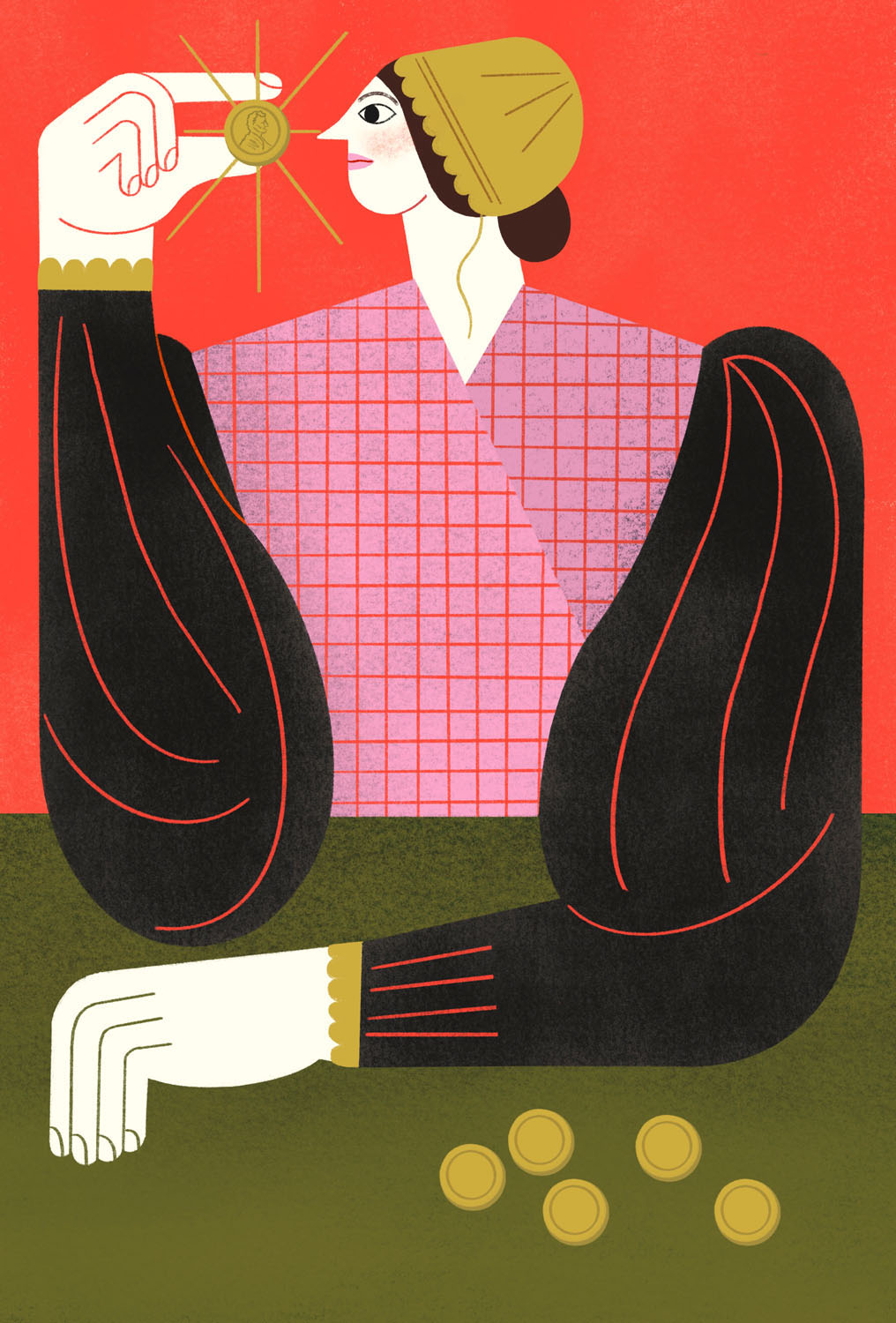
Sarah sits at the table by the open door, stacking coins, each squat pillar an allotment for their household. Rifle and wire, seed and sugar, tack and horseshoe, tobacco and flour, and—God forbid—the doctor. Sarah tells Thomas she’s planning for winter with eight mouths to feed, and he leaves her to it, not knowing that she’s equally keeping an eye on him. She learned from her first husband that a man’s arithmetic may require confirmation.
Her hands feel unnatural from the silver’s tarnish and the pennies’ grime. She moves the little towers across the table as if they were chess pieces and she, an adversary, contemplating her strategy. A penny here, a nickel there. She considers what they can and cannot buy, these dingy pennies with their plump-cheeked Liberty and the languid long-armed lady on the half dime, what happinesses and assurances, what indulgences, how few wishes they will grant. She finishes her tallies and sighs.
The light across the table darkens, and she looks up to see her stepson, Brahm, in the doorway, a crown of sunshine in his hair. He’s but ten years old and already so tall he stoops to cross the threshold. They say he resembles his late mother: gray eyes, a prominent forehead, a melancholy air. So different from her own John, Lizzie, and Matilda. Though truly, so different from any other child she’s known—and she, with no idea how to mother him.
“Someone’s coming down the road,” Brahm says, wrist to eyes, wiping sweat. His sister, Sally, materializes by his side, holding the cat. Sarah rises carefully, mindful of the coins on the table.
They all look out toward the gate. “Peddler of some sort,” Brahm says.
The cart rattles closer. Sally, two years the elder, dashes off to take cover in the chicken coop. Sarah can picture her there, chewing the end of her braid.
The stranger barely waits for Sarah’s half-hearted assent before he sweeps into the room, smelling of spirits and an animal tang so strong it’s hard not to recoil. Sarah stands guard by the coins, sizing up the peddler, who’s shorter than Brahm and leaner than her. The money needn’t be put away.
She listens to him. He’s a profile cutter, a scissorist, a silhouettist, a word she’s not sure she knows how to spell, so he spells it for her, “so you can write and tell your sister, tell her to get one too if she hasn’t yet.” He’s talking fast, in a French accent she doubts is real. He snaps open his valise, which is in fact a large double picture frame. He brushes the dust from it with his own dusty yet nonetheless lace-edged sleeve. The frame is lined with ovals, black paper on cream: profiles of the young and old, the slope-shouldered and the swan-necked, heads bonneted or top-hatted or piled with curls.
“Someday,” he says, “when the parlor’s built, madame will be wanting decorations for the walls and over the mantel.” Sarah winces. There’s no mantel here in Little Pigeon Creek, not yet. Do I wear it so plainly, she wonders, this grasping for a better life? Or has the scissorist’s trade simply educated him in the run-of-the-mill complaints of disgruntled wives in every state?
Meanwhile, the scissorist’s contraptions hold Brahm’s attention. Click, click. The second valise opens. The profile cutter calls it his “physiognotrace,” a contrivance with a screen and two long arms shaped like billiard cues, one to prop it open, the other for the sitter to grasp to position their shadow. Then comes a taper on a candlestick, a sheaf of papers, and, of course, sharp little shears.
He’s telling Brahm of a profile cutter he saw in Missouri. “Such a sight to behold—no hands, and only three toes on one foot, and her silhouettes were the finest I’d seen, and devotional works too, made from cut paper. She’d write a customer’s favorite prayer in a circle no bigger than a dime. It’s amazing what a woman can do with her feet, when she puts her mind to it.” He casts a glance at Sarah’s bare toes, and she curls them slightly as if to hide them. The scissorist asks Brahm to sit at the shadow apparatus, with the lit candle beside him, his peculiar profile cast against the physiognotrace’s board. My boy. She thinks of him as such, though she knows she gained him unfairly. Eighteen months in the house and she hasn’t won him over yet.
The profile cutter points to a dime on the table and says, “This is all it’ll cost you, the both of you, two silhouettes in their frames.” But it’s too much. She looks hard, willing herself not to blink so as to commit this phantom to memory. There, in the shadow, his childish expressions flattened, she sees Brahm as a man: the heavy forehead, the long straight nose, the top lip shorter than its partner, the stub at the chin as if God, when making him, had put an extra daub there.
“We can’t pay,” Brahm says, still frowning.
“Your firstborn—” the peddler says, assuming, but she doesn’t correct him and doesn’t meet Brahm’s eyes to acknowledge the mistake. “Just a penny for his profile if I don’t sell you the frame.” Brahm squirms on the stool beside the physiogno—whatever it’s called. She presses her hand to his shoulder, to keep him there, and takes a penny from the pile closest to her—the pillar that budgets for her own necessities. Her penny for the doctor.
“A mother’s love is a beautiful thing,” the scissorist says.
The penny glints in the midday light. Sarah realizes that no matter what side the coin landed on, Brahm would have told her she’d won. She smiles, then chides herself: “Back to work.” But when she brushes the penny into her flattened palm, she shouts in surprise. The coin has instantly seared a perfect circle, already puffing to blister.
“My boy will really be something,” Sarah replies, and hands the penny to him. Quickly, he cuts the profile, scissors flashing. He blows out the candle and adds a flourish for the hank of hair that droops over Brahm’s eyes, and another for his lashes.
He hums as he tidies up. “I’m here by mistake, you know. An associate misrepresented the district to me. Didn’t know I was in free territory. My business is half made of masters selling their chattel. Customers tell me they make a better profit when a profile’s on the bill of sale.”
Brahm says, “Work of the devil.”
The profile cutter sighs. “That half of my business is the dirty half, but money is money.” He looks around the room once more, then lumbers out the door with the two valises, listing from side to side.
A moment later, Brahm follows after him. “Didn’t close the gate,” he says, and disappears.
When he returns he finds Sarah studying the silhouette. The profile cutter had written Beloved Son in white pencil on the back.
Brahm slides something across the table to her. The penny. “Couldn’t let a bad man get our money.”
“You shouldn’t—” she begins, changes her mind, restarts. “How in the world—”
“Magic?” His voice says it’s a joke, though his face is somber.
Sarah had been ready to scold him, but now, because she thinks how his visage is too often serious, she counters, “Heads or tails? Winner keeps it.”
The child’s eyebrows peak. With a practiced flick, thumb to pointer, he tosses the coin to the rafters. It seems to linger there. That’s how it always is with Brahm, she thinks: a little—she admits the word, from her books—enchanted. It’s wonderful to love someone this much.
Brahm calls tails. He catches the penny and leaves it on the table, where it looks so bright she’s hesitant to touch it. The metal shimmers like the lead bullets Thomas smelts in the grate before a hunt.
“You win, Ma,” Brahm says, calling her this for the first time, the corner of his mouth crooked. She knows he said it purpose-fully. Ma.
The penny glints in the midday light. Sarah realizes that no matter what side the coin landed on, Brahm would have told her she’d won. She smiles, then chides herself: “Back to work.” But when she brushes the penny into her flattened palm, she shouts in surprise. The coin has instantly seared a perfect circle, already puffing to blister. And while the pain makes her eyes water, she stifles her cries and drops the coin to the table, where to her confusion it leaves no mark on the wood.
Something on it’s not right. This bears no resemblance to the countless other pennies she’s seen. Is it a foreign coin? A token from some fair? It’s still face up, heads. She touches it gingerly, then finds for comparison’s sake another penny from the other piles of coins and places them side by side. On the new coin, a man, bearded. On her old penny, Liberty, beribboned hair curling. Liberty who has always irked Sarah a little with her plump face and throat. This coin is 1806, the year of her own first marriage. On the new coin it is—but it can’t be—1909. For a moment, her reckoning fails. Ninety years into the future. She turns both coins over, reading the same words: ONE CENT. UNITED STATES OF AMERICA. Garlands on the older coin, sheaves of wheat on the new, and writing in a foreign tongue. She flips again.
The man’s profile.
Her son’s profile.
Well, her stepson’s, she corrects herself.
An extraordinary version of the profile she’s just seen, that’s now cut into the paper tucked between the pages of her Bible. Brahm, grown to a man, bearded, on a penny!
She sits heavily, jostling the table. Coin towers topple and scatter. She runs to the road, but the peddler’s long receded in a cloud of dust. Somehow, she thinks she can still hear him singing.
She leans against the jamb, knees ready to give.
“Ma?” Brahm asks. Sally has resumed her place beside him.
“That penny. Did you play some foolery on me?” She tries to ask gently.
Sally glances up, which gives the cat in her arms a chance to escape. “What penny?”
Sarah ignores her stepdaughter, staring only at the boy.
Brahm looks puzzled, shakes his head. “No. No trick, Ma.”
Magic penny or not, it doesn’t stop time in Little Pigeon Creek. Sarah can barely complete her usual tasks. She singes the strings of her apron, lets the pot boil over, and doesn’t even blush when Thomas thrusts his calloused hands, wet from washing, into her bodice “to dry them.”
“Now who’s made you such a happy young bride?” Thomas teases her. She ignores him, thinks only of Brahm’s penny, tied in her handkerchief and knotted into the pocket of her calico.
That evening, she leads Thomas behind the barn. It’s a moonlit night, and he prances around her like a puppy. Thinks something else is afoot. No need to disabuse him, but she wants to test the magic first.
“Well?” she asks, hand outstretched, with the penny lying there, glinting pink.
“Well,” he replies.
She flips the coin, switches hands. Still nothing. The crickets are loud. Fireflies spark around them. Something scurries in the underbrush. “I always said you came from funny folk,” he says with a hesitant, flirtatious smile.
“Don’t see anything special?”
He cocks his head and looks puzzled, as he often does when some adult matter comes between them. She presses her palm, with the penny at its center, to his lips and he kisses her there, on the coin, directly. But he doesn’t notice the bloody taste of copper or start at the metal’s warmth.
So she clutches the penny in her fist while Thomas paws at her. The experience is not without pleasure. Mosquitoes bite her neck and thighs, her mind drifts. Why Thomas chose her was a simple answer to an old equation—two households half-orphaned, plus widow and widower from the same town. But why a penny transformed with Brahm’s profile should have chosen her…this she cannot understand. Her father had told her about a predilection toward prophecy on his Dutch grandmother’s side. These forebearers possessed an uncanny “sight,” irregular in its occurrence, passed down through the women. He spoke often of their visions, in particular her grandmother’s, like how she refused to board the first boat they’d booked passage on from Rotterdam, which sank ten miles from New York. The second, via Liverpool, made record time on unseasonably calm seas. Sarah never put much stock in these stories, though now she wishes she had, for guidance as to her own state of mind. Thomas breathes fast, clings to her.
Back in the cabin, she scrapes the dirt from her soles and lies beside her husband, her breast to the knobs on his spine. He is a good man. Not clever, but no fool either. After all, he fathered Brahm. As with her first husband, she never expected to share her secrets with a man, and the penny will be one of these. A certain withholding seems fundamental to marriage.
She spends the rest of the night considering whether the profile cutter seemed capable of magic, or if Brahm wrought the magic himself, or if it’s a hoax, or the work of the devil. The profile cutter, with his Francophile patter, had come off as average at best in his ruses. The labor and fruitlessness of counterfeiting a coin dated into the future is baffling. This leaves hellfire, in which she’s never put much stock. If she has inherited the sight, it is mute magic, bearing no message. By dawn, Sarah decides that she must get rid of the counterfeit penny, whatever its origins. While the loss of any money is a pity, calm reasoning is too precious a commodity for any mother to part with.
By chisel, by axe, by fire, by dirt, by water, she sets about to destroy the thing. And yet it always reappears within a day or two: knocking in the toe of a boot, suspended in the pith of a tomato, on the face of the dead Grigsby grandfather laid out for his wake. After two weeks of this, she puts it on her tongue, ready to swallow it, but reckons she’d likely choke. She decides to examine it once more instead.
Upside down, it looks a bit like a mushroom. Right side up, the face is still her Brahm’s. The profile cutter’s silhouette confirms this. The worried brow that seems so heavy, even comic on his little ten-year-old face now reveals its grandeur on the grown man. The nose, already large and an occasional source of derision, here outlines a stately, craggy profile. Of course it’s him, with a curlicue pattern stamped just below his cravat (cravat!). She traces over the date, 1909. It’s a hundred years from the boy’s birth. She knuckles her eyes and rubs the coin to the cotton at her wrist, but the bas-relief remains unchanged. LIBERTY. IN GOD WE TRUST. These are politicians’ words. This, then, must be his future. And whose face would they put on a coin but a great man’s?
She remains alert to premonitions. She revisits again and again the penny’s arrival. And for some time she cannot fit one piece to another, until one afternoon it occurs to her, as the two of them are walking to the creek to harvest melons. The cottonwood’s boughs rustle in the shoals, making a papery sound. Like pages turning. Books, she thinks. I must set Brahm to reading. He’s already hungry for it, though his days in ABC school have been scant.
“I have some books in my trousseau,” she tells him, trying to keep up with his long strides. Books from Bleakley and Montgomery’s in Elizabethtown. She names the titles: Pilgrim’s Progress. Aesop’s Fables. And a fine one on elocution and another of orators and their speeches. Back in Kentucky, she’d kept the books through the sales of their pots and linens. When she moved to Indiana, she had traveled with them swaddled in muslin to keep the silverfish out. These new books of hers are monumental. She hopes they will occupy Brahm’s mind in ways the seed catalog cannot.
In no time, he makes his way through Dilworth’s Spelling. At Sarah’s request, while she darns socks and mends trousers, he recites speeches from the elocution book. He learns easily, quickly. His absorption is a beautiful thing.
Next, Sarah tells Thomas, “The children should not be in rags, they should live in a house with a proper floor.” What she really means when she says “the children” is Brahm. So, by late November, her husband has laid a wood floor and planed it for her to do the scouring. He makes good beds, and she inveigles him to tinker with the roof so that the boys, who sleep in the loft, won’t wake with snowflakes in their hair. At meals, she drops extra victuals on Brahm’s plate. The others are so accustomed to this that they hardly protest.
Sarah wonders if he might prefer to introduce himself by his Christian name. Brahm, she suggests, does sound like a miller’s product or a pricking thistle. And now that he is sixteen…
“Mama called him ‘Brahm,’” says Sally. And though Brahm is still tied to his elder sister as if they were twins, for once, he takes sides against her.
However, his Christian name also falls quickly into disuse. It’s too big a mouthful when the pigs get out. Abe, of course, is the natural choice.
It’s on one of these sleepless nights, midwinter, kneeling in prayer and teeth chattering, that the next vision comes to her: that is, that her vision has been faulty all along. Tragedy, not promise, begot the penny and its portrait, and it has thus levered the boy from her. The higher she sought to raise him, the further he ranges.
Abe has grown faster than any of them has ever seen a boy grow. Sarah jokes that he must wash his hair more frequently lest his forelock leave prints on her ceiling. So one day when she’s visiting with the church ladies, Abe puts mud on the heads of the littler ones and uses them like paintbrushes in her rafters. She laughs and laughs, though Thomas says—and not for the first time—that she’s too indulgent with their son.
A year passes. Scarlet fever comes for Matilda, John, and, finally, Abe. While the doctor presides over the first two sickbeds, Sarah insists her hand is the only one that can cure Abe. Leeches, clysters, and bleeding follow. Thomas and Sally ask to send for the doctor, but Sarah’s blinded by her confidence in the penny. Their boy can’t die of scarlet fever at seventeen if he’s commemorated on US currency as a man of fifty. She keeps vigil at his bedside while the others move around her like the cutouts in a shadow play. Thomas is called away on business. Sally reprises the role of woman of the house and hovers but doesn’t intervene, though Sarah vaguely senses she wants to.
Abe doesn’t wake for three days. He goes from gaunt to wasted to skeletal. His skin is jaundiced, damp; his pulse thready and weak. He already looks like a corpse.
“You mustn’t die, Abraham,” she whispers to him as she kneels by his bed and explains why. Her lips brush his clammy ear as she tells him of the penny: the burn, the coin’s reappearances at the Grigsby’s burial and in the pith of the tomato, her consideration of its symbols, and the century celebration of his birth. How it slumbers now in the band box from her trousseau with its strips of lace. She tells him that he must live, no matter what, because his image will be engravened on something that will change hands ten thousand times. That, whereas Liberty’s face alone graces the money of their era, in the new generation he will be its Liberator. Abe will be so beloved to the nation that they will mint his face on the coin of the common man. This penny has made them a magical promise.
The boy shifts. His eyes open and his chalky lips shape the words Sally and water.
For the first time in weeks, Sarah drops into a deep sleep, so sound that she does not wake until the following night. When she does, Abe is staring down at her, and she screams, believing he’s died and it’s his ghost visiting. The ghost laughs and offers her hot whiskey and honey. Sally props her pillows, and Sarah sits up in bed.
Abe says, “Mother, Sally has something to tell you,” and drifts away before she can see the look on his face.
Sally, hands wringing, announces her engagement. But to whom? Sarah asks. Sally names Aaron Grigsby. Sarah pictures him: small, mean, stub-fingered. Surly at his grandfather’s wake and scratching at the rash beneath his yellowed collar. Whips his horses at the slightest provocation.
Sarah tries to protest. She touches the girl’s soft cheek, her thick braids. “But he’s no good. You can’t.”
Sally turns aside, eyes brimming. Outside, the blurry shapes of the boys move from the new greased-paper window. Their shouts seem to come from another life, one distant from the sorrow descending indoors.
Sarah sews Sally a wedding dress, with bobbin lace at the throat and hem, as if she could sew penance into each stitch that will encase the girl’s blossoming body. The Grigsby father haggles over the dowry, though the Grigsbys are the richer clan. There’s the question of a bed, a mattress, a carriage. Sarah leaves it all to Thomas, who seems surprised by her behavior. Decisions agonize her now. The wedding day comes, and it’s a miserable one—rainy, muggy, with clouds of mosquitoes. At the altar, the groom taps his toe, and the bride’s smile makes Sarah wonder if she has forgotten a pin in the dress’s seams.
In a week’s time, Abe comes to her. He speaks to her from the other side of the cabin. Her son! She yearns to hold him close.
“Ma,” Abe starts. A long pause follows. He runs his massive hand through his hair. “During my sickness, I had such terrible fever dreams. Goats with a woman’s mouth, that sort of thing. And you were there too, telling me about magic, and a penny, and seeing my face on it—” his voice trails off.
She senses his unhappiness. He’s been gloomy since Sally left. She tries a laugh, as there’s always been laughter between her and Abe, but the peals are too shrill.
“Did I really say that?” she stalls, blathers, prevaricates. “I was worried out of my head. Telling stories. It’s what all mothers do at a child’s bedside.”
In the months that follow, a chasm opens between them. She overhears Abe tell a boy from town how he can’t wait to leave his parents and their provincial, frontier ways. Whereas before Abe disliked being hired out, now he jumps at the chance to be anywhere but home. Worse, Abe speaks to Sarah and Thomas as one. She sees he misses Sally. When Sally does come home—apron dirty, plaits awry—she’s downcast and silent. But Abe, as always, can cheer her, saying that she must name the child she’s carrying after him. Abraham, girl or boy! They take to calling the unborn child Baby Brahm, then B. B. for short. With an eagerness that surprises her, Sarah anticipates how Sally soon will be another mother to talk to—life has been lonely, especially with Abe’s absence. Sarah will be so helpful to Sally, and Sally in turn will provide welcome camaraderie.
They are all expectant.
Even the harvest is good. A band comes through town, Abe marches in the parade, and for a while everyone is distracted with the preparations for B. B. Together, Abe and Thomas make a cradle and a rocking chair.
The birthing day comes. The child is a stillborn, and Sally dies shortly after. Abe is desolate. He rages that the Grigsbys delayed in calling the doctor. At the funeral, they bury Sally holding B. B. in her arms. Abe is barely civil to the widowed bridegroom. Afterward, he storms the house and attacks the rocking chair, fists windmilling, the sound of the wood splintering not nearly as horrible as the weeping that follows.
Abe can’t stand the town another moment and makes plans to leave, working longer hours farther from home to pay for the trunk and clothes and stagecoach that will furnish his escape to a different life. She sleeps poorly when he is elsewhere, though she knows he can defend himself. Who would tussle with a giant? Still, this hardly quiets her mind.
It’s on one of these sleepless nights, midwinter, kneeling in prayer and teeth chattering, that the next vision comes to her: that is, that her vision has been faulty all along. Tragedy, not promise, begot the penny and its portrait, and it has thus levered the boy from her. The higher she sought to raise him, the further he ranges. She opens the Bible to find the coin tucked between its pages, face down, its writing ringed with wheat. Wheat! How had she not remembered John 12:24, not even at Abe’s bedside? What was she thinking then, if not of the Good Book? Verily, verily, I say unto you, Except a corn of wheat fall into the ground and die, it abideth alone: but if it die, it bringeth forth much fruit. She reads a different fortune in the penny now. Abe, in his goodness, shall be cut down. It is her private torment and a public funerary monument.
There’s a brief early thaw, and the roads clear. Abe can take a stagecoach to New Salem a fortnight earlier than anticipated. But his happiness only brings her more sorrow. The penny now reappears in the coffee tin, and she doesn’t bother to move it, feels ill each day at the sight of it. Thomas laments how she’s changed, asks where she’s hidden his happy bride.
Abe writes, though not often. He’s studying law, passing the bar, opening a law office. He visits, but it’s always as if half of him is elsewhere, even though his person takes up more room than another’s. He never asks Sarah for her opinion, and when Sarah says of his sweetheart, “That Miss Mary, isn’t she a bit haughty? Too accustomed to the finer things?” she worries that she’s only goaded him forward with her disapproval; that, on principle, he will advance the opposite of her choice.
Thomas falls from the plow. The doctor sends for the priest. Sarah sends for Abe, but by the time he arrives Thomas has recovered, and Abe takes them for liars and leaves quickly. Later, when consumption makes Sarah a widow again, Abe doesn’t visit, doesn’t attend Thomas’s funeral, doesn’t commission a proper headstone like he promised because, she supposes, he’s too preoccupied with his responsibilities as a state representative. She reads the newspaper’s coverage of his debates with Stephen Douglas before he can write her himself. Likewise with his speech at Cooper Union, which catapults him to the Republican nomination. She curses the scissorist, the penny, Dilworth’s Spelling, and the elocution books. Could she have been content with only ordinary happiness for the boy? She tells herself yes, but her thoughts are interrupted by a neighbor bringing reports of Mary Todd’s latest fashion, a purple velvet dress piped in satin. Is Abe hers, or theirs?
She’s seventy-three, living with Matilda in Goosenest Prairie, near Farmington, on the day that she learns he’s won the presidency. Though a string of friends and acquaintances come to congratulate them, Sarah cannot celebrate. She tells the mayor that the proslavers will kill her son. Asks the pastor’s wife if she heard how the Georgia Constitution printed the news of Abe’s win ringed with a black border, like a death notice.
Matilda glides to her side. “Best not to read the papers, Ma,” her daughter says.
A single bullet. The clatter of the horse’s hooves, tearing toward the house, announce what has happened even before the words are spoken. Despite her years of dread, Sarah is still shocked, numb. People come and go from the veranda, whispering about Booth, who has yet to be apprehended. All movement around her seems slowed, as if underwater. Each breath is too shallow, insufficient. Someone gives her a draught, and she sleeps until she’s woken by a rustling in the room. Eyelids heavy from weeping, she rises unsteadily to find her sewing basket, where the penny last appeared stuck between the sundries of her pin cushion. Inexplicably, her heart lifts. That wheat-sheaf penny will tell her something. Of some message, some meeting, some consciousness in the beyond. With fumbling fingers, she plucks the coin out only to discover that it is now an ordinary penny, dated 1859, minted with a fat-faced Liberty wearing a crown of feathers atop her flowing hair. Sarah wails with such force that three of the house help come running.
Time passes. Sarah wears mourning crêpe so often that she can no longer recall when she donned it. Daily, she asks God to let her die. Each spring, as her boy’s death day approaches, these entreaties grow more fervent: If there is kindness in His heart, may He send her to join Abe, may He not ask her to suffer the anniversary once more. April 15 dawns again. That morning, Matilda finds Sarah in her chair on the veranda, face upturned, dew in her hair and on her cheeks and hands and the blanket across her knees as if she’s spent a long night there. Above her, a pair of house finches flit to and fro building their home in the eaves. They were the only witnesses, then, to the moment when, at last, a mother’s will rose to meet her magic. How she sat bolt upright in that rocking chair, eyes and mouth wide, rejoicing to gaze once more on her boy’s beloved face, copper bright, amid the twigs and twine in the finches’ nest.
Helena Pallarés is a Paris-based illustrator whose work has been featured in The Washington Post, Glamour, Libération, and Madame Figaro, among others.