Image

A few years ago, I traveled to Skovsbostrand on the island of Funen in my native Denmark to write in a solitary residence by the sea. It was winter, too cold to sit in the garden among the priestly Eranthis and flocks of snowdrops, their heads bent toward the earth. My days were spent in a corner room, writing and watching gullible-looking ferries plow white furrows in the dark-green sea. Over the decades, many writers have found refuge in this whitewashed, half-timbered cottage—one hundred or so miles from Copenhagen, where I was born—among them the German dramatist Bertolt Brecht and his friend the essayist Walter Benjamin. A photograph of the two playing chess in the garden hung on the wall. I read about Benjamin’s angel of history, and during dark afternoons, the august space felt a little haunted. Alone in the cottage, I thought about the past asserting itself on the present and longed for my mother, who plunged to her death in a stairwell when she was forty-three. I was thirteen.
My mother was commensurate with the world, the first person to teach me I was a person, distinct, a self. To lose her was to become unmoored, to lose my bearing on time and place. Is it surprising I sought to anchor myself in the present by becoming a journalist? Reporting and writing were ways to make sense of the world, to find a foothold in facts, and since I didn’t know how to write about her, I wrote about other people. As a young reporter in California, I covered murders, wildfires, and earthquakes, the scale of my loss recalibrated against the backdrop of inscrutable malice and the indiscriminate power of nature. My notebook was a form of protection in a precarious world: Words are an attempt to control events by giving them shape. If I could pin death to the page, horror would lose its power. Observe and describe meaningless accidents and random catastrophes. Observe and describe violence. I became a foreign correspondent, reporting from Israel and Gaza, Beirut and Baghdad at the height of the war. I didn’t write for my mother or with her in mind. Yet behind everything, there she was, a shadow. My origin and mold, me but not me.
A friend once told me that we go to the archives hoping the dead will speak to us, and it occurred to me that if I could find some documentation that told the story of her death, it would cancel the empty decades between us and allow me to spend time with her again. Perhaps I could approach her death as I approached any story: Find the indisputable facts. I started by emailing the Copenhagen Police and was told the report related to my mother’s death had in fact been transferred to the national archives, and so I wrote an official request for the file and was told it might take some time to process. (The national archives, or Rigsarkivet, which describes itself as “Denmark’s memory,” holds documents from the twelfth century on: parish registers, divorce and probate court records, police reports, death certificates, and handwritten documents in Gothic script, among them. Denmark is a small country with deep shelves.)
I returned to New York, taken with this idea of a conversation with the past, however painful it might be. When I told friends and colleagues that I was looking for my mother’s file, I was met with misgivings. An unsentimental older friend bluntly asked what I hoped to achieve. I didn’t think it would do anything. Some things are irredeemably bad and resistant to our narrative efforts, I told her, knowing my protests disavowed the notebook in my bag and my life as a writer.
A few months later, I heard from Rigsarkivet. I could only get the file in person. And so, in late June, I was back in Copenhagen, walking along lakes that mirrored the weak gray sky. It was mild, the city drained of color, the horizon dissolved. Near the archives, I thought I saw my mother sitting at an outdoor café in that dusty blue leather jacket, drinking a glass of wine and smoking a cigarette. Returning to the place of my childhood felt like confronting the mystery of time, past and present no longer so easily separated. I thought again of Benjamin’s angel, who would like to “awaken the dead, and make whole what has been smashed.”
The reading room at Rigsarkivet is housed in the Royal Library, known colloquially as the Black Diamond on account of its modern wing in glass and polished dark granite. It sits on an embankment behind Denmark’s Parliament, like a giant gemstone about to tumble into the canal. The interior, too, has a jewel-like quality. The building’s materials reflect the shimmering water, so a visitor on a bright day has the sense of being trapped by refracting light. At the entrance to the archives, a guard informed me that bags were prohibited. I went downstairs and placed the bag in a locker, then returned to the reading room to fill out a form. I felt defenseless without my belongings. Beyond the security desk, the reading room was quiet. I handed the archivist a slip of paper with the file’s call number, and eventually he brought it to me. I was acutely aware of the yellow folder’s smoothness in contrast to the coarser paper inside. The absence of folds in the stapled pages suggested that no one had actually read them. Removing the staple, I placed the pages, unread, one by one, on the glass plate of the scanner. Half an hour later, here was the digital ghost of my mother: D:/Zeta/annelise.pdf. Paper to digits, digits to cloud.
A police report is a claim to discoverable facts—who, what, when, and where—and as such is related to journalism. The anguished why is not an official concern. Like the dead, why exists outside of time, in the realm of poetry and religion. A police report aims for finality. My mother’s, however, was full of contradictions and mistakes.
I was back in New York, the summer nearly over by the time I gathered the courage to read what I had brought home. The file, it turned out, comprised four documents: the police report, the autopsy results, a letter from my father, and a note about my grandmother.
Written over four days by five different officers, passed from cop to cop between shifts like a secret message or a game of telephone, the report was as messy as life itself, a chorus of dissonant voices. What struck me first was the misspelling of my mother’s given name, Annelise, which, with careless violence, the officers broke in two. Seeing “Anne Lise” on the page infuriated me. A proper noun is specific: The name is the person. In wrecking her name, they wrecked her further.
Both my parents were writers, so they understood and cared for the intricacies of language. Coming home from school, bounding up the steps of our townhouse, the first sound I heard was their insistent typewriters imposing their ideas onto paper. My mother wrote freelance ad copy; my father did public relations. They worked in adjoining offices in my childhood home, a townhouse in the historic center of Copenhagen. Although they had divorced, we still spent most days together as a family.
A family friend later told me that when my mother asked my father for a divorce, he didn’t respond with what she had hoped to hear: that he wanted her to stay. Instead, he told her if she left, she would forfeit her married name, Bokkenheuser, and would go back to being Olsen, the suggestion being that theirs was a Pygmalion story; that he had made her and could therefore unmake her. Was this cruelty an attempt to mask his despair?
My parents met in a business meeting. The first evidence of a romance is dated October 3, 1969, when my father sent my mother a note en route to Paris.
Dear Miss Olsen,
Rapidly, alas, we draw near to the year of dust, and while I am gone, you suddenly age by a year. Well, I hope you have a lovely day and take these lines as applause for the many years.
Best, Søren (Bok.)
He added in a loopy hand: “Imagine being born on a Monday!!! It sounds more like Charlie Brown.”
On March 18, 1970, my father wrote:
My beloved!
Even before you have walked out my door, I miss you.
How, then, does it feel when you have actually left?
It is pleasure and agony to feel like this.
Until tonight.
In five months, they traveled the distance from “Dear Miss Olsen” to “My beloved,” the letter arriving by morning post, a twice-daily postal delivery that allowed for a volley of romantic missives. And through this retrospective lens, our lives seem inevitable, one thing leading to another like the beginning of war. My mother was demonstrative, and I’m certain she replied. But the correspondence I have is one-sided: Her letters have vanished. Did my father get rid of them, or did others clean out the drawers after both were gone? I have only one thing by her hand, a poem of sorts about my father:
My beloved smokes forty cigarettes a day
The sun paints white-yellow stripes in his hairMy beloved is a gambler. Cards, roulette, horses—the lot
He has the most beautiful eyes and the loveliest smile that I knowMy beloved can drink a bottle of gin—and does so with relish
He thinks of the sweetest, funniest little things to tell meMy beloved has shapely, sensuous lips
With ease, he talks me out of one thing and into anotherMy beloved fears big words and uncontrolled emotions
He values intellect, says its use should be encouragedMy beloved doesn’t like to give or receive consumer goods
He sometimes talks about the children we will have together
And his eyes are gentle
Every year, my father commissioned an artist to create a lithograph, which he would give in numbered prints to friends and clients. His own father had been a painter, and he liked supporting the arts. The year of the divorce, he instead commissioned a composer to write a piece of music to commemorate the year. It is an elegy, a piece for four hands.
On October 11, 1986, a Saturday, family friends came by to pick up a kitten from our cat’s recent litter and then stayed for dinner and drinks. Eventually, I went to bed, falling asleep to jazz drifting up from the living room. Friends later recalled a delicious meal and a beautiful candle-lit table and how my parents flirted with each other. Sometime after midnight, my mother walked home to the apartment she shared with my eleven-year-old brother, Andreas, who was away at camp. The walk along the cobblestoned streets took about five minutes. At around 2 a.m., my mother entered her building, where she and my brother were the only residents. Offices occupied the floors below her apartment at the top. A gay nightclub, El Toro Negro, took up the mezzanine.
The first voice of the police report belongs to the nightclub’s doorman, who, through the peephole, observed my mother coming home in her gray coat. They spoke briefly; she told him she appreciated his keeping an eye on things. She appeared inebriated and unbalanced, he testified, and I wonder: Did he judge her? Did the police? I emailed one of the family friends who came for dinner that night to ask what she remembered. “Your mother was tipsy, pleasantly sociably tipsy certainly NOT very drunk,” she responded.
In her book Full Lives, the Danish journalist Anna von Sperling charts how drinking became a symbol of progressive prosperity during the 1970s and ’80s. The temperance movement never took root in Denmark as it did in other Scandinavian countries. The consumption of alcohol exploded after the country joined the European Union in 1973, which reduced the cost of wine and dovetailed with the women’s liberation movement. My mother sometimes drank wine with her clients, many of whom doubled as friends, during lunch meetings or as the afternoon got underway. The line between business meetings and social events wasn’t always clear in the advertising industry in the 1980s, and anyway, few Danes took a dim view of drinking at work. Do I offer this cultural history because I still feel an impulse to protect my mother? The word used in the report is beruset. I am aware that in my initial translation of it, I shied away from the word drunk and downgraded intoxicated to inebriated. To whom does the shame belong? And is it somehow worse because she was a woman?
The police report offers this: A sample of my mother’s blood taken six hours after she was found showed a blood-alcohol content of 0.05 percent. In the United States, the legal limit for drivers is 0.08 percent. But the level of alcohol in the body over time depends on the size and composition of the particular body. Reading the report, I could feel what I felt as a child about her drinking. The sense of catastrophe on its way. How someone who suffers migraines might feel the barometric pressure drop.
After wishing her goodnight, they parted ways, my mother continuing up the stairs. Inside the apartment, she took off her coat and put down her bag. Fifteen minutes later, the doorman returned to the vestibule and found her at the foot of the stairwell in a pool of blood, alive but unconscious. She lay on her stomach with her head turned toward the front door, he told the police. This is a description of a victim. This is my mother. This is not my mother.
Bishop Absalon founded Copenhagen in 1167. Consider the city’s defenses: to the west and north, a moat; to the southeast, dentelated ramparts. Impressive earthworks, irrelevant against the successive fires that lay waste to the city. My mother’s home, built by a porcelain merchant in 1796 after the second fire, is on the Danish registry of protected buildings on account of its “calm expression and harmonious proportions in the classicist style.” The police report is not concerned with aesthetics. The stairwell is a little more than three feet wide, the investigators tell us, noting that only a small bit of wood has been broken off the banister. Wouldn’t she have had to propel herself into the middle of the stairwell for her body to stay clear of the railings all the way down? Or does her trajectory describe a physical law? Did she lose her footing? Or was she drawn to the void?
The doorman alerted the owner of the nightclub, and together they called an ambulance. By the time police arrived, medics had taken my mother to the hospital. What remained was a small pool of blood and a broken flower. On the stairs, investigators found leaves and petals from what appeared to be a rose. There were no flowers in the apartment that matched the leaves found on the stairs, the report says dispassionately, offering no explanation. The missing roses, a kind of poetry.
Upon closer examination of the victim’s apartment, we noticed the light was on and a window was open. A charcoal-gray coat was lying on the couch, and there was a lady’s bag on a chair. Everything in the apartment was nicely neat. No signs of carousing or carrying on.
These facts—the open window, the gray coat thrown onto the couch, the light streaming onto the landing—have no material value. Yet they are charged for me. I know this apartment well. I can see my mother as she flicks on the light, throws down her coat, and opens the window. She knew what it meant to be a daughter and a mother. This small home was how she sought to build independence, its IKEA furniture assembled, proudly, with the help of other women. Unstated, of course, but the “nicely neat” observation is a judgment, an instruction to remember: Clean up before you go out. For a woman in particular, tidiness can become a character witness.
At 5:17 a.m., a doctor from the hospital called the on-duty officer to say my mother’s condition was serious. Police notified my father more than an hour later, at 6:35 a.m. Why, I wonder, did it take that long? Perhaps by then it didn’t matter.
My mother was commensurate with the world, the first person to teach me I was a person, distinct, a self. To lose her was to become unmoored, to lose my bearing on time and place. Is it surprising I sought to anchor myself in the present by becoming a journalist?
That Sunday morning in October, I am cocooned inside turmeric-colored bed linen, bæk og bølge, warm from my body and soft from my mother’s constant, absentminded laundering. The day spreads open before me. Stacks of library books on my desk. Yellow sunlight floods the room. Through my window, I see the Copenhagen spires, the green roofs of oxidized copper.
“I have bad news,” my father says as he steps into my room, wearing what he always wears: blue corduroys and a blue V-neck pullover, the wool thin from wear on the elbows; its logo, two white golf clubs, stitched across his heart like a talisman. He hasn’t in fact come into my room but is standing in the doorway, his profound frame a kind of wholeness that still signals safety and home. My cares at that moment are still simple ones: Should I stay in bed? Have breakfast or shower first? I have lived a sheltered life. My father calls me tusindfryd, “a daisy; a thousand joys.” “Your mother…” he says now. Or does he say just Mother? In my native tongue, your mother would be distant and formal. But then my father has always kept his emotions hidden, his sorrows too deep. “There has been an accident.” And this is not strictly accurate in my native tongue, either, but something more like “Your mother has met with an accident,” a kind of emphasis on the unpredictability of life, existentialism embedded in a casual phrase. Time slows down. I know this is the moment of my ruin. I cannot recall his exact words, but my father wants to communicate the end of hope—that much I remember. I gather the duvet around my body and wedge myself against the wall in an attempt to cradle myself, like how you might swaddle a newborn. I understand I will not be held again by my mother. “You know I love you?” my mother often asked. Not a rhetorical question. She wanted to know. Only years later did it strike me as odd that the child should reassure the mother.
When my father and brother go to say goodbye to my mother, who is still in a coma, I refuse to go with them. I am too invested in her familiar beauty, that slightly upturned nose, the high cheekbones freckled in summer. I cannot bear to imagine the first face I knew, now unrecognizable. At the hospital, my maternal grandmother confronts my father, a family friend later tells me. “Why did you let her go?” my grandmother cries, her only child now beyond her. “None of this would have happened if you’d taken her back.” “I was going to,” he tells her quietly. “That was my plan.”
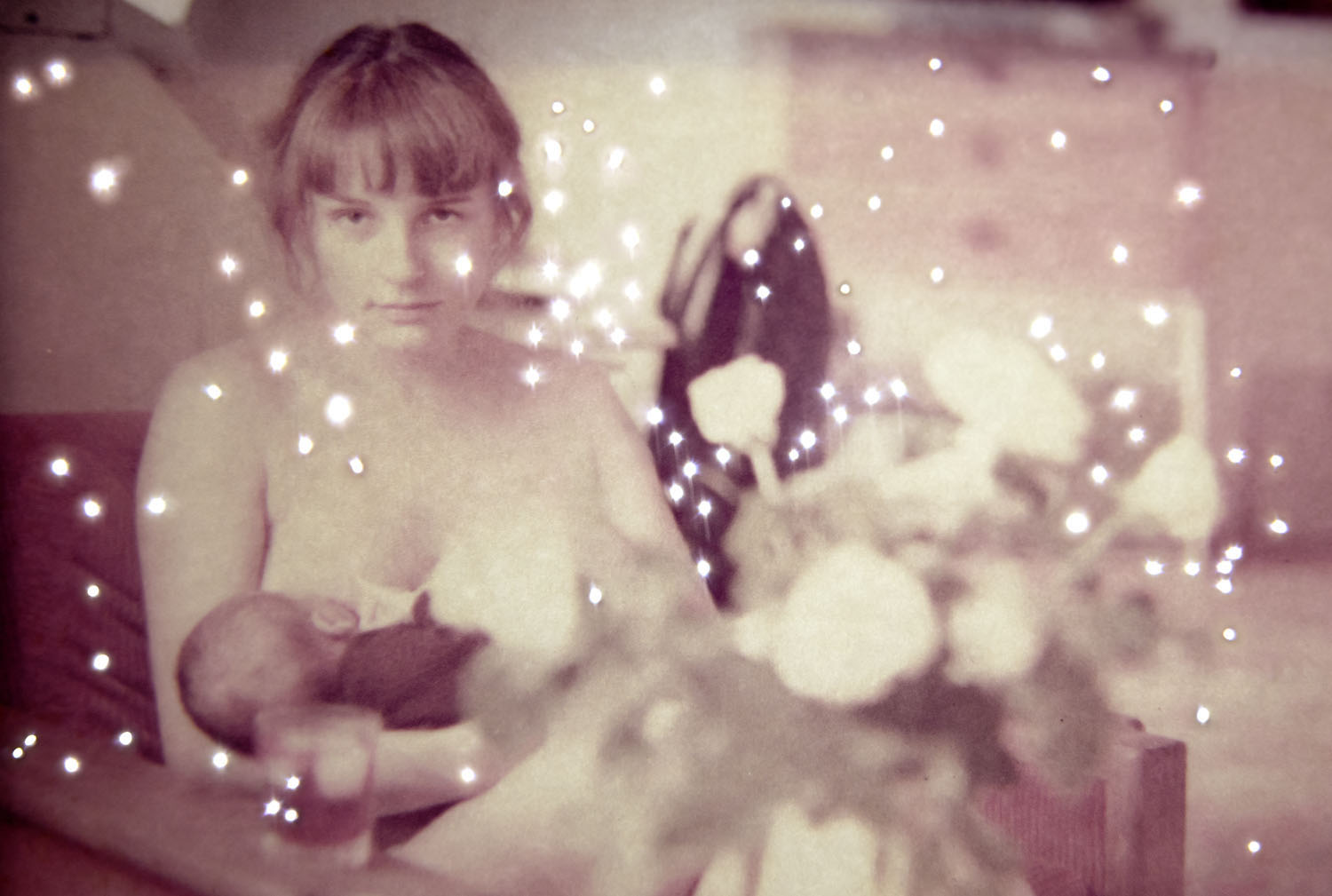
In one of the earliest photographs of us together, taken soon after my birth in the summer of 1973, she sits naked in an armchair, holding me in her arms. A drink sits on the armrest. Campari and soda, I think, given its ruby color and the high summer. My mother, just shy of thirty, appears at ease in her nudity, which is mostly obscured by me and a small bouquet of roses in the foreground. (Here are the roses again.) She looks at my father behind the camera with an intense, inscrutable gaze. Is this a moment of love and contentment? Or is she enraged by the claims we have made and will continue to make on her body? Even before her sudden death, she was a mystery. Perhaps every mother is. But why did her presence feel transgressive, at once too close and never close enough? What does it mean to be of another person?
Once I started on the autopsy report, I understood my resistance to reading the file. Here is where I meet my mother once more. I am inside her body again. In the report, I read that the dark-purple discoloration of her skin was a sign of livor mortis. Once the heart stops pumping, gravity works on the stagnant blood, which pools in the parts of the body closest to the earth, in this case, her back. Her death is finally real to me. Her warm skin gone cold. I remember her touch and the importance she placed on pleasure, the love affairs that consumed her, especially (though not exclusively) after the divorce. One afternoon around Easter, we took a walk near the beach. The day was bright, the black asphalt dusted with pale sand. Should she tell my father she was going to Paris with her lover? I was eleven or twelve and felt my father might be upset by such news. But lying wasn’t an option. My parents were divorcing and I had met her lover; she had brought me to his house and introduced me to his daughter, a girl my age whom I despised—not for the person she was, but for what she represented. I don’t remember what advice I gave my mother. I just remember her need for collusion and the complex pity she evoked. No one told her to cover her softness, to hide her yearning to be held, to shield those beautiful green eyes, prone to hurt. Her vulnerability frightened and repelled me. And it was my duty as her daughter to protect her. Her exposure was my deepest fear. And now, here she is, an object, constituent parts. The pupils are uniformly rounded. No leakage of blood into the mucus membrane that covers the front of the eye and lines the inside of the eyelids. Relief that this porous periphery between her and the world remained intact, even if the solidity and integrity of the human body is itself a fiction. We are made mostly of six elements: calcium, carbon, hydrogen, nitrogen, oxygen, and phosphorus, and, in a finite system, of what came before us. A hopeful thought. She did not disappear but transformed.
Inside my mother’s mouth, this intimate space, the coroner finds nothing abnormal. I let meaning through in increments. A couple of broken ribs. Her body surprisingly untouched by the fall. The damage mostly done to her head. Blood in her brain. Her skull and neckbone crushed. The right eye socket and temple fractured. My mother would have liked that a woman conducted the autopsy, a hard, laborious task. An IUD in the uterus. When I was still a child, I asked her what sex was, and she laughed because I was young, maybe nine or ten. What is it like, I wanted to know. “You know that feeling when I stroke your skin with my fingers? It is like that. Only infinitely better.” She gave me an understanding of pleasure as its own reward, and even as a child I understood the complicated pride she took in her body’s communication with the world, an ancient call-and-response. Did her beauty distract her from discovering the part of her that existed not in relation to others, but free of them?
The forensic pathologist sawed through her ribs. My mother’s heart weighed half a pound. This mighty muscle. This small thing. Was she put into the ground like a husk, her heart and brain incinerated with other hospital waste? Was she still my mother by then?
On October 26, 1986, two weeks after my mother’s death, my father wrote a letter to the police:
On Sunday 12 October 1986, Annelise Bokkenheuser was found critically injured at the bottom of the stairwell in the property at Boldhusgade 2. Copenhagen Police, Store Kongensgade handled the case. Annelise was my former wife and the mother of my children. In this situation, you think about big things and small, and among them, I remembered the watch I gave Annelise on her 40th birthday. It would be a lovely thing to give to our daughter at a later date. Absolutely indestructible watch and really a nice thing. Checked whether the watch was among Annelise’s things when she was found. And it wasn’t. Have done a little research and tried to reconstruct what happened. Have been informed that a doctor at the entrance to the Municipal Hospital gave Annelise a drip [an IV] in her left hand, and he says she wasn’t wearing a watch. Annelise wore the watch day and night, and that means it must have been taken from her sometime between her lying unconscious at the bottom of the stairwell and her arrival at the Municipal Hospital. It is unlikely, but stranger things have happened. So maybe…It would be good to get the watch back.
Someone slipped the watch off my mother’s wrist, stole this symbol of my father’s love as she lay dying. I knew the story but, wishing it not to be true, chose to forget. The watch was never recovered.
After my mother’s death, my father busied himself with the errands of death. Funeral arrangements, purchasing a coffin. He was a freethinker with an atheist’s distrust of religion but was grateful for the pastor’s service at the funeral, noting in his diary the sincerity of her eulogy. I don’t remember the service. But in the days afterward, I wore my mother’s clothes in private, the autumn-colored knit dress and cashmere sweater too large for me at thirteen but still fragrant with her scent of wood and musk. My father still sang “Oklahoma” as he woke us in the morning, his familiar round shape pulling the curtains back. But when I came home from school, it was just the sound of one typewriter now. And sometimes even that was silent.
Then, one day without warning, he went under. Didn’t leave the house but lay in bed, catatonic. I tried to reason with him and poured out the bottles. Later I raged and I begged. For a long time, this was our life. He was fine and then he wasn’t, his sorrow like the ocean, unpredictable and vast. Years later, I read his diaries and noted the missing days, the ones too painful to record. Like our first Christmas without my mother, when he committed himself to the psych ward, his faithful history-keeping resuming on the other side after his release. “Probably the worst night of my life,” he wrote in spidery ink, and I believed him, believed the terse understatement of “probably.”
At Christmas, two years after my mother’s death, my father’s flickering heart went out. After his death, family friends, who had pledged to become our guardians, clarified they wanted a part-time arrangement. In quick succession, we lost our childhood home and most of our possessions. My brother and I fled Denmark as soon as we could, leaving behind my mother’s building, a blóthús in Old Norse, “a place of sacrifice.” We gave up our mother tongue, the word mor itself. From now on there was only Mother, a less painful abstraction. In return for her life, we took the world. Andreas moved to Asia, trained as a financial analyst, learned how to think about risk. I became a reporter at the Los Angeles Times, drove between crime scenes in search of the story. My editor would tell me: Figure out what happened. Write it up.
In one of the earliest photographs of us together, she sits naked in an armchair, holding me in her arms. She looks at my father behind the camera with an intense, inscrutable gaze. Is this a moment of love and contentment? Or is she enraged by the claims we have made and will continue to make on her body? Even before her sudden death, she was a mystery. Perhaps every mother is. But why did her presence feel transgressive, at once too close and never close enough? What does it mean to be of another person?
A loose sheaf in the folder dated three weeks after my mother’s death. My maternal grandmother, Ada, showed up at a police station in central Copenhagen, depressed and crying intermittently. She was, at this point, seventy-three. During an earlier interview, she had told police my mother had been unhappy since the divorce. She had at times drunk a fair amount, for which the respondent had scolded her. What I remember: My mother called my grandmother every day and most days put the phone down in tears. For fifty years, my grandmother lived in a loveless marriage with a small-minded tyrant and it made her bitter. But in pictures of her as a young woman she has the same faraway look of longing as my mother. After my mother died, I fought with her until one day when I realized she was the only woman left to me, and in our last years together, we became close. Like me and my paternal grandmother, Ulrikke, she lost her mother at thirteen. A family curse. Women without mothers.
According to the file, my grandmother told the on-duty officer that she was the mother of Annelise Bokkenheuser, her only child, whose death she didn’t understand. She had been told the daughter had fallen from a landing but nothing else. The undersigned, who knew nothing about the case, could of course not disclose anything to Mrs. Olsen but I hinted at the possibility of suicide. Suicide. An idea thoughtlessly introduced by the young officer. My grandmother was not receptive and responded that my mother was not depressed. Against suicide, she added to the ledger: two small children. Us. Against suicide, she suggested murder. Mrs. Olsen stated that her daughter several times had expressed that she was afraid of living in Boldhusgade where so many strange people roamed, to and from the gay nightclub. Is it my grandmother or the on-duty officer who uses the term strange?
The daughter once recounted a man who stood outside her door in the middle of the night…Mrs. Olsen suspected her daughter’s death was the result of a crime, but could not—beyond the above—substantiate this suspicion. The story comes back to me. In her bedroom at the back of the apartment, my mother preferred a mattress to a bed and propped her pillow up against the door leading to the back stairs. One night, she heard footsteps; someone walking up the stairs as she was falling asleep. The person reached the landing on the other side of the door. My mother lay still and listened to the person breathing. After some time, the footsteps retreated.
During the conversation with Mrs. Olsen, the undersigned got the impression that she wanted a reasonable explanation for what had happened. She could not live with just being told that her daughter had fallen down a stairwell and died. Reading this last part of his report, I see the officer in a new light. He understood that she suggested murder in her distress, not because it was plausible, and he did the best a person can do. In response to her unstated, unanswerable question, he tried to offer comfort.
On April 11, 1987, exactly six months after my mother, the Italian writer and Auschwitz survivor Primo Levi plunged to his death in the stairwell of his apartment building in Turin. The coroner ruled Levi’s death a suicide. “Primo Levi died at Auschwitz forty years later,” the writer Elie Wiesel said when he heard of Levi’s death. The suicide, in this reading, was delayed murder. In spare and dignified prose, Levi had given voice to a humanist ideal in the ashes after the Holocaust. The mild-mannered Italian chemist survived Auschwitz, and his books, notably If This Is a Man and The Truce, represented a kind of hope. His writing suggested it was possible to come out of the death camp, the Lager, and still in some way be whole. “The composition of the last Lager manuscript was complete, the heart burned out; there was no more to tell,” Cynthia Ozick wrote in her essay “Primo Levi’s Suicide Note.”
The heart burned out; there was no more to tell. A heart exhausted by the pain of bearing witness. Friends and scholars rejected that reading. The Italian writer Diego Gambetta argued Levi’s death was an accident; that Levi lost his balance and fell. The manner of his death mattered. Suicide annulled the hope he represented.
Was Levi’s death a murder delayed by forty years? Did my father, by not asking my mother to stay that night, bear some responsibility for her death? And what of the others? My grandmother, who made my mother cry; the doorman, who noticed my mother’s intoxication but did nothing as she continued to climb the stairs. And what of my brother and me? Where are we on the scales? The report leaves no room for ambiguity. The verdict is unequivocal. My mother’s death was an accident. But the file is not solid ground. It is imperfect, like most things, and opens more questions than it answers. Who took the watch? Where were the roses in her apartment? She fell, but did she want to die? Figure out what happened. Write it up. As if that were even possible.
Here is one version, the one I believe. That night, my mother walked back to her apartment unsteady on her feet. In the vestibule, she spoke to the doorman, telling him she was grateful for his presence. In her apartment, she plucked a single rose from a small vase on a table and went back to the stairs, leaning over the low banister to drop the rose as a sign of flirty appreciation. And then she lost her balance. (I can’t explain why the police didn’t find flowers in her apartment to match the petals they found on the stairs. A friend of my mother insists she saw a vase of roses when she went to the apartment a few days later.) The story brings together several of my mother’s traits to give it credibility. She was a flirt, and she was clumsy. But this is not just about plausibility. This version appeals to me for its tragedy and meaning, and I know the stories we choose to tell obliquely express our hope and despair.
A coda to the file: faded police photos of the stairwell reminding me that 1986 was ages ago. A heavyset uniformed officer stands stiffly posed on the stairs, clearly uncomfortable but doing his duty as illustration. The railing barely reaches his hip, and the steep incline of the stairs is clearly visible. Unlike much else in the file, this is indisputable, and I am grateful to the officer who stood there forty years ago to show me these forgotten things; the railing so low, the stairs so steep.
Six months later, I return to Copenhagen to hear what stories the blóthús might tell. From the outside, the building appears unchanged, its façade of plaster blushing in the slanted winter light. A high-end restaurant has taken the place of El Toro Negro, long gone, the dark and empty streets of my childhood reimagined into a bright modern city appealing to tourists. Copenhagen is a small place, and I vaguely know the restaurant’s owner, who agrees to let me into the building. The stone step at the entrance is marked by the centuries, by my mother’s feet, by my brother and me, and I wonder which parts of me were written by her death. The hallway with its long-forgotten terrazzo floor leads up to a staircase fenced by a balustrade with thin iron bars. The interior seems uncanny to me, as if I have only seen it before in a dream. I walk up the stairs, disembodied, like I am the ghost who haunts this house. Was this where she stood that night?
I lean over the railing, vulnerable in the vertiginous pull of the stairwell, and for a moment it seems I am no longer me but her. Then I right myself. “This is so odd,” I say feebly. The restaurant owner takes a step forward and pulls me into an embrace. And then I am myself again, slightly embarrassed by a stranger’s mercy.
Amy Friend is a Canadian artist whose work has been exhibited internationally at Paris Photo, the National Portrait Gallery (London), and the DongGang Museum of Photography (South Korea). Friend released her latest monograph in 2025, Firelight (L’Artiere, 2025).